

Author: Hazel Secco, CFP®, CDFA®
Estimated reading time: 11 minutes
Table of contents
- Survivor Benefits at 60 Start at 71.5%, Not 100%
- The Earnings Test: Why Claiming Survivor Benefits While Working Pays You Nothing
- Widow Benefits vs Your Own Retirement Benefit: Two Separate Claims
- The Social Security Survivor Benefits Switch Strategy, With Real Numbers
- The Widow’s Penalty Makes This a Tax Decision Too
- What to Do This Week
- Are you on track?
- Listen to This Episode
- Frequently Asked Questions
- Sources
Sixty is the age everyone mentions. Somewhere in the paperwork after your husband’s death, someone told you about widow Social Security benefits at 60. You can claim a survivor benefit on his record as early as your 60th birthday. Here is what almost nobody tells a woman who is still working. Still earning a strong salary, still holding a seven-figure portfolio. For her, claiming at 60 usually pays nothing at all.
Losing your husband is disorienting enough without a claiming decision stacked on top. I won’t pretend a blog post fixes that. What I can do is give you the sequencing. This decision is not urgent this month, and rushing it is the only way to get it wrong permanently.
The big eligibility pages bury the part that actually moves money. Survivor benefits and your own retirement benefit are two separate claims. The order you take them in can be worth six figures over a long retirement. I’ll show you the reduction math and the earnings test that erases a working widow’s check. Then the switch strategy, with real numbers.
Survivor Benefits at 60 Start at 71.5%, Not 100%
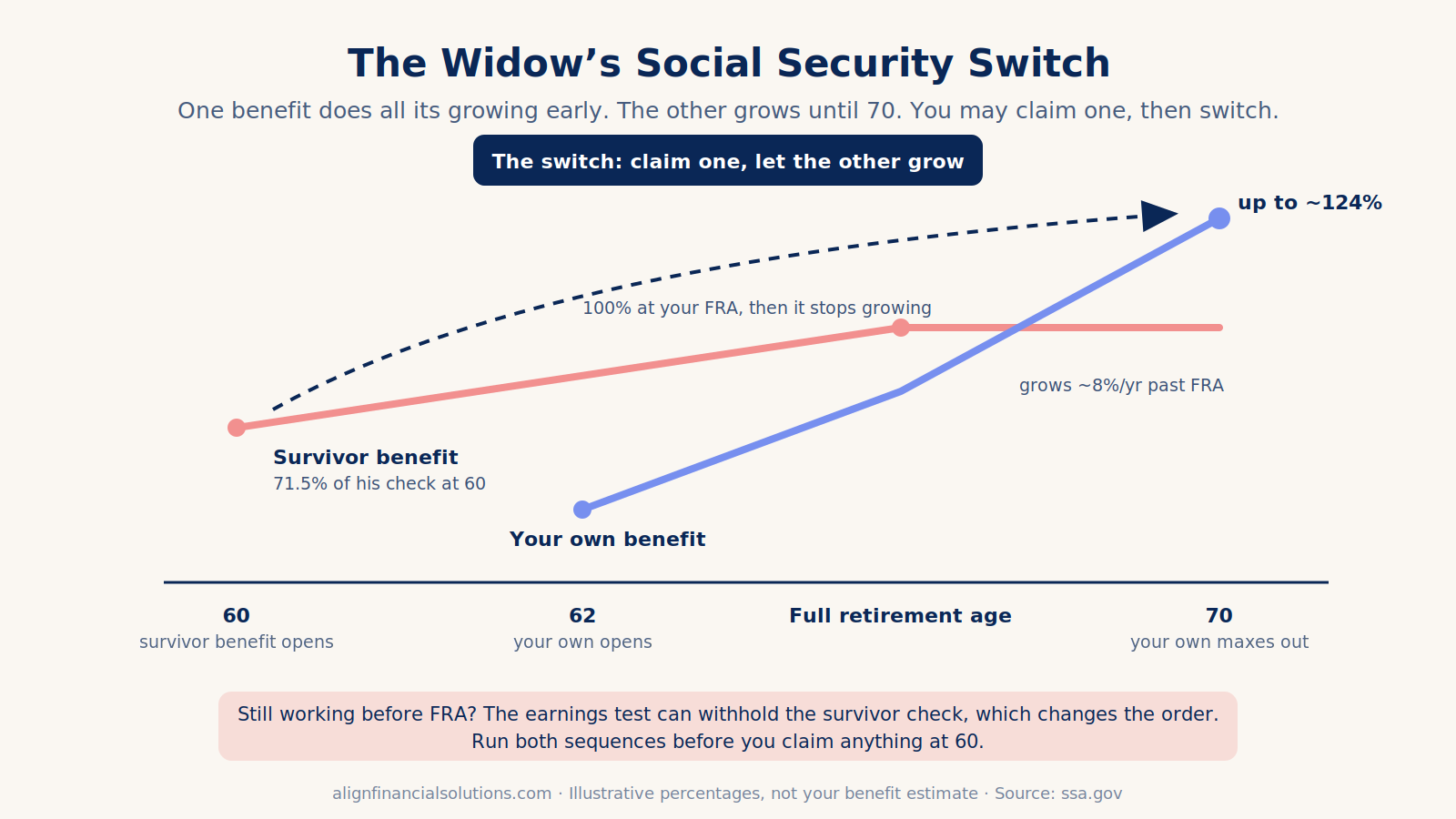
Here is the first number that matters. Survivor benefits at 60 do not pay you your husband’s full benefit. Per the Social Security Administration, a claim at 60 starts at 71.5% of his benefit. The percentage climbs each month you wait, reaching 100% at your full retirement age for survivor benefits. That age falls between 66 and 67 depending on your birth year. For most women reading this, it is 67.
That 28.5% haircut is not a temporary discount. If you claim at 60 and keep receiving those checks, the reduction stays with you. It lasts as long as you stay on the survivor benefit. On a $3,200 benefit, that is a gap of roughly $912 a month, about $11,000 a year, every year.
Two eligibility notes while we’re here. You can claim as early as 50 if you are disabled. And remarriage after age 60 does not affect your survivor benefit; only remarrying before 60 disqualifies you. So if a new relationship is somewhere in your future, the benefit on your late husband’s record survives it. Any wedding just has to wait until after your 60th birthday.
So the reduction alone argues for patience. But if you are still working, the case against claiming at 60 gets much stronger than a haircut. It becomes a zero.
The Earnings Test: Why Claiming Survivor Benefits While Working Pays You Nothing
Before your full retirement age, Social Security applies an annual earnings test to any benefit you receive, survivor benefits included. For 2026, the exempt amount is $24,480, and SSA withholds $1 of benefits for every $2 you earn above it. In the calendar year you reach full retirement age, the limit rises to $65,160 with gentler $1-for-$3 withholding. Once you reach full retirement age, the test disappears entirely, no matter how much you earn.
Now run that at an executive salary. At $250,000, you are $225,520 over the limit. Half of that, $112,760, is the amount SSA would withhold, which is several times the entire annual survivor benefit. Every check gets withheld. You would file the claim, trigger the 71.5% reduction, and receive nothing.
There is one piece of fairness built in. SSA recalculates your benefit at full retirement age to credit back the months that were fully withheld. So a wiped-out claim is not a catastrophe, it is just pointless paperwork. The real damage comes from the middle path. Say you claim at 60, then drop to part-time or retire at 63 and start cashing those reduced checks. The early-claiming reduction attaches to every month you were paid. That is how a working widow turns an intended head start into a permanent pay cut.
The practical rule: while you are earning well above $24,480, do not file. A survivor claim before full retirement age gets you nothing but downside risk. If you are under 60, the rules are different again: before 60 the benefits on his record belong to the children, and your own is withheld while you work. I covered that in widowed before 60.
Widow Benefits vs Your Own Retirement Benefit: Two Separate Claims
Here is the part the big sites bury, and the reason this decision deserves an hour of real math. You now have two benefits available to you. The survivor benefit on his record, and the retirement benefit on your own. They are separate claims. SSA lets you take one first and switch to the other later, and each one follows different growth rules.
Your own retirement benefit keeps growing if you wait. Every year you delay past your full retirement age, up to age 70, adds about 8% in delayed retirement credits. Those credits are guaranteed and inflation-adjusted.
The survivor benefit does not. It maxes out at 100% of his benefit at your survivor full retirement age. Delayed credits do not apply to it. Waiting past your FRA to claim a survivor benefit buys you nothing. That dictates the whole strategy. There is never a reason to delay the survivor claim beyond your full retirement age.
Put those two rules together and the sequencing writes itself. If your own age-70 benefit will be larger, take the survivor benefit at your FRA at its full 100%. Let your own record compound at 8% a year in the background. Then switch to your own at 70. If his record is clearly the bigger one, run it in reverse. Take a reduced benefit on your own record earlier, once you have stopped working. Then switch to the untouched survivor benefit at your FRA. Either way, one benefit pays the bills while the other one finishes growing.
The Social Security Survivor Benefits Switch Strategy, With Real Numbers
Meet Diane, a hypothetical composite. She is 60, a marketing VP earning $250,000. She holds $1.9 million across her 401(k), IRAs, and a brokerage account. Her husband died this year; his benefit was $3,200 a month. Her own projected benefit is $2,900 at her FRA of 67. It grows to roughly $3,600 at 70 with three years of delayed credits.
What claiming at 60 gets her: nothing. The survivor benefit at 60 would be 71.5% of $3,200, about $2,288 a month. Her salary puts her $225,520 over the earnings limit. The potential withholding of $112,760 swallows the entire $27,456 annual benefit. Zero dollars arrive.
The switch strategy. Diane does nothing at 60. At 67, her survivor FRA, she claims the survivor benefit at the full $3,200 a month. No reduction, and no earnings test even if she is still consulting. Meanwhile her own record keeps earning delayed credits. From 67 to 70 she collects about $115,000 in survivor checks. At 70, she switches to her own benefit at roughly $3,600 a month. That is an upgrade of about $400 a month, inflation-adjusted, for life.
Compare the alternatives. If she claimed her own benefit at 67 instead, she would lock in $2,900. She would forfeit both the larger survivor check and the delayed credits. Suppose she claimed the survivor benefit at 67 and simply never switched. She would leave roughly $4,800 a year on the table from 70 onward. That is close to $100,000 by age 90. Long lifespans are exactly when this compounding matters, and women own the long lifespans.
The reverse order. Flip the records: suppose his benefit was $4,000 and her own would only reach $3,100 even at 70. Then the survivor benefit is her forever check. The goal is to take it untouched at 100% at her FRA. Once she stops working, she can claim a reduced benefit on her own record as early as 62. That creates income during the bridge years. Then she switches to the full $4,000 survivor benefit at 67. Her own record becomes the placeholder; his becomes the destination.
The pattern in both directions is the same. Claim the smaller benefit early only when the earnings test can no longer touch it. Save the larger benefit for its maximum value.
The Widow’s Penalty Makes This a Tax Decision Too
There is a second clock running underneath the claiming decision. Starting the year after your husband’s death, you generally file as a single taxpayer. Single brackets reach each higher rate at roughly half the income of a married couple. I call this the widow’s penalty, and it is the subject of the episode linked above. Same portfolio, same spending, noticeably higher tax bill.
Social Security timing interacts with that penalty directly. Up to 85% of your benefits can be taxable once your other income is meaningful. I break down that mechanic in Do You Pay Taxes on Social Security. And every year between your retirement date and your first Social Security check is a low-income year. That is precisely the window for Roth conversions at compressed single-filer rates, before required distributions arrive. The bracket-by-bracket mechanics are in my retirement tax playbook if you want the full framework. Delaying the survivor claim to 67 and your own benefit to 70 does not just buy bigger checks. It holds those conversion-window years open.
Funding the bridge from 62 or 65 to your claiming ages is its own design question. The order you tap accounts matters as much as the amounts. I cover that sequencing in which accounts to draw from first. Maybe the loss is recent and Social Security is only one item on a frightening list. Then start with my first-year financial checklist for widows. It sorts what must happen now from what can wait. The same goes for his 401(k). The spousal inheritance options there are also easier to get wrong by rushing than by waiting. This claiming decision sits firmly in the second category. It belongs inside a full retirement plan for women over 50, not on its own.
What to Do This Week
- Get both numbers. Pull your own benefit estimates at ssa.gov, then contact SSA for a survivor benefit estimate on your husband’s record. You cannot compare claims you have not priced.
- Check your salary against $24,480. If your 2026 earnings clear the limit by any real margin, a survivor claim before FRA pays you nothing. Take filing at 60 off the table. Put the decision on your FRA calendar instead.
- Run the two sequences on paper. Survivor at FRA then your own at 70, versus your own early then survivor at FRA. The larger age-70 number tells you which record is the destination.
- Map your conversion window before you claim anything. List projected taxable income for each year between retirement and your first benefit check. Those single-filer bracket years are when Roth conversions do the most work, and claiming early shrinks them.
Are you on track?
If you want to see where you actually stand, I built a free 3-minute Retirement Readiness Assessment that gives you a personalized score and a specific dollar gap estimate based on your numbers. Take the assessment here.
Hazel Secco, CFP®, CDFA®, is the founder of Align Financial Solutions, a fee-only fiduciary firm in Hoboken, New Jersey, that helps high-net-worth women bring retirement, equity compensation, tax, and estate planning into one plan. Learn how Align approaches retirement planning for women. Align is a fee-only financial advisor for women in Hoboken, New Jersey, and its financial planning for women treats retirement timing, taxes, equity compensation, and estate decisions as one plan.
Already past the research phase? Book a free 15-minute Align Call: https://alignfinancialsolutions.com/book-a-call/
🌐 https://alignfinancialsolutions.com
📺 https://www.youtube.com/@AlignYourRetirement
💼 https://linkedin.com/in/hazel-secco
Listen to This Episode
🎧 Apple Podcasts
🎧 Spotify
📺 YouTube
Disclaimer: Advisory services are offered through Align Financial Solutions LLC (“AFS”), an Investment Advisor in the State of New Jersey. This article is for educational purposes only and does not constitute personalized tax, legal, investment, or financial planning advice. Rules and figures are current for 2026 and subject to change. All client scenarios are hypothetical composites for illustration and do not represent any specific client outcome. Consult a qualified professional about your specific situation.
Each decision in this article touches the others, which is why we manage investments, taxes, and retirement income as one coordinated plan through Align360™ Wealth Management. And if your assets have crossed the seven-figure mark, here is how we work with high-net-worth women.
Frequently Asked Questions
Can I collect widow benefits at 60 and still work full time?
You can file, but at a full-time professional salary you will not be paid. In 2026, SSA withholds $1 of benefits for every $2 you earn above $24,480 before full retirement age. So a $250,000 salary wipes the entire benefit to zero. The earnings test ends at your full retirement age, which is why working widows usually wait until then.
Can I switch from survivor benefits to my own Social Security later?
Yes. Survivor benefits and your own retirement benefit are separate claims. SSA allows you to start with one and switch to the other later. The common sequence: take the survivor benefit at full retirement age. Let your own benefit grow 8% a year to age 70, then switch if it is larger.
Does remarrying after 60 affect my survivor benefits?
No. Remarriage at or after age 60 does not affect your eligibility for survivor benefits on your late husband’s record. The age is 50 if you are disabled. Only remarriage before age 60 disqualifies you.
Do survivor benefits increase if I wait past my full retirement age?
No. A survivor benefit reaches its maximum, 100% of your husband’s benefit, at your survivor full retirement age. It never grows beyond that. Delayed retirement credits apply only to your own retirement record. So there is no reason to postpone a survivor claim past your FRA.
Sources
- Social Security Administration, What You Could Get From Survivor Benefits: https://www.ssa.gov/survivor/amount
- Social Security Administration, Survivor Benefits Eligibility: https://www.ssa.gov/survivor/eligibility
- Social Security Administration, Receiving Benefits While Working (2026 earnings limits): https://www.ssa.gov/benefits/retirement/planner/whileworking.html
- Social Security Administration, Delayed Retirement Credits: https://www.ssa.gov/benefits/retirement/planner/delayret.html