

Author: Hazel Secco, CFP®, CDFA®
Estimated reading time: 12 minutes
Table of contents
- Weeks One to Six: The Part of the Widow Financial Checklist That Cannot Wait
- Months Two to Six: Claims, Retitling, and the Deadlines in His Name
- Widow Financial Planning Deadlines Hiding in Years One and Two
- The First Year After Your Husband Dies: What Deliberately Waits
- What to Do This Week
- When you are ready for help
- Frequently Asked Questions
- Sources
Everyone tells you to take time to grieve, and in the same week someone hands you a 40-item to-do list where every item feels urgent. What nobody gives you is the order: what to do financially when your husband dies, which deadlines are real, and which ones can wait. This is the checklist for when a spouse dies, written for a household with real assets, not the generic 40 items.
Roughly 2,800 women in the U.S. become widows every day, according to U.S. Census Bureau data compiled by Modern Widows Club, and the average age of widowhood is 59, not 75. The woman doing this paperwork often still has a mortgage, a career, and children in college. Many also have a seven-figure balance sheet that includes his 401(k), his deferred compensation, and his equity awards. The generic checklists were written for a much simpler estate.
The version I use with clients runs on three clocks: what must happen in the first weeks, what happens in months two through six, where the real deadlines live, and what deliberately waits until later in the year. The goal for this first year is to miss nothing that expires and to touch nothing that cannot be undone.
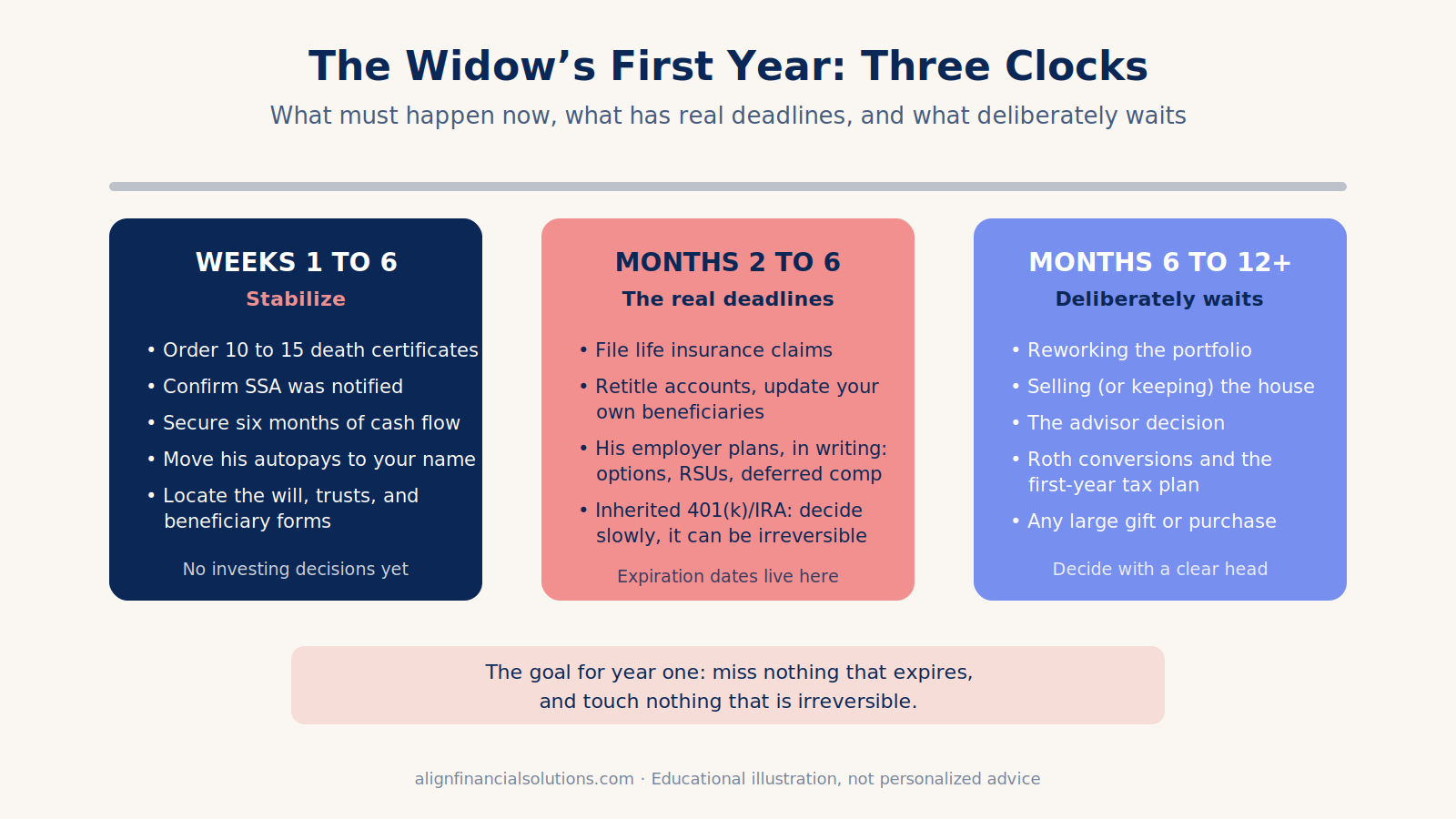
Weeks One to Six: The Part of the Widow Financial Checklist That Cannot Wait
Order death certificates first, and order more than you think you need: 10 to 15 certified copies. Every insurer, custodian, bank, and title company will want its own, and re-ordering later stalls everything downstream.
Notify Social Security. The funeral home usually reports the death, but confirm that it did. Because Social Security pays a month behind, a benefit received for the month of death generally has to be returned. An eligible surviving spouse also receives a one-time lump-sum death payment of $255. It is small, but it is yours.
Next, secure your cash flow. Joint accounts stay open and available to you, while accounts in his name alone freeze until the estate process catches up, so confirm you can cover roughly six months of spending from accounts you control. Credit cards in his name alone will be closed, which means every autopay running through them, from insurance premiums to utilities and subscriptions, will start failing. Pull his statements, list the autopays, and move each one to your name.
Finally, locate the estate documents: the will, any trusts, and the beneficiary designations on every retirement account and insurance policy. In an affluent estate, beneficiary designations, not the will, control where most of the money goes. Call the estate attorney who drafted the documents. You will notice what is missing from this list: no investment decisions, no real estate decisions, and no benefit elections. The goal in these weeks is to stabilize, not to optimize.
Months Two to Six: Claims, Retitling, and the Deadlines in His Name
Months two through six are the working phase of surviving spouse finances, and this is where the real expiration dates sit.
Claims, Retitling, and Your Own Beneficiaries
File the life insurance claims with certified death certificates. The death benefit itself is generally not taxable income, but interest and estate tax can be. Retitle the house, vehicles, and joint investment accounts. Update your own beneficiary designations as well, since many of them probably still name him. None of this is hard, but all of it takes time.
His Employer Benefits Have Clocks
Get his employer’s benefits summary in writing, because this is where affluent estates lose real money. Unpaid salary and bonus, group life insurance, and his 401(k) are the obvious items. The less obvious ones have clocks. Vested stock options typically carry a post-death exercise window in the plan document, often 90 days to a year, and options that miss it expire worthless. Some RSU plans accelerate vesting at death and some do not. Deferred compensation pays out on the schedule the plan dictates, which sometimes means a lump sum that stacks income into a single tax year. You need the plan documents, not a phone summary from HR.
The Inherited 401(k) Decision: Slow Down
His 401(k) and IRAs deserve their own slow decision. As his spouse, you can roll them into your own IRA or keep them as an inherited account, and the right answer depends heavily on your age. If you are under 59½, money kept in an inherited account comes out without the 10 percent early-withdrawal penalty, while money rolled into your own IRA is generally locked until 59½. You can move an inherited account into your own name later, but you cannot undo a rollover. I walk through the full decision in what a surviving spouse can do with an inherited 401(k).
Survivor Benefits and the Portability Election
Two more items belong in this window. Social Security survivor benefits can be claimed as early as 60, at 71.5 percent of his benefit, scaling up to 100 percent at your full retirement age. You can take one benefit first and switch to the other later. If you are still working, the earnings test applies in the years before the year you reach full retirement age. It withholds $1 for every $2 you earn above $24,480 in 2026, with a higher limit and a gentler formula in the year you reach it. Over a lifetime, the claiming order can be worth six figures. I cover it in detail in survivor benefits at 60.
The second item is portability, which is a question for the estate attorney. Filing an estate tax return lets you carry his unused estate tax exemption forward. Form 706 is due nine months after death, and extensions are available. Because the 2026 exemption is $15 million per person, most estates owe no tax, but the election can preserve his unused $15 million for your estate if the law changes later. A simplified late election exists for up to five years when the estate was not otherwise required to file. Filing on time is still the safer path.
What This Looks Like in Practice
Consider a hypothetical composite. Ellen, 58, lost her husband at 61. He was a pharma executive with a $2.1 million 401(k) and $380,000 in deferred compensation, and his vested options had a 12-month post-death exercise window. Three decisions mattered most in her first year: keeping part of the 401(k) as an inherited account for penalty-free access at 58, spreading the option exercises across two tax years, and filing Form 706 for portability. All three came from reading the plan and estate documents, and no generic checklist mentions any of them.
Widow Financial Planning Deadlines Hiding in Years One and Two
The tax rules have their own calendar for widows.
For the year he died, you file one final joint return. From the following year, you file as single, unless a dependent child at home gives you two years of qualifying surviving spouse status at joint rates. With the same house and similar income, your standard deduction is suddenly half and your bracket thresholds are roughly half. Medicare’s IRMAA surcharges also start at $109,000 of income for a single filer in 2026, compared with $218,000 for a couple. I call this the widow’s penalty.
I break down the full math in why taxes rise after losing a spouse. The planning point most people miss is that the final joint return is your last year at married brackets. Painful as it sounds, that can make the year of death the best year for a Roth conversion, which is exactly the kind of move I map out in my retirement tax playbook. That window closes on December 31 and does not reopen.
The Two-Year Home Sale Window
The primary home has a two-year clock too. A widow who sells within two years of her husband’s death can generally exclude up to $500,000 of gain can generally exclude up to $500,000 of gain on the home, the full married amount, as long as she has not remarried and meets the ownership and residence tests. After two years, the exclusion drops to $250,000. The step-up in basis adds to this: at least half the home’s basis resets at his death, and the full basis resets in community property states. As a result, many widows can sell entirely tax-free inside the window and face a real tax bill outside it. I will also tell you below not to rush a home sale. The way to hold both is to avoid deciding in month three while putting the two-year date on your calendar now.
Widow financial deadlines at a glance
| Deadline | When | What happens if you miss it |
|---|---|---|
| Stock option exercise window | Set by his plan, often 90 days to 1 year after death | Vested options expire worthless |
| Final joint tax return | Covers the year of death (December 31) | Your last year at married brackets, and often the best Roth conversion year |
| Form 706 portability election | 9 months after death, extensions available | His unused estate tax exemption may not carry over to you |
| Qualifying surviving spouse status | The 2 tax years after the year of death, only with a dependent child | Single filing rates apply |
| Home sale exclusion | 2 years from the date of death | The exclusion drops from $500,000 to $250,000 |
The First Year After Your Husband Dies: What Deliberately Waits
Here is the list almost nobody gives you: what not to do yet.
Do not sell the house or move in the first six to twelve months, and do not make large gifts to your children. The life insurance money can make you feel, briefly, more liquid than you have ever been. Avoid paying off the mortgage with retirement-account money, because that converts a cheap debt into a large tax bill. Leave the portfolio overhaul for later as well. There will be time to reposition everything, and nothing on this list gets better by deciding it early.
The Advisor Question Can Wait Too
The advisor question deserves the same patience. Widowed women change financial advisors at roughly three times the rate of other investing households, according to a 2026 analysis of RFI Global’s MacroMonitor survey data, and the usual reason is that the advisor only ever talked to him. That instinct may be sound, but the timing matters. Interview replacements in month eight with a clear head, not in month two, when anyone confident sounds trustworthy. Hold them to the standard I would hold myself to: a CFP® and fee-only fiduciary who works for you and is paid only by you. Once you are ready to think past this year, my guide to retirement planning for women over 50 covers the bigger picture.
One test covers every decision this year: is it reversible, and does it have a real deadline? If it has a real deadline, act on schedule. If it does not, it waits. That single filter replaces most of the 40-item list. If you were widowed before 60, there is a second list, with Social Security for the children, COBRA, and your own estate plan, in widowed before 60.
Prefer a printable version? Get the one-page Widow’s First-Year Financial Checklist by email. Print it and check things off as you go, so you do not have to hold it all in your head.
What to Do This Week
- Order 10 to 15 certified death certificates. Every claim, retitling, and account change requires one. Re-ordering mid-process stalls everything.
- List every autopay in his name and move each to yours. Cards in his name alone will be closed. Failed autopays on insurance premiums are the expensive surprise.
- Confirm six months of spending is reachable in accounts you control. Joint accounts stay open. Solely-titled accounts freeze until the estate process finishes.
- Request his employer’s benefits package and equity plan documents in writing. Option exercise windows, RSU treatment at death, and deferred compensation payout schedules all have dates.
- Calendar three dates. December 31 of this year is the final joint return. Nine months from his death is the Form 706 portability deadline. Two years from his death closes the $500,000 home-sale window. Those are the deadlines hiding in years one and two.
When you are ready for help
If you are in your first year and want someone to sort the urgent from the permanent with you, our page on financial planning for widows explains how we work with widows and what the plan includes.
Related reading: 7 Financial Mistakes Widows Make in the First Two Years.
Hazel Secco, CFP®, CDFA®, is the founder of Align Financial Solutions, a fee-only fiduciary firm in Hoboken, New Jersey, that helps high-net-worth women bring retirement, equity compensation, tax, and estate planning into one plan. About a quarter of her clients came to her after the loss of a spouse, and Align’s financial planning for widows treats the first-year decisions, the taxes, and the long-term plan as one coordinated plan. Align works with clients across the country virtually.
Already past the research phase? Book a free 15-minute Align Call: https://alignfinancialsolutions.com/book-a-call/
Each decision in this article touches the others, which is why we manage investments, taxes, and retirement income as one coordinated plan through Align360™ Wealth Management. And if your assets have crossed the seven-figure mark, here is how we work with high-net-worth women. If you are local to us, our team meets with widows in person as a fee-only financial advisor in Hoboken, NJ.
Frequently Asked Questions
What should a widow do first financially?
First, order 10 to 15 certified death certificates and confirm Social Security has been notified. Then make sure you can cover about six months of spending from accounts in your name or held jointly. Then redirect autopays running through cards in his name and locate the will, trusts, and beneficiary designations. Investment and real estate decisions come months later.
Do taxes go up after your husband dies?
Usually, yes. You file one final joint return for the year of death, then move to single filing rates. The standard deduction is half and bracket thresholds are roughly half. The exception is a dependent child, which qualifies you for two years of surviving spouse status at joint rates. Planners call this the widow’s penalty. So the final joint year is often the best remaining window for moves like Roth conversions.
How long does a widow have to sell her house and keep the $500,000 exclusion?
Two years from her spouse’s date of death. Sell the primary home within that window and up to $500,000 of gain is generally excluded. That assumes you have not remarried and meet the ownership and residence tests. After two years the limit drops to $250,000. Also, the step-up in basis at death often shrinks the taxable gain further.
Can I collect my husband’s Social Security at 60?
Yes. Survivor benefits are claimable as early as age 60. They start at 71.5 percent of his benefit and reach 100 percent at your full retirement age. You can also claim the survivor benefit first and switch to your own larger benefit as late as 70. Or the reverse. Remarrying after 60 does not affect your survivor benefit.
Sources
- Survivor Benefits: How Much You Could Get, Social Security Administration. https://www.ssa.gov/survivor/amount
- How Work Affects Your Benefits (2026), Social Security Administration. https://www.ssa.gov/pubs/EN-05-10069.pdf
- Publication 523, Selling Your Home, Internal Revenue Service. https://www.irs.gov/publications/p523
- What’s New: Estate and Gift Tax, Internal Revenue Service. https://www.irs.gov/businesses/small-businesses-self-employed/whats-new-estate-and-gift-tax
- Widowhood demographics (approximately 2,800 new widows daily; average age 59), U.S. Census Bureau data compiled by Modern Widows Club.
- Kehrer Group analysis of RFI Global MacroMonitor data on widowed women and advisor relationships, 2026 (cited by attribution).
Disclaimer: Advisory services are offered through Align Financial Solutions LLC (“AFS”), an Investment Advisor in the State of New Jersey. This article is for educational purposes only and does not constitute personalized tax, legal, investment, or financial planning advice. Rules and figures are current for 2026 and subject to change. All client scenarios are hypothetical composites for illustration and do not represent any specific client outcome. Consult a qualified professional about your specific situation.