

Author: Hazel Secco, CFP®, CDFA®
Estimated reading time: 10 minutes
Here is what a well-sequenced withdrawal plan can look like in practice: $200,000 of retirement income and almost no federal tax:
Table of contents
- Why the Order You Tap Accounts Changes Your Lifetime Tax Bill
- The Three Tax Buckets, and What Each Costs to Touch
- Which Retirement Accounts to Withdraw From First: The Conventional Order, and When It’s Wrong
- The Coordination Traps: IRMAA, NIIT, and the ACA Cliff
- Why the Widow’s Penalty Makes Sequencing Urgent for Married Women
- Your Withdrawal Rate Is Not Your Withdrawal Strategy
- What to Do This Week
- Are you on track?
- Frequently Asked Questions
- Sources
You spent thirty years deciding how much to save. In retirement, the harder question is which account to spend from, and in what order. Your retirement withdrawal strategy determines how much of your portfolio you actually keep after taxes, and most people get exactly zero guidance on it. Your 401(k) provider will happily send you a check. Nobody asks what that check does to your Medicare premiums, your capital gains rate, or your surviving spouse’s tax bracket.
Here’s the part that surprises people: two retirees with identical portfolios and identical spending can end up with meaningfully different lifetime tax bills. Same money, same lifestyle, different sequence of withdrawals. The difference isn’t investment skill. It’s coordination.
In this post I’ll walk through the three tax buckets, the conventional withdrawal order and where it breaks down, the coordination traps that quietly raise your costs, and why this matters more (not less) if you’re a married woman. I’m a CFP® and fee-only fiduciary, and this is the work I do with clients every fall before year-end.
Why the Order You Tap Accounts Changes Your Lifetime Tax Bill
Every dollar you spend in retirement comes out of an account with its own tax treatment. Pull from a traditional IRA and the whole withdrawal is ordinary income. Sell in a brokerage account and only the gain is taxed, often at capital gains rates. Pull from a Roth and the IRS isn’t involved at all.
That means your taxable income in any given year is largely a choice. You decide it when you decide where the money comes from. String thirty years of those choices together and you’ve either kept your income smooth and your brackets low, or you’ve created a spike pattern: low-tax years early, then large forced distributions later that land in the 24% or 32% bracket and drag Medicare surcharges along with them.
The IRS forces the issue eventually. Required minimum distributions from tax-deferred accounts begin at age 73 if you were born between 1951 and 1959, and at 75 if you were born in 1960 or later. A $2 million IRA at 75 doesn’t ask whether you need the money. It distributes on schedule, at ordinary income rates, on top of Social Security and everything else. The goal of a withdrawal sequence is to shrink that future forced income while the shrinking is cheap.
The Three Tax Buckets, and What Each Costs to Touch
Tax-efficient withdrawals start with knowing the price tag on each bucket.
Taxable (brokerage accounts). You already paid income tax on these dollars. When you sell, you owe tax only on the gain, and long-term gains get preferential rates, with a 0% bracket at lower incomes. Cost basis matters enormously here; a position you bought decades ago behaves very differently from cash you added last year. I break down the mechanics in how taxes work in a brokerage account.
Tax-deferred (traditional 401(k), traditional IRA). Every dollar out is ordinary income, taxed at your highest rate. This bucket also carries the RMD mandate, which means it’s the only bucket that eventually forces income on you whether you want it or not.
Tax-free (Roth IRA, Roth 401(k), HSA for medical costs). Qualified Roth withdrawals cost nothing, and Roth IRAs have no RMDs during your lifetime. That makes Roth dollars the most valuable dollars you own, and the ones to spend last, or strategically, not first. An HSA works similarly for qualified medical expenses, which is why I call it the most tax-favored account in the code: the power of an HSA for retirement.
Same $10,000 of spending. Depending on the bucket, the pre-tax cost might be $10,000, $11,500, or $14,000. That spread, repeated every year for three decades, is the whole game.
| Taxable (brokerage) | Tax-deferred (401k, traditional IRA) | Tax-free (Roth, HSA) | |
|---|---|---|---|
| What a withdrawal costs | Capital gains rates on the gain only (0%, 15%, or 20%) | Ordinary income rates on every dollar | Nothing, when qualified |
| Forced withdrawals? | No | Yes. RMDs begin at 73 or 75, based on birth year | No RMDs for the original owner |
| Best years to touch it | Early retirement, while managing realized gains | Low-bracket years, on purpose, before RMDs | Late retirement, big one-off expenses, or leave for heirs |
| Watch out for | NIIT above $200K single / $250K joint MAGI | Withdrawals raise MAGI: IRMAA and ACA subsidy tripwires | Five-year rules on conversions |
Which Retirement Accounts to Withdraw From First: The Conventional Order, and When It’s Wrong
The default advice on which retirement accounts to withdraw from first goes: taxable first, tax-deferred second, Roth last. Let capital gains rates carry the early years, defer ordinary income as long as possible, let the Roth compound untouched.
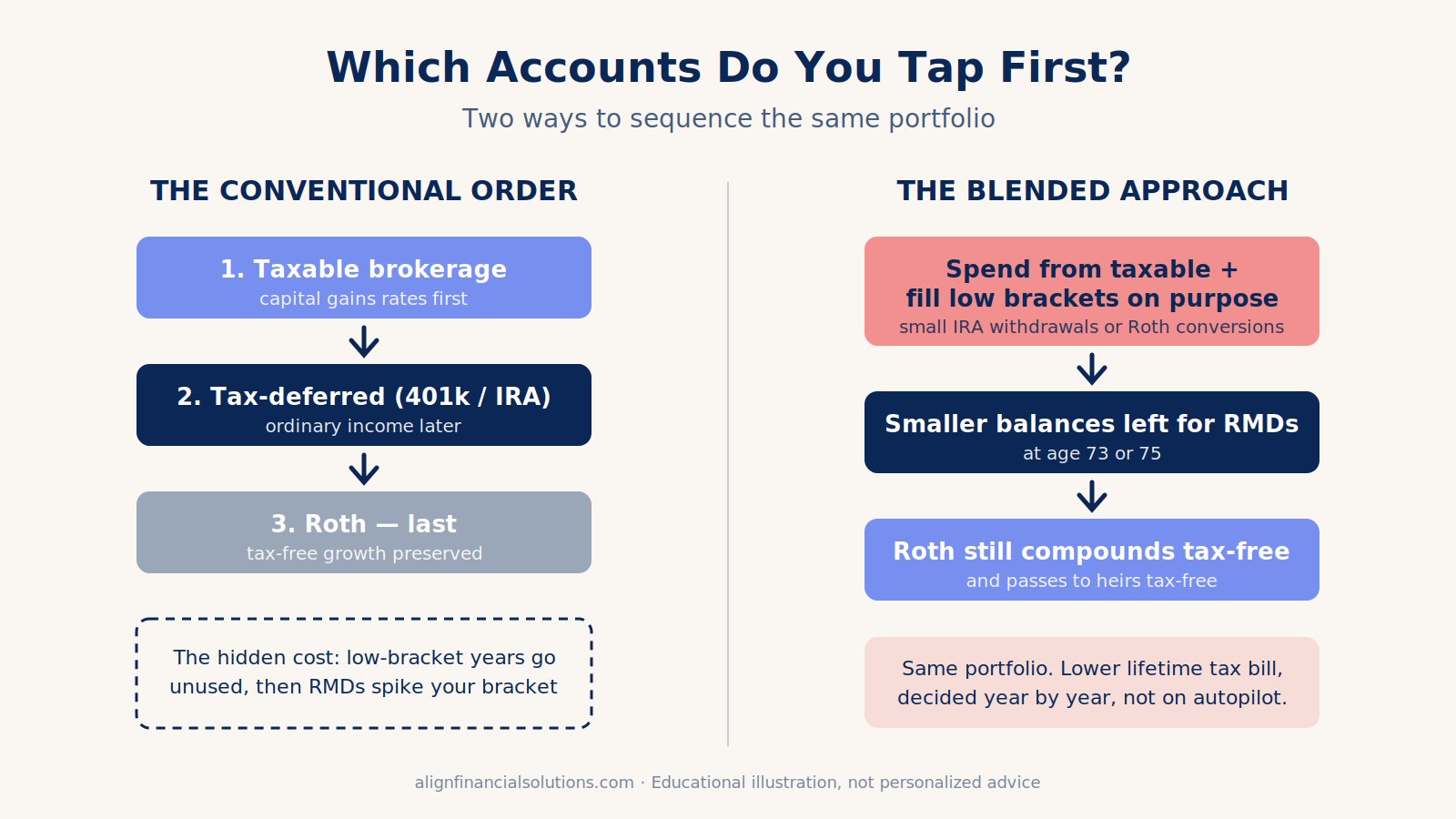
It’s not crazy. It’s just incomplete, and for retirees with large tax-deferred balances, it can be expensive. Here’s the failure mode. You retire at 62 with, say, $1.8 million in a traditional 401(k) and IRA. You dutifully live on your brokerage account for a decade. Your taxable income is minimal; you’re in the 10% or 12% bracket, maybe paying 0% on your capital gains. Feels great. Meanwhile the IRA keeps growing, untouched. Then RMDs arrive at 73 or 75 and the deferred bucket detonates: large mandatory distributions, stacked on Social Security, pushing you into brackets you never occupied while working part of the year.
You spent your lowest-tax-rate years withdrawing from the bucket that was nearly free anyway, and saved the most expensive bucket for the years when it would be taxed hardest.
The better answer for many retirees is a blended withdrawal: draw something from taxable for cash flow, and at the same time pull or convert from the tax-deferred bucket up to the top of a deliberately chosen bracket. The gap between retirement and RMD age, what I call the conversion window, is often the cheapest tax decade of your life. Filling the 12% or 22% bracket with Roth conversions during those years moves money from your worst bucket to your best bucket at a discount, and every dollar converted is a dollar that never becomes a future RMD. Whether conversions make sense for you depends on your bracket now versus later; I walk through the decision in is a Roth IRA conversion right for you.
One more sequencing note: delaying Social Security to let conversions run in a lower-income window often pairs well with this strategy, especially since up to 85% of your benefit can itself be taxable once other income rises.
The Coordination Traps: IRMAA, NIIT, and the ACA Cliff
Sequencing isn’t only about brackets. Several other systems key off your income, and they don’t coordinate with each other. You have to.
IRMAA and the two-year lookback. Medicare premiums rise with income. In 2026, the standard Part B premium is $202.90 a month, but a single filer with 2024 modified adjusted gross income above $109,000 pays $284.10, and the tiers climb from there ($405.80, $527.50, $649.20, up to $689.90 at the top). Married filing jointly, surcharges start above $218,000. The trap is the lookback: your 2026 premium is set by your 2024 income. A large withdrawal or Roth conversion at 63 shows up as a Medicare surcharge at 65. If you’re within two years of Medicare, every income decision is also a premium decision.
NIIT. The net investment income tax adds 3.8% on investment income above $200,000 of MAGI for single filers and $250,000 married filing jointly. Those thresholds are not indexed for inflation, so more retirees drift into them every year. IRA withdrawals aren’t themselves subject to NIIT, but they raise your MAGI, which can push your dividends and capital gains over the line.
The ACA cliff, if you retire before 65. Enhanced marketplace subsidies expired at the end of 2025, and for 2026 the subsidy cliff at roughly 400% of the federal poverty level is back. Marketplace subsidies key off household MAGI, not assets. One dollar of extra income over the cliff can cost thousands in lost premium credits. For pre-65 retirees, this can temporarily flip the whole strategy: keep MAGI low, live on basis and Roth dollars, and hold the big conversions until Medicare starts.
Capital gains bracket management. Ordinary income stacks under capital gains. Every dollar you withdraw from an IRA can push long-term gains from the 0% rate into 15%, or from 15% toward 20% plus NIIT. This is why the buckets have to be planned together; a conversion that looks fine in isolation can quietly re-price every share you sell that year. This is the difference between tax filing and actual tax planning for retirement.
And once you reach 70½, if you give to charity, qualified charitable distributions let you send IRA dollars directly to charity, satisfying RMDs later without the income ever touching your return. Details here: what is a QCD.
Why the Widow’s Penalty Makes Sequencing Urgent for Married Women
Here’s the piece I insist my married clients look at, because women statistically outlive their husbands. When one spouse dies, the survivor typically keeps most of the household income (both the assets and often the larger Social Security benefit) but files as a single taxpayer starting the following year. Same money, half the bracket widths, and IRMAA thresholds that start at $109,000 instead of $218,000. The survivor inherits the IRA and its RMDs too.
That’s the widow’s penalty: higher tax rates on roughly the same income, at the worst possible time. It changes the withdrawal math while both spouses are alive. Every year you file jointly is a year you can convert tax-deferred dollars at married-filing-jointly rates that the surviving spouse will never see again. A couple that defers everything until RMDs isn’t just postponing taxes. They may be shifting the bill onto whichever spouse lives longer, at single-filer rates. For most couples I work with, that’s her.
Your Withdrawal Rate Is Not Your Withdrawal Strategy
One distinction to keep clean in your retirement income strategy: the rate answers how much you can spend; the source answers where it comes from. Morningstar’s 2026 research puts the safe starting withdrawal rate around 3.9% for a roughly 30-year retirement, a useful guardrail on the amount and a notch below the old 4% rule (I’ve written separately about whether the 4% rule works for women at all). But 3.9% of a $2 million portfolio is $78,000, and nothing in that number tells you whether the $78,000 should come from your brokerage account, your IRA, a Roth conversion layered on top, or some blend of all three.
Get the rate wrong and you risk running out of money. Get the sequence wrong and you’ll likely still be fine; you’ll just hand the IRS and Medicare a larger cut of the same portfolio than you had to. The rate protects your portfolio. The sequence protects your share of it.
Withdrawal order is a multi-year decision, and it changes as tax law, your accounts, and your spending do. We coordinate all of it inside Align360™ Wealth Management, and you can read more about how we work with high-net-worth women.
What to Do This Week
- Total your three buckets. Add up taxable, tax-deferred, and tax-free balances separately. If tax-deferred is more than about two-thirds of the total, you’re a candidate for conversions before RMDs. The imbalance is the warning light.
- Find your RMD age and run a rough projection. Age 73 if you were born 1951 to 1959, 75 if 1960 or later. Estimate what your first RMD would be if the account keeps growing untouched, and see what bracket it lands in on top of Social Security.
- Check this year’s bracket headroom. Pull your projected 2026 taxable income and measure the gap to the top of your current bracket. That gap is space for a Roth conversion or a low-cost IRA withdrawal, and it expires December 31.
- Map the IRMAA cliffs before any big move. If you’re 63 or older, compare your projected MAGI to the surcharge thresholds ($109,000 single / $218,000 joint for 2026 premiums, based on income from two years prior). Landing $1 over a tier costs the same as landing at the top of it, so plan to a tier, not near one.
- If you’re married, run the survivor scenario. Recalculate your projected taxes and Medicare premiums as a single filer with the same income. That number is the case for converting more, sooner, while joint brackets last.
Are you on track?
If you want to see where you actually stand, I built a free 3-minute Retirement Readiness Assessment that gives you a personalized score and a specific dollar gap estimate based on your numbers. Take the assessment here.
Related reading: Asset Location Strategy: Which Investments Belong in Which Account.
Hazel Secco, CFP®, CDFA®, is the founder of Align Financial Solutions, a fee-only fiduciary firm in Hoboken, New Jersey, that helps high-net-worth women bring retirement, equity compensation, tax, and estate planning into one plan. Learn how Align approaches retirement planning for women. Align is a fee-only financial advisor for women in Hoboken, New Jersey, and its financial planning for women treats retirement timing, taxes, equity compensation, and estate decisions as one plan.
Already past the research phase? Book a free 15-minute Align Call: https://alignfinancialsolutions.com/book-a-call/
🌐 https://alignfinancialsolutions.com
📺 https://www.youtube.com/@AlignYourRetirement
💼 https://linkedin.com/in/hazel-secco
Frequently Asked Questions
What is a tax-efficient retirement withdrawal strategy?
A tax-efficient retirement withdrawal strategy coordinates your three tax buckets, taxable, tax-deferred, and tax-free, so the same spending produces a smaller lifetime tax bill. Two retirees with identical portfolios and identical spending can owe meaningfully different lifetime taxes based purely on sequence. The goal is smooth income in low brackets instead of forced spikes once RMDs begin.
Which retirement accounts should I withdraw from first?
For many retirees, a blended order beats the conventional advice of taxable first, tax-deferred second, Roth last. Draw from taxable accounts for cash flow while also pulling or converting from tax-deferred accounts up to the top of a deliberately chosen bracket, and save Roth dollars for last. Every dollar converted is a dollar that never becomes a future RMD.
Why is saving my IRA for last a mistake?
Living only on your brokerage account while a large IRA grows untouched means spending your lowest-tax years on the bucket that was nearly free anyway. When RMDs arrive at 73 or 75, large mandatory distributions stack on top of Social Security, land in brackets you never occupied, and can drag Medicare surcharges along with them.
How does the widow’s penalty change withdrawal strategy?
When one spouse dies, the survivor keeps most of the household income but files as a single taxpayer, with half the bracket widths and IRMAA thresholds starting at $109,000 instead of $218,000. Every year of joint filing is a chance to convert tax-deferred dollars at married rates the survivor will never see again, which argues for converting more, sooner.
Disclaimer: Advisory services are offered through Align Financial Solutions LLC (“AFS”), an Investment Advisor in the State of New Jersey. This article is for educational purposes only and does not constitute personalized tax, legal, investment, or financial planning advice. Rules and figures are current for 2026 and subject to change. All client scenarios are hypothetical composites for illustration and do not represent any specific client outcome. Consult a qualified professional about your specific situation.
Sources
- IRS, Retirement Topics: Required Minimum Distributions (RMDs): https://www.irs.gov/retirement-plans/plan-participant-employee/retirement-topics-required-minimum-distributions-rmds
- IRS, Topic No. 559, Net Investment Income Tax: https://www.irs.gov/taxtopics/tc559
- Medicare.gov, Costs (Part B and Part D premiums by income): https://www.medicare.gov/basics/costs/medicare-costs
- Morningstar, The State of Retirement Income for 2026: https://www.morningstar.com/business/insights/research/the-state-of-retirement-income