

Author: Hazel Secco, CFP®, CDFA®
Estimated reading time: 13 minutes
Table of contents
- Why Retirement Planning for Women Runs on Different Math
- The Retirement Runway: Where the Irreversible Decisions Cluster
- The Five Decisions That Cluster in the Runway
- How Much Do I Need to Retire? Wrong Question. Ask Where It Sits
- If You Hire Help, Hire It on These Two Tests
- What to Do This Week
- Are you on track?
- Frequently Asked Questions
- Sources
Most retirement advice was built around a model client: a man who worked forty uninterrupted years, claims Social Security with his spouse, and dies at 82. If that’s not you (and if you’re a woman over 50, it almost certainly isn’t), the standard playbook quietly works against you. Retirement planning for women isn’t a softer version of regular retirement planning, and after 50 the differences stop being theoretical. It’s a different problem: a longer life to fund, often a last-survivor tax bill to manage, and frequently fewer contribution years to fund it with.
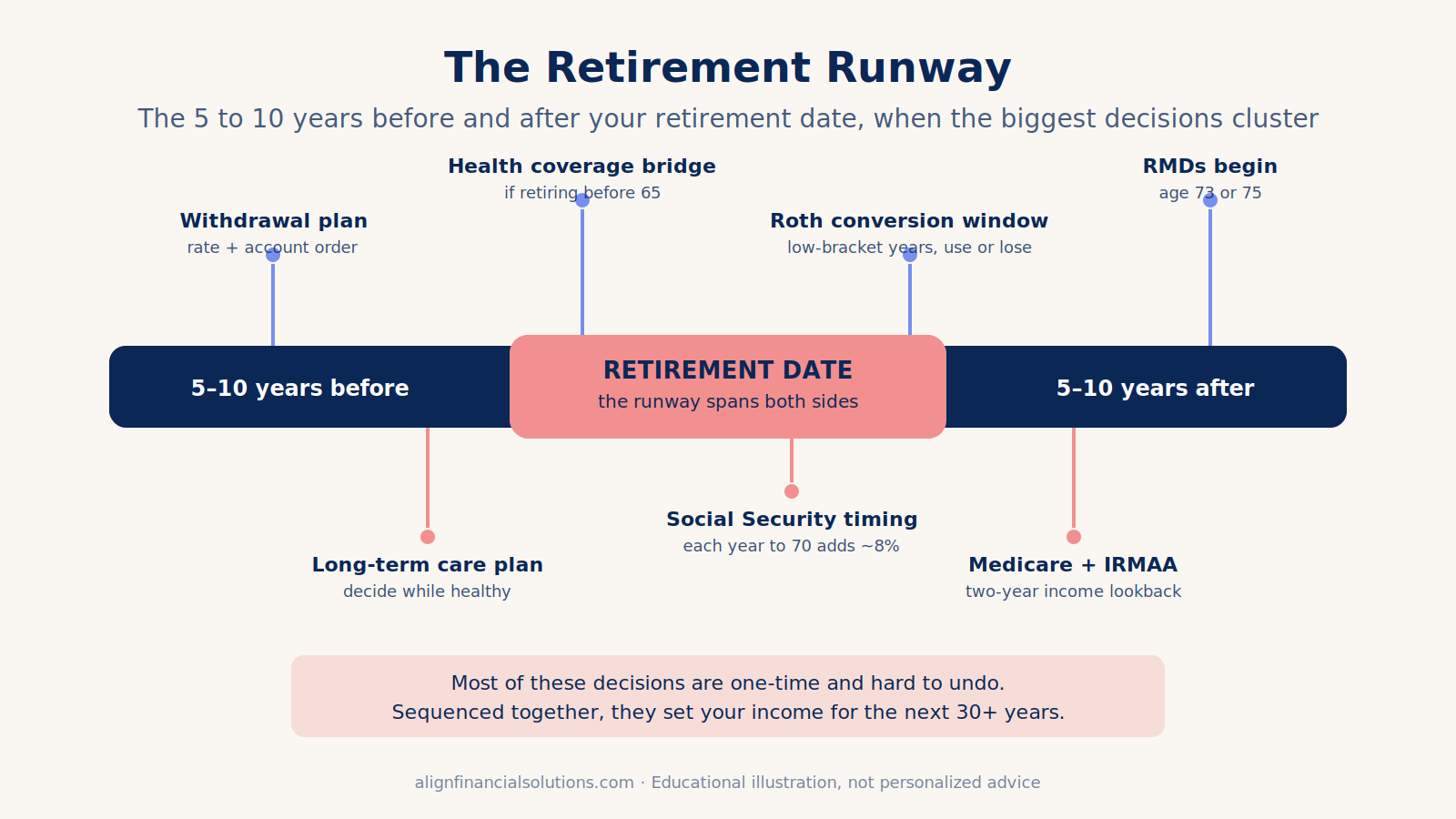
Here’s the frame I use with every client. I call it the retirement runway: the five to ten years before your retirement date, and the five to ten years after it. That 10 to 20 year window is where the biggest irreversible decisions cluster: when you claim Social Security, whether you use your low-income years for Roth conversions, how you set your first withdrawal rate, how you bridge healthcare to Medicare. Get those right and the following decades mostly take care of themselves. Get them wrong and there’s often no do-over.
This guide walks through the whole runway: why the math is different for women, the five decisions that cluster in that window, how to structure your accounts, and what to look for if you decide to hire help. Use it as a map. I’ll link to the deeper piece on each topic as we go.
Why Retirement Planning for Women Runs on Different Math
Retirement planning for women differs from the standard playbook in three measurable ways: a longer life expectancy, so the same savings must fund more years; a last-survivor phase in which a widow keeps only the larger Social Security check and files taxes as a single person; and, for a single woman, a plan that has to carry itself on one income and one Social Security check. Each one changes the numbers, so the plan has to price them in from the start.
Longevity
Start with longevity. The Department of Labor’s women and retirement savings guidance puts it plainly: a woman retiring at 67 can expect to live about 20 more years, over two years longer than a man the same age. And that’s the average. Half of women outlive it. So when I build a plan for a woman in her early 50s, I model it to age 95 or beyond. Planning to your life expectancy means a coin-flip chance of outliving your plan. That’s not a plan. That’s a bet.
Last-survivor reality
Second, the last-survivor reality. If you’re married, one of you will very likely manage this money alone. Statistically, it’s you. The surviving spouse keeps most of the household income and assets but drops to single filing status, which means higher brackets on the same money. I’ve written about this in detail as the widow’s penalty, and it’s why a married couple’s plan should be stress-tested on a last-survivor basis, not a joint one. If you’re already single, the math is different but no gentler: one income funds everything, and there’s no survivor benefit backstop. My guide to retirement strategies for single women over 50 covers that version of the problem.
Career-interruption effect
Third, the career-interruption effect. The same DOL guidance notes women are more likely to have worked part-time jobs without retirement plan access and to have paused careers for caregiving: fewer contribution years, smaller balances, and smaller Social Security earnings records. If you spent your 30s or 40s carrying family obligations, your balance today reflects those years, not your ability. Your 50s, likely your peak earning years, have to do more work per year than the generic calculators assume. For executives, that usually means coordinating equity compensation with everything else; my guide to retirement strategies for female executives covers that layer.
The Retirement Runway: Where the Irreversible Decisions Cluster
Why do I keep pointing at this one window? Because of what’s inside it. The years just before and just after your retirement date contain nearly every decision that can’t be unwound: your Social Security claiming age, your Roth conversion window, your Medicare enrollment, your first sequence of withdrawals in a down market. A portfolio mistake at 45 has twenty years to heal. A claiming mistake at 65 is permanent.
The runway is also when you have the most control you’ll ever have over your taxable income, especially in the gap between your last paycheck and your first required minimum distribution. That control is an asset. Most people let it expire unused. And your retirement date itself is more flexible than you think: a phased retirement (consulting, part-time, a two-year glide instead of a cliff) can stretch the runway and lower the pressure on every decision below.
The Five Decisions That Cluster in the Runway
1. The Roth conversion window: before RMDs begin
Between your retirement date and the year required minimum distributions begin (age 73 if you were born 1951 to 1959, 75 if you were born in 1960 or later), many women pass through their lowest-income years since their 20s. That’s the conversion window: the stretch where you can move money from a traditional IRA to a Roth and pay tax at bracket rates you may never see again. Every dollar converted is a dollar that never becomes a forced RMD, never inflates a surviving spouse’s single-filer tax bill, and grows tax-free from there.
Conversions are not automatically a win. The tax is real, and the amount you convert raises the income that Medicare and other thresholds key off. Whether they make sense depends on your bracket now versus your bracket at RMD age, and on who’s likely to inherit the account. I walk through the full decision in Is a Roth IRA Conversion Right for You. The point here: the window opens on your retirement date and closes at RMD age. It does not reopen.
If most of your savings sit in a pre-tax 401(k), the size of the problem is easy to underestimate. Here is what a $3 million all-pre-tax balance does to your tax return at 75, and why the years between your last paycheck and your first RMD are the window that fixes it.
2. Social Security timing: the 8% you can’t buy anywhere else
For every year you delay claiming past full retirement age, your benefit grows by roughly 8% until age 70, per the Social Security Administration. For a woman planning into her 90s, that’s not a footnote: delayed credits are an inflation-adjusted, government-backed raise on an income stream you cannot outlive. The longer you live, the more the age-70 claim wins. And if you’re the higher earner in a couple, your benefit is also the survivor benefit: delaying isn’t just about your check, it’s about the check whoever lives longest keeps for life.
Two cautions. First, delaying only works if you have assets to bridge the gap, which is exactly what the conversion-window years and your taxable accounts are for, and why these decisions have to be made together. Second, your benefit is likely taxable once you have other income; up to 85% of it can land on your return. I cover how that works in Do You Pay Taxes on Social Security.
Married? The rule changes. At the first death the household’s two checks become one, so it is the higher earner’s check that should wait until 70 while the smaller one often starts early. I walk through the survivor math in which spouse should delay Social Security.
3. Your withdrawal rate: the 4% rule has aged
The famous 4% rule comes from Bill Bengen’s 1994 research: withdraw 4% of your portfolio in year one, adjust for inflation, and a 30-year retirement historically held up. Two problems for you. Morningstar’s 2026 State of Retirement Income research puts the safe starting rate at about 3.9% for a 30-year horizon based on current market conditions. And you may not be planning a 30-year retirement: a woman retiring at 60 planning to 95 is funding 35 years, which argues for starting lower still. I take a closer look at whether the 4% rule works for women in its own post.
On $1.5 million, 3.9% is $58,500 in year one. If that number lands short of the life you’re planning, you’ve learned something important while you can still act on it: work a year longer, phase out gradually, or delay Social Security to raise the guaranteed floor. The other lever is flexibility: guardrails-style spending, where you take modest cuts in bad markets and raises in good ones, supports meaningfully higher starting withdrawals than a rigid inflation-adjusted number. Rigid rules are for people who won’t adjust. You can adjust.
4. Healthcare: the bridge to Medicare, and the IRMAA cliff after it
Retire before 65 and you own your health insurance until Medicare begins. If you’re buying marketplace coverage, know that the enhanced ACA subsidies expired at the end of 2025. The subsidy cliff is back for 2026, and subsidies key off your household income, not your assets. That makes the bridge years another reason to manage taxable income deliberately, and it makes a well-funded HSA one of the most efficient assets you can carry into this window. Here’s how an HSA works as a retirement asset.
After 65, the trap changes names. The 2026 standard Medicare Part B premium is $202.90 a month, but IRMAA surcharges raise it once your modified adjusted gross income crosses $109,000 as a single filer ($218,000 married filing jointly), and the lookback is two years: your 2026 premium is set by your 2024 return. A large Roth conversion or asset sale at 63 shows up as a Medicare surcharge at 65. This is where the widow’s penalty compounds, too: the same income that cleared the married threshold can breach the single one. My overview of Medicare options for retirees covers enrollment and plan choices.
5. The long-term-care plan: decide on paper, not in a crisis
Women are the long-term-care story on both ends: we do most of the caregiving, then we’re more likely to need paid care ourselves, for longer, often without a spouse left to provide it. The numbers are not small. The Genworth/CareScout Cost of Care Survey puts the national median for a private nursing-home room at $10,798 a month (roughly $129,575 a year), and costs vary widely by region.
A plan doesn’t have to mean insurance. It means a named answer: self-fund from a designated bucket, buy traditional or hybrid coverage, or some mix, decided in your 50s or early 60s while you’re insurable and while premiums are priced for your age, not later when the options have narrowed to whatever’s left. I weigh the tradeoffs in Is Long-Term-Care Insurance Worth It.
| Decision | When it lands | Why it’s hard to undo | Start here |
|---|---|---|---|
| Roth conversion window | Between your last paycheck and Social Security/RMDs | Each year’s low-bracket room expires December 31 | The Roth conversion window |
| Social Security timing | Any time from 62 to 70 | Claiming locks your benefit (and your survivor’s) for life | Social Security and taxes |
| Withdrawal rate and order | Year one of retirement, then every year | Early-year mistakes compound for decades | Which accounts to tap first |
| Healthcare before Medicare | Any retirement before 65 | Income choices set your subsidy year by year | The bridge to Medicare |
| Long-term care plan | Best decided in your 50s while healthy | Insurability and premiums move against you with age | Is LTC insurance worth it |
How Much Do I Need to Retire? Wrong Question. Ask Where It Sits
“How much do I need to retire” is the most-searched question in retirement planning, and the number alone is only half the answer. Two women with $2 million can be in completely different positions, a comparison I take further in Can I Retire With $2 Million as a Single Woman.
If all $2 million sits in a traditional 401(k), every withdrawn dollar is ordinary income: the IRS effectively owns a share of the account, RMDs will eventually force income whether you need it or not, and every threshold in this guide (Social Security taxation, IRMAA, the ACA cliff) gets harder to steer around. If it’s spread across taxable, tax-deferred, and tax-free accounts, you can fill each year’s low brackets from the IRA, take the rest from the taxable account at capital-gains rates, and leave the Roth to grow for your 80s and 90s.
That’s account-type diversification, and in the runway years it matters as much as investment diversification. It’s what turns income control from theory into an actual dial you can set each year. Most women I meet have it backwards (heavy tax-deferred, light everything else) because that’s what decades of maximizing the 401(k) produces. The fix is the conversion window above, plus deliberately building the taxable and Roth buckets in your final working years.
As for the number itself: work backward from spending, not forward from a rule of thumb. Annual spending, minus Social Security and any pension, is the gap your portfolio must fill. Divide that gap by roughly 3.9% (lower for a longer horizon) for a starting estimate, then pressure-test it. I show the full method in How to Calculate Your Retirement Readiness.
If You Hire Help, Hire It on These Two Tests
You don’t need an advisor to use this guide. But if you want one for the runway years, apply two filters. First, fee-only fiduciary: an advisor paid only by you, legally required to act in your interest, with no commissions shaping the advice. Ask directly: “Are you fee-only, and are you a fiduciary at all times?” Anything other than two clean yeses is your answer. Here’s why fee-only matters for women.
Second, tax planning, not tax preparation. Filing in April records what already happened; planning decides what happens next: conversion amounts, which account funds which year, IRMAA and threshold management. Nearly every decision in this guide is a tax decision, and an advisor who doesn’t do forward tax work is leaving the biggest lever untouched. The difference is spelled out in Tax Planning vs. Tax Filing.
What to Do This Week
- Pull your Social Security statement at ssa.gov. Check your earnings record for missing years (caregiving gaps sometimes hide reporting errors) and note your benefit at full retirement age versus 70. That delta is the raise you’re deciding whether to take.
- Map every account into three buckets: taxable, tax-deferred, tax-free. One page, current balances. If tax-deferred is over 80% of the total, your runway plan almost certainly includes conversions, and you now know it.
- Count your conversion-window years. Planned retirement age to RMD age (73 or 75, by birth year). That’s how many low-bracket years you have to reposition money. If the answer is ten, you have room. If it’s two, you have urgency.
- Put a number on long-term care. Multiply roughly $130,000 a year by two to three years and decide, on paper, which bucket would fund it. If nothing can, that’s your signal to price coverage while you’re still insurable.
Are you on track?
If you want to see where you actually stand, I built a free 3-minute Retirement Readiness Assessment that gives you a personalized score and a specific dollar gap estimate based on your numbers. Take the assessment here.
Hazel Secco, CFP®, CDFA®, is the founder of Align Financial Solutions, a fee-only fiduciary firm in Hoboken, New Jersey, that helps high-net-worth women bring retirement, equity compensation, tax, and estate planning into one plan. Learn how Align approaches retirement planning for women. Align is a fee-only financial advisor for women in Hoboken, New Jersey, and its financial planning for women treats retirement timing, taxes, equity compensation, and estate decisions as one plan.
Already past the research phase? Book a free 15-minute Align Call: https://alignfinancialsolutions.com/book-a-call/
🌐 https://alignfinancialsolutions.com
📺 https://www.youtube.com/@AlignYourRetirement
💼 https://linkedin.com/in/hazel-secco
Frequently Asked Questions
How is retirement planning different for women over 50?
Retirement planning for women over 50 is a different problem, not a softer version of the standard playbook. A woman retiring at 67 can expect to live about 20 more years, over two years longer than a man the same age, and half of women outlive that average. Add the last-survivor tax reality and fewer contribution years from caregiving, and I model plans to age 95 or beyond.
What is the retirement runway?
The retirement runway is the five to ten years before your retirement date and the five to ten years after it. That window holds nearly every irreversible decision: your Social Security claiming age, the Roth conversion window, Medicare enrollment, your first withdrawal rate, and the healthcare bridge. Get those right and the following decades mostly take care of themselves.
How much money does a woman need to retire?
Work backward from spending, not forward from a rule of thumb. Take annual spending, subtract Social Security and any pension, and divide the gap by roughly 3.9 percent, lower for a longer horizon. Where the money sits matters as much as the amount: $2 million all in a traditional 401(k) behaves very differently from $2 million spread across taxable, tax-deferred, and tax-free accounts.
What should a woman look for when hiring a financial advisor?
Apply two tests. First, a fee-only fiduciary: an advisor paid only by you, legally required to act in your interest, with no commissions shaping the advice. It is how I built my own practice. Second, forward tax planning rather than just tax preparation, because nearly every decision in the runway years is a tax decision.
Disclaimer: Advisory services are offered through Align Financial Solutions LLC (“AFS”), an Investment Advisor in the State of New Jersey. This article is for educational purposes only and does not constitute personalized tax, legal, investment, or financial planning advice. Rules and figures are current for 2026 and subject to change. All client scenarios are hypothetical composites for illustration and do not represent any specific client outcome. Consult a qualified professional about your specific situation.
Sources
- U.S. Department of Labor, EBSA, Women and Retirement Savings: https://www.dol.gov/agencies/ebsa/about-ebsa/our-activities/resource-center/publications/women-and-retirement-savings
- Social Security Administration, Delayed Retirement Credits: https://www.ssa.gov/benefits/retirement/planner/delayret.html
- Morningstar, The State of Retirement Income (2026): https://www.morningstar.com/business/insights/research/the-state-of-retirement-income
- Genworth/CareScout, Cost of Care Survey: https://www.genworth.com/aging-and-you/finances/cost-of-care