
Written by Hazel Secco, CFP®, CDFA®
In this post
- What is a supplemental executive retirement plan?
- How much is a SERP worth?
- How is a SERP taxed?
- What are the risks of a SERP?
- Should you take a SERP as a lump sum or monthly payments?
- How does a SERP fit with your pension, deferred comp, and Social Security?
- What to Do This Week
- Frequently Asked Questions
- Get the Retirement Tax Playbook
If your offer letter or benefits summary mentions a supplemental executive retirement plan, it may be one of your largest retirement benefits, yet it’s rarely explained well. A SERP can add tens of thousands of dollars a year to your retirement income. It also comes with tax rules, risks, and payout choices that work very differently from your company’s regular pension or 401(k).
Most of the decisions that matter are made years before you retire, when you first become eligible or when you choose how the benefit will be paid. If you are 5 to 10 years from retiring, this is the time to understand what your SERP is worth and what could reduce it.
This guide explains what a supplemental executive retirement plan is, how it’s taxed, the risks to check, and how to think about a lump sum versus monthly payments, using 2026 federal figures.
What is a supplemental executive retirement plan?
A supplemental executive retirement plan, or SERP, is a retirement benefit a company provides to a select group of senior employees on top of its regular retirement plans. It’s usually paid entirely by the employer. Most SERPs exist to make up for the benefits that federal limits cut from the company’s qualified pension or 401(k) for higher-paid employees.
A SERP is a type of nonqualified deferred compensation. It isn’t held in a protected trust in your name, and it isn’t covered by most of the funding and protection rules that apply to a regular pension. Your benefit is a promise from your employer, paid from company assets when you retire.
SERPs come in two main designs. A pension-style SERP pays a monthly benefit based on a formula, usually your years of service and final average pay. An account-style SERP credits a dollar amount to a bookkeeping account each year, much like a 401(k) without the limits. Your plan document says which one you have.
The federal limits a SERP makes up for
Qualified retirement plans can only count pay up to a set amount, and pensions can only pay up to a set benefit each year. For executives, those limits can leave a large gap between the pension the formula promises and the pension the plan is allowed to pay.
| Federal limit | 2026 | 2027 |
|---|---|---|
| Pay a qualified plan can count | $360,000 | $375,000 |
| Highest yearly pension a qualified plan can pay | $290,000 | $300,000 |
| 401(k) employee contribution limit | $24,500 | $25,500 |
How much is a SERP worth?
A pension-style SERP is usually worth the difference between the full pension formula applied to all of your pay and the pension the qualified plan can pay under the limits. For an executive whose pay is well above the limit, that difference can be a quarter or more of the total pension.
Here’s a hypothetical example. Nicole is 58 and plans to retire at 60 with 25 years of service and final average pay of $500,000. Her company’s pension formula, simplified for this example, is 1.5% of final average pay for each year of service. Using the 2026 pay limit of $360,000 for the whole calculation keeps the math simple.
| Pay counted | Yearly pension | |
|---|---|---|
| Full formula on all her pay | $500,000 | $187,500 |
| What the qualified pension can pay | $360,000 | $135,000 |
| What the SERP pays to close the gap | $52,500 |
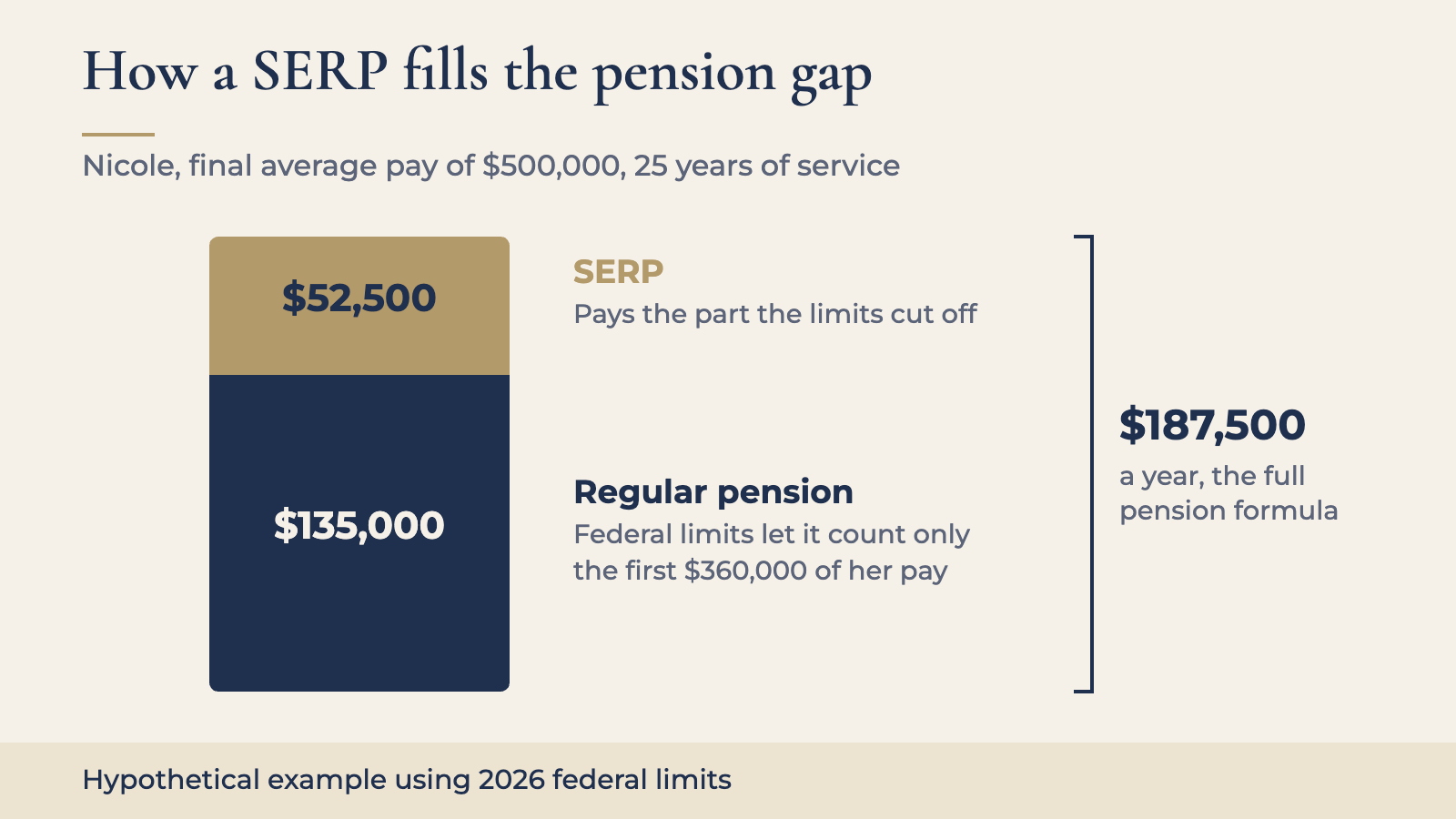
The SERP adds $52,500 a year to her retirement income. Her qualified pension of $135,000 is under the $290,000 yearly maximum, so the pay limit is what creates the gap here. Real formulas vary, and many use averages over several years, so your plan’s benefit statement is the number to rely on.
How is a SERP taxed?
SERP payments are taxed as ordinary income in the year you receive them, for federal income tax and usually state income tax. Medicare tax works differently. For a pension-style SERP, it’s often charged once, on the present value of the whole benefit, around the time you retire, rather than on each payment.
The one-time Medicare tax at retirement
Under the Social Security and Medicare tax rules for deferred compensation, a pension-style SERP is taxed for Medicare when the amount, form, and start date of your benefit are known. For many plans, that’s the year you retire. Your employer calculates the present value of all your future payments and withholds the tax on it in that year. After that, the payments themselves aren’t taxed for Medicare again.
For Nicole, a simplified present value of $52,500 a year for 25 years, discounted at 5%, is about $740,000. Medicare tax is 1.45%, plus an additional 0.9% on wages above $200,000 for a single filer. If her other wages that year are already above $200,000, the tax would be about $17,400, withheld in her retirement year. Social Security tax wouldn’t apply if her salary that year already passed the $184,500 wage base for 2026. Your employer’s actuaries will use their own assumptions, so treat this as an estimate.
One consequence is worth knowing. That Medicare tax is generally paid even though the future payments depend on the company staying able to pay them.
Your payout election is usually fixed early
SERPs follow the same federal timing rules as other deferred compensation. The form of payment, such as a lump sum or monthly payments, is usually set when you first enter the plan. Changing it later generally requires the change to be made at least 12 months ahead and to push payment back at least 5 years. Our guide to nonqualified deferred compensation before retirement explains those rules.
State tax if you move
Federal law limits a former state’s ability to tax retirement income after you move. For SERPs, payments made in substantially equal amounts over your life or at least 10 years are protected. Payments from a plan maintained only to restore benefits above the qualified plan limits can also be protected after you leave your job, regardless of payment form. Your plan administrator can tell you which test your plan meets. Our guide to retiring in a high-tax state covers the move itself.
What are the risks of a SERP?
The biggest risk is that a SERP is an unsecured promise. If your employer goes bankrupt, you’re a general creditor, and the Pension Benefit Guaranty Corporation (PBGC), which insures regular pensions, doesn’t cover these plans. The other risks are losing the benefit by leaving too early and the 6-month payment delay at public companies.
No pension insurance
A regular pension is funded in a trust and insured up to limits by the PBGC. Unfunded plans for a select group of management or highly compensated employees are excluded from that insurance. Some companies set assets aside in a rabbi trust, but those assets stay available to the company’s creditors. When your salary, stock awards, deferred pay, and SERP all depend on one company, it’s worth adding them up.
Vesting and forfeiture
Many SERPs require a minimum age or years of service before any benefit is earned. Some plans also include conditions after you leave, such as not working for a competitor, and a benefit can be forfeited if those conditions are broken. If a layoff or early exit is possible, check how much of your SERP is vested today and what happens to the rest.
The 6-month delay at public companies
If you’re among the key officers of a publicly traded company, payments triggered by leaving can’t start until 6 months after your separation date. Plan for that gap in the first year’s budget.
Should you take a SERP as a lump sum or monthly payments?
A lump sum removes the risk of your employer failing later, but it usually lands in one tax year at top rates. Monthly payments spread the tax over many years and can last for life, though each one depends on the company still being able to pay. The right choice depends on your employer’s financial strength, your other income, and how much flexibility your plan allows.
If your plan offers a lump sum, interest rates matter. A lump sum is the present value of future payments, so a higher interest rate produces a smaller lump sum. As a simplified illustration, 25 years of $120,000 a year is worth about $1,691,000 at a 5% rate and about $1,534,000 at 6%. That 1-point change lowers the lump sum by about $157,000, or roughly 9%.
Your qualified pension uses IRS-set interest rates for lump sums, and many plans lock in the rate from a set month before your retirement date. A SERP uses whatever assumption its plan document names, which can differ. Ask both plans which rate applies and when it’s set, since the month you retire can change the number. Our guide to taking a pension as a lump sum or an annuity covers the broader choice.
How does a SERP fit with your pension, deferred comp, and Social Security?
A SERP adds to the same retirement years as your qualified pension, any deferred compensation payouts, and Social Security. Together, they can keep your taxable income high in retirement, which affects your tax bracket, Medicare premiums, and how much room you have for Roth conversions.
Nicole’s SERP and qualified pension alone total $187,500 a year. Before Social Security or IRA withdrawals, that’s already above the 2026 Medicare surcharge line of $109,000 for single filers, so her Part B and Part D premiums would be higher from 65 on. Our 2026 IRMAA guide shows each tier.
When several income sources start in the same years, the order matters. Scheduling deferred compensation installments, choosing when to claim Social Security, and planning IRA withdrawals around the SERP can keep more of your income in lower brackets. If you work at Bristol Myers Squibb, our BMS retirement planning guide covers that company’s retirement benefits.
What to Do This Week
- Request your SERP benefit statement. Ask for the estimated benefit at your planned retirement age and at the earliest age you could leave.
- Read the payout and vesting terms. Note the form of payment on file, the interest rate used for any lump sum, and any forfeiture conditions after you leave.
- Ask how Medicare tax will be handled. Find out the year your employer expects to tax the present value, so you can plan the withholding in that year’s paycheck.
- Add up your exposure to your employer. Total the SERP’s present value, deferred comp balance, unvested stock, and company shares.
- Map your retirement income by year. List pension, SERP, deferred comp, Social Security, and IRA withdrawals from your retirement date to 75, then review it with your CPA.
Frequently Asked Questions
Is a SERP the same as deferred compensation?
A SERP is one type of nonqualified deferred compensation, but it’s usually funded entirely by your employer rather than by your own salary deferrals. It follows the same federal timing rules for payout elections. The main difference is that a SERP restores retirement benefits lost to federal limits, while an elective deferred compensation plan holds pay you chose to postpone.
Can you roll a SERP into an IRA?
No. SERP payments can’t be rolled into an IRA or a 401(k), even when paid as a lump sum. Each payment is taxable as ordinary income when you receive it. That’s why the payout form matters, since monthly payments or installments are the main way to spread the tax over several years.
What happens to a SERP if you leave the company early?
It depends on your vesting terms. Many SERPs pay nothing until you reach a minimum age or years of service. If you’re vested, leaving usually starts payments on the schedule you elected, with a 6-month delay at public companies for key officers. Some plans can forfeit benefits if you later work for a competitor.
Is a SERP protected if the company goes bankrupt?
Generally not. A SERP is an unsecured promise, so in a bankruptcy you’re a general creditor of the company. The PBGC doesn’t insure these plans, and assets in a rabbi trust remain available to the company’s creditors. Some executives weigh taking a lump sum when it’s available for this reason.
Get the Retirement Tax Playbook
A SERP, a pension, and deferred comp payouts can stack up in the same years. Our free Retirement Tax Playbook covers how to plan income, Roth conversions, and IRA withdrawals around them.
Hazel Secco, CFP®, CDFA®, is a fiduciary financial advisor and founder of Align Financial Solutions in Hoboken, New Jersey. She helps individuals and couples make informed decisions about retirement, investments, and taxes so their money supports the life they want.
We are fee-only advisors. We receive no commissions, we do not sell products, and we are paid only by our clients. Align is based in Hoboken, NJ, but we work with clients across the country virtually.
If you’d like help reviewing your SERP and the payout choices around it, you can book a 15-minute Align Call. Whether we work together or not, you’ll walk away with clarity on your best next step.
Nicole is a hypothetical example, not a client, and her figures are illustrative. The pension formula, the use of the 2026 pay limit for all years, and the present value and lump sum figures (simplified 25-year payments at the interest rates shown) are assumptions for illustration only. Your plan document and benefit statement control your actual benefit, taxes, and payout options. State income tax is not included. Align Financial Solutions does not provide tax or legal advice. This article is for educational purposes only and is not personalized financial, tax, or legal advice. Talk with your CPA before acting on your own situation.
Sources
- IRS, Notice 2025-67, 2026 retirement plan limits. https://www.irs.gov/pub/irs-drop/n-25-67.pdf
- IRS, Notice 2026-66, 2027 retirement plan limits. https://www.irs.gov/pub/irs-drop/n-26-66.pdf
- 26 CFR § 31.3121(v)(2)-1, FICA treatment of nonqualified deferred compensation, including nonaccount balance plans. https://www.ecfr.gov/current/title-26/chapter-I/subchapter-C/part-31/subpart-B/subject-group-ECFR996050e2e4c4937/section-31.3121(v)(2)-1
- IRS, Questions and Answers for the Additional Medicare Tax. https://www.irs.gov/ADMTfaqs
- Social Security Administration, Contribution and Benefit Base. https://www.ssa.gov/oact/cola/cbb.html
- 26 U.S.C. § 409A, Nonqualified deferred compensation plans. https://www.law.cornell.edu/uscode/text/26/409A
- 26 U.S.C. § 417, Minimum survivor annuity requirements and present value rules. https://www.law.cornell.edu/uscode/text/26/417
- 4 U.S.C. § 114, Limitation on State income taxation of certain pension income. https://www.law.cornell.edu/uscode/text/4/114
- Pension Benefit Guaranty Corporation, Small Business Guide (plans not covered). https://www.pbgc.gov/sites/default/files/legacy/docs/smallbusinessguide.pdf
- U.S. Department of Labor, ERISA Advisory Council, Examining Top Hat Plan Participation and Reporting (2020). https://www.dol.gov/sites/dolgov/files/ebsa/pdf_files/2020-examining-top-hat-plan-participation-and-reporting.pdf
- Social Security Administration, POMS HI 01101.031, How IRMAA is calculated. https://secure.ssa.gov/poms.nsf/lnx/0601101031