
Written by Hazel Secco, CFP®, CDFA®
In this post
- What is nonqualified deferred compensation?
- Is deferred compensation a good idea before retirement?
- When do you make deferred compensation elections?
- How is deferred compensation taxed when it’s paid out?
- Should you take deferred compensation as a lump sum or installments?
- What happens to deferred compensation if you quit or get laid off?
- What to Do This Week
- Frequently Asked Questions
- Get the Retirement Tax Playbook
Every fall, your company opens enrollment for its deferred compensation plan, and you have a few weeks to decide how much of next year’s pay to set aside and when you want it paid back. A nonqualified deferred compensation plan can lower your tax bill in your highest-earning years. It can also create a large tax bill, on a payout schedule you can’t easily change, in the years you planned to spend retired.
The choices on the election form are locked in for years. If you are 5 to 10 years from retiring, the payout choice matters as much as the amount you defer, because it decides which tax years the money lands in and how much of it gets taxed at the top rates.
This guide covers how these plans work, when the elections are due, how payouts are taxed, and how a lump sum compares with installments, using 2026 federal figures.
What is nonqualified deferred compensation?
Nonqualified deferred compensation, often shortened to NQDC, is an employer plan that lets you postpone part of your salary or bonus to a later year. You don’t pay federal income tax on the deferred amount until it’s paid to you. Unlike a 401(k), there’s no IRS cap on how much you can defer, and your balance is a promise from your employer rather than money held in a trust in your name.
Large employers usually offer these plans to senior employees on top of the 401(k). Some add a company contribution on pay above the 401(k) limits. The investment options that track your balance, the payout choices, and the deadlines are all set by your plan document, so the plan summary and enrollment guide are the first things to read.
Some employers also offer a supplemental executive retirement plan, or SERP. It’s a related nonqualified plan that the company funds on its own to top up a pension or other retirement benefit above the IRS limits. Our guide to the supplemental executive retirement plan covers how those payouts work and how they’re taxed.
| 401(k) | Nonqualified deferred compensation | |
|---|---|---|
| How much you can defer in 2026 | $24,500, plus catch-up if eligible | Set by your plan, no IRS cap |
| If your employer fails | Held in a trust for you | You’re an unsecured creditor |
| Rollover to an IRA | Yes | No |
| When it’s paid out | Flexible, with required minimum distributions later | On the dates and events you elected in advance |
| Early access | Loans or withdrawals, often with a penalty | Generally only at the events in your election |
Is deferred compensation a good idea before retirement?
It can be, when three things line up. You expect a lower tax bracket when the money is paid out, you’re comfortable with your employer’s long-term financial strength, and you won’t need the cash before the payout date. If any of the three is uncertain, deferring a smaller amount is usually the safer choice.
The tax rate gap
The benefit comes from the difference between your tax rate now and your rate when it’s paid. For 2026, a single filer pays 35% on taxable income above $256,225, and 32% above $201,775. If the same dollars come out later in the 22% or 24% bracket, the gap is meaningful. If you expect high income in retirement from a pension, rental property, or large IRA withdrawals, the gap shrinks.
Your employer’s promise
Your balance is an unsecured promise to pay. If the company goes bankrupt, you stand in line with its other general creditors. Some employers set money aside in a rabbi trust, but those assets still belong to the company and remain available to its creditors. When your salary, your stock awards, and your deferred pay all depend on one company, this is the same concentration question you’d ask about holding vested company stock.
Cash you can’t reach
There are no loans, and early payment is generally limited to the events in your election, plus an unforeseeable emergency if the plan allows it. Funding your 401(k), your emergency savings, and any big expenses in the next few years before deferring more keeps this money from being needed early.
When do you make deferred compensation elections?
Most deferral elections are due by December 31 of the year before you earn the pay. For a bonus based on a performance period of at least 12 months, a plan can allow the election up to 6 months before the period ends. You usually choose when and how the money will be paid at the same time, separately for each year’s deferral.
| Election | Federal deadline | What it means in practice |
|---|---|---|
| Defer next year’s salary | By December 31 of the year before | Your 2027 salary election is due by December 31, 2026. Your plan can set an earlier date. |
| Defer a performance bonus | At least 6 months before a performance period of 12 months or more ends | June 30 for a calendar-year bonus, if your plan allows it |
| Choose when and how it’s paid | Usually with the deferral election | Separation from service, a fixed date, or both, as a lump sum or installments |
| Change the payout later | At least 12 months before the scheduled payment | The new date must be at least 5 years later, and the change doesn’t take effect for 12 months |
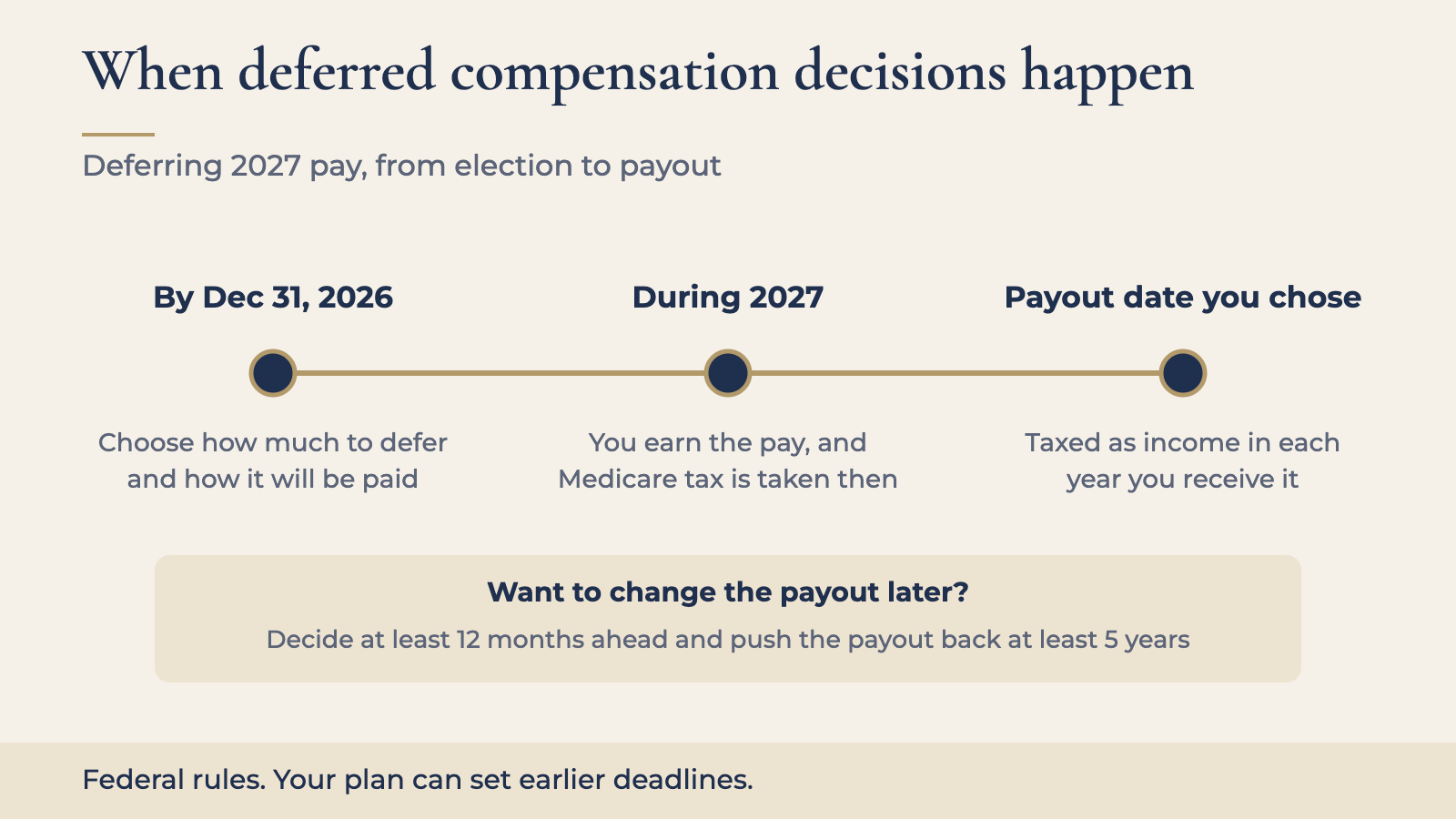
Federal rules allow payment only on specific events. Those are separation from service, a fixed date or schedule, disability, death, a change in control of the company, or an unforeseeable emergency. Payments can’t be sped up once elected. A plan that breaks these rules can make the deferred amounts taxable right away, plus an additional 20% tax and interest, and that tax falls on you, the employee.
Changing your payout later
The change rules are strict. If you elected a lump sum at 60, a change has to be made before 59, and the new payment date can’t be earlier than 65. Because any later change pushes payment back at least 5 years, it’s worth getting the first election right.
The 6-month delay at public companies
If you are a specified employee of a publicly traded company, which generally means one of its key officers, payments triggered by leaving can’t start until 6 months after your separation date. Plan your cash for that gap, especially if severance and your deferred pay are both part of the first year’s budget.
How is deferred compensation taxed when it’s paid out?
Payments are taxed as ordinary income in the year you receive them, for federal income tax and usually state income tax. Social Security and Medicare taxes generally applied when you deferred the pay, or when it vested, so they usually aren’t taken again at payout. The money can’t be rolled into an IRA to keep deferring the tax.
Social Security and Medicare taxes
Under a special timing rule, deferred pay counts as wages for Social Security and Medicare tax when you earn it, or when it’s no longer at risk of being forfeited, if that’s later. Once those taxes are paid, the same money and its earnings aren’t taxed for them again. If your salary that year was already above the Social Security wage base, only the Medicare tax applied to the deferred pay.
State tax if you move in retirement
Federal law bars a state from taxing the retirement income of someone who no longer lives there. For deferred compensation, that protection covers payments made at least once a year in substantially equal amounts over your life expectancy or over at least 10 years. A 5-year installment schedule doesn’t meet that test. If you might leave New Jersey or New York for a state with no income tax, a 10-year installment election can keep the old state from taxing the payments. Some excess benefit plans qualify under a separate test, and your plan administrator can confirm which applies. Our guide to retiring in a high-tax state covers the move itself.
Medicare premiums
Payouts count toward the modified adjusted gross income (MAGI) Medicare uses for its income-related surcharge, called IRMAA, with a 2-year lookback. For 2026 premiums, a single filer with 2024 MAGI above $109,000, or a joint filer above $218,000, pays more for Part B and Part D. A large payment at 63 or later can raise your premiums 2 years after. Our 2026 IRMAA guide has the full table.
Should you take deferred compensation as a lump sum or installments?
Installments usually spread the tax over more years at lower brackets, while a lump sum can push most of the balance into the top brackets in one year. A lump sum can still make sense for a small balance, when you’re worried about your employer’s finances, or when you’ll have an unusually low-income year to absorb it.
Here’s a hypothetical example. Lauren is 55, single, and earns $420,000 a year in salary and bonus. She defers $100,000 a year from 55 through 58, for a $400,000 balance. She plans to retire at 60 and expects about $70,000 a year of other taxable income. To keep the math simple, this uses 2026 federal brackets and the $16,100 standard deduction for every year, ignores investment growth, and leaves out state tax.
Every deferred dollar would have been taxed at 35% while she worked, so she avoids $35,000 of federal tax each year, or $140,000 over 4 years. What happens next depends on her payout election.
| Payout election | Taxable income in each payout year | Federal tax on the deferred money | Tax avoided while working, minus tax at payout |
|---|---|---|---|
| Lump sum at 60 | $453,900 in one year | $121,064 | $18,936 |
| 10 yearly installments of $40,000 | $93,900 each year | $88,000 ($8,800 a year) | $52,000 |
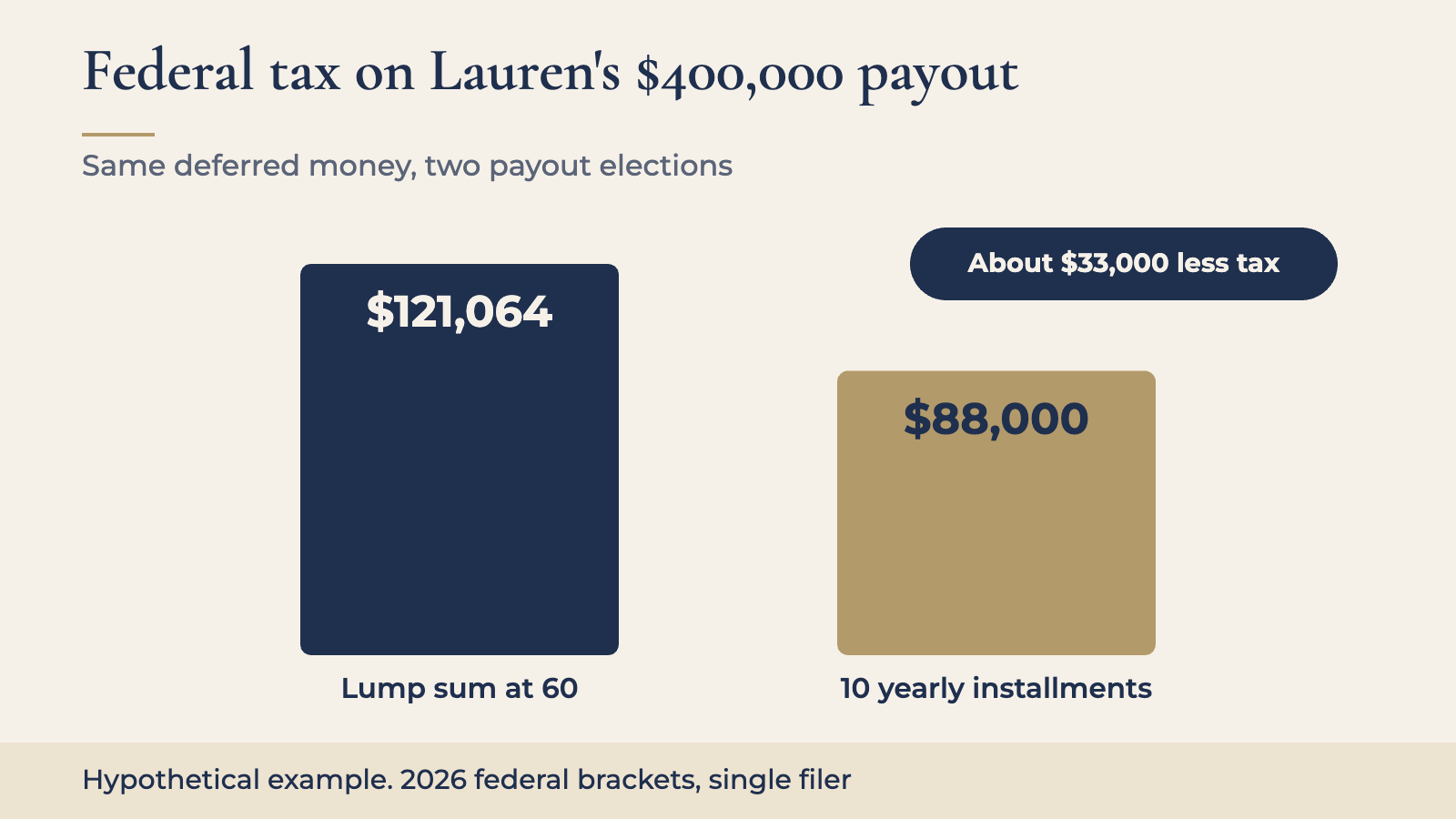
The installments save her about $33,000 compared with the lump sum, because each year’s taxable income stays in the 22% bracket. The lump sum pushes most of the balance back into the 35% bracket she was trying to avoid. The 10-year schedule also meets the state-tax test above if she moves.
One more check is worth doing. Her MAGI with installments is $110,000, which is $1,000 over the 2026 IRMAA line for single filers. From 63 on, a slightly smaller IRA withdrawal in those years would keep her under it. The threshold is adjusted for inflation each year, so the exact line will be different by then. A payout plan like this also shapes your Roth conversion window, since the same bracket room is being used.
What happens to deferred compensation if you quit or get laid off?
Leaving your employer usually counts as a separation from service, which starts the payout schedule you already elected. You generally can’t delay it or change it at that point. Company contributions that haven’t vested may be forfeited, depending on your plan.
If you’re laid off in your 50s and elected a lump sum at separation, the payment can land in the same tax year as severance and a final bonus. Our guide to how severance pay is taxed walks through that year. Some plans let you choose one payout for leaving before a certain age and a different one for leaving after it, which can protect you from a large lump sum in an early, unplanned exit.
If you work at Bristol Myers Squibb or Pfizer, our BMS retirement planning guide and Pfizer benefits guide cover each company’s retirement benefits.
What to Do This Week
- Find your enrollment deadline. Check the date in your plan’s enrollment guide. It can be earlier than December 31.
- Read the payout options. Note whether your plan offers fixed dates, installments of 10 years or more, and a different payout for leaving before a certain age.
- Map your income by year. List expected salary, pension, Social Security, and IRA withdrawals from your planned retirement date to 75, so you can see which years have room in the 22% and 24% brackets.
- Add up your exposure to your employer. Total your deferred balance, unvested stock, and company shares. If that number makes you uneasy, defer less this year.
- Review the elections with your CPA before you submit. Once the window closes, most choices are fixed for years.
Frequently Asked Questions
Is deferred compensation taxable?
Yes. You pay federal income tax, and usually state income tax, in the year the money is paid to you, not the year you earned it. Social Security and Medicare taxes generally apply when you defer the pay or when it vests. The payout is ordinary income, so the payout schedule you choose decides which tax brackets it lands in.
Can you roll deferred compensation into an IRA?
No. Payments from a nonqualified deferred compensation plan can’t be rolled into an IRA or a 401(k). Each payment is taxable when you receive it. That’s why the payout election matters so much. Choosing installments over several years is the main way to spread the tax, since rolling the balance over isn’t available.
Does deferred compensation count toward Medicare IRMAA?
Yes. Payments are part of your modified adjusted gross income, which Medicare uses to set the IRMAA surcharge with a 2-year lookback. For 2026 premiums, the surcharge starts above $109,000 of 2024 MAGI for single filers and $218,000 for joint filers. Large payments at 63 or later can raise premiums 2 years after.
What happens to deferred compensation when you die?
Your remaining balance is paid to the beneficiary named under the plan, on the schedule the plan sets for death. Your beneficiary pays income tax on the payments as they’re received, the same way you would have. Check that the beneficiary form with your plan is current, since a will doesn’t control it.
Get the Retirement Tax Playbook
If your payouts will start in the years before Medicare, the same years are also your best window for Roth conversions and planned IRA withdrawals. Our free Retirement Tax Playbook covers how to plan income in those years.
Hazel Secco, CFP®, CDFA®, is a fiduciary financial advisor and founder of Align Financial Solutions in Hoboken, New Jersey. She helps individuals and couples make informed decisions about retirement, investments, and taxes so their money supports the life they want.
We are fee-only advisors. We receive no commissions, we do not sell products, and we are paid only by our clients. Align is based in Hoboken, NJ, but we work with clients across the country virtually.
If you’d like help choosing your deferral and payout elections, you can book a 15-minute Align Call. Whether we work together or not, you’ll walk away with clarity on your best next step.
Lauren is a hypothetical example, not a client, and her figures are illustrative. Tax figures use 2026 federal brackets and the 2026 standard deduction for a single filer in every year shown, ignore investment growth, and do not include state income tax. Your plan document controls your actual election deadlines and payout options. Align Financial Solutions does not provide tax or legal advice. This article is for educational purposes only and is not personalized financial, tax, or legal advice. Talk with your CPA before acting on your own situation.
Sources
- 26 U.S.C. § 409A, Inclusion in gross income of deferred compensation under nonqualified deferred compensation plans. https://uscode.house.gov/view.xhtml?req=granuleid:USC-prelim-title26-section409A
- 26 CFR § 1.409A-2, Deferral elections. https://www.law.cornell.edu/cfr/text/26/1.409A-2
- 26 CFR § 31.3121(v)(2)-1, FICA treatment of amounts deferred under nonqualified deferred compensation plans. https://www.ecfr.gov/current/title-26/chapter-I/subchapter-C/part-31/subpart-B/subject-group-ECFR996050e2e4c4937/section-31.3121(v)(2)-1
- 4 U.S.C. § 114, Limitation on State income taxation of certain pension income. https://www.law.cornell.edu/uscode/text/4/114
- IRS, IR-2025-103, Tax inflation adjustments for tax year 2026. https://www.irs.gov/newsroom/irs-releases-tax-inflation-adjustments-for-tax-year-2026-including-amendments-from-the-one-big-beautiful-bill
- IRS, IR-2025-111, 401(k) limit increases to $24,500 for 2026. https://www.irs.gov/newsroom/401k-limit-increases-to-24500-for-2026-ira-limit-increases-to-7500
- Social Security Administration, POMS HI 01101.031, How IRMAA is calculated. https://secure.ssa.gov/poms.nsf/lnx/0601101031
- IRS, Publication 5528, Nonqualified Deferred Compensation Audit Technique Guide. https://www.irs.gov/pub/irs-access/p5528_accessible.pdf
- IRS, Publication 559, Survivors, Executors, and Administrators (income in respect of a decedent). https://www.irs.gov/publications/p559