SAMPLE FINANCIAL PLAN · HYPOTHETICAL COMPOSITE

What a financial plan from Align looks like.

This is a complete sample of the Wealth Blueprint™, the written plan at the center of every Align relationship, built for a hypothetical single woman named Elena: where her money sits today, the job each account has, the five decisions in her retirement runway, the action list that follows, and what changed for her because of it. Read it here.

Elena is not a real person. She is a composite built to illustrate the decisions a single woman typically faces in the retirement runway. Every figure is illustrative, and nothing on this page is a recommendation for you.

WHERE THINGS STAND

You have about $2.4 million invested, $210,000 of it in your employer's stock with another $210,000 still vesting, and no one else's paycheck behind the plan. That is the design constraint of the whole plan.

Elena is 55, single, and a senior director at a New Jersey healthcare company, earning $265,000 in salary and about $45,000 in bonus, with restricted stock vesting each spring and a deferred compensation account she has been funding for nine years. Her mother is 84 and in assisted living nearby; Elena holds her power of attorney. She would like to stop working at 60, and she wants to know whether that is realistic.

Run through the software with her own numbers, 60 is closer to a coin flip than she expected: the plan holds in 48 of 100 market paths. At 62, with the changes below, it holds in 64 of 100. The two extra years are worth more than any single move in this plan, and that is the first thing we told her. What makes her plan different from a couple’s is that every number has to hold on its own: one income now, one Social Security check later, one person to make the care decisions when the time comes. So the plan carries more margin in the bridge years, a longer runway on Social Security, and the solo-aging decisions made on paper now rather than in a crisis later.

$2.38M
Investable assets, all accounts
58%
Pre-tax, including deferred comp, taxed as income when paid out
16%
In one employer’s stock, counting unvested shares
$124K
Living, housing, and travel each year in retirement, today’s dollars, before health costs, taxes, and the care-policy premium

What Elena told us matters

  • Stop working as early as the numbers allow, and not spend the next 30 years second-guessing it.
  • Never be a burden on her sister or her nieces. The care plan should be hers, funded and written down.
  • Keep the house in Summit for now. Downsizing is a later decision, not a funding source.
  • Give more, and give better, than she does now.

The balance sheet, in one view

AccountTax treatmentValue
401(k), pre-taxTaxed as income on withdrawal$1,150,000
401(k), RothQualified withdrawals tax-free$60,000
Roth IRAQualified withdrawals tax-free$95,000
Nonqualified deferred compensationTaxed as wages when paid; currently elected as a lump sum at separation$220,000
Brokerage, diversifiedCapital gains; basis $330,000$480,000
Employer stock, vested sharesCapital gains; basis $140,000$210,000
Cash, checking and savingsInterest$110,000
Health savings accountTax-free for qualified medical costs$52,000
Investable assets$2,377,000
Unvested RSUs, next 3 yearsTaxed as wages at each vest; for reference, not counted above or in net worth$210,000
Home, SummitMortgage $120,000 at 3.1%, 6 years left$850,000
Net worth$3,107,000
WHAT CHANGED

What changed for Elena.

A retirement date chosen with the cost in front of her

62 instead of 60, and she knows what the 2 extra years buy her in the care years.

One tax year turned into five

The deferred compensation that would have made 2033 the highest-tax year of her life is paid over 5 ordinary ones instead.

About $458,000 more after tax at 95

From the withdrawal order and the Roth conversions, with the same spending and the same risk.

The care plan she asked for, decided now

Funded inside the Roth, with her sister and a professional backup named, so no one has to guess later.

$1.2 million going where she intends

The 401(k) was still headed to her 84-year-old mother. The fix takes 30 minutes online.

Giving more, at a lower cost

Her annual gifts funded with appreciated stock instead of cash, and a $28,000 gain nobody ever pays tax on.

None of this required Elena to earn more, save more, or take more risk. It came from putting the pieces in the right order, and from someone whose job is to keep them there every spring and fall.

Want to know what would change for you? Book a 15-minute Align Call.

THE MAP

Every account has one job.

Left is where the money sits today. Right is the job it will do. The middle is the one move that gets it there. When the jobs are clear, the withdrawal order, the tax plan, and the investment mix all follow from the same picture instead of being argued one account at a time.

TodayThe moveIts job
Cash, $110,000
earning close to nothing in savings
Keep $50,000 as the household cushion. Move $60,000 to a Treasury money market now; it becomes part of bridge year 1.The bridge, year 1
Living costs from the last paycheck to the first planned withdrawal
Employer stock, $210,000 vested
plus $210,000 vesting over three years
Sell down to a 10% ceiling, counting unvested shares, over 24 months, highest-basis lots first. Gift the lowest-basis lot, about $40,000, to a donor-advised fund in 2032, her last year of salary.The bridge, years 1 to 2
and the giving Elena already does, funded with appreciated shares instead of cash
Brokerage, $480,000
diversified, $150,000 of unrealized gain
No sale needed now. Turn dividends to cash instead of reinvesting at retirement.Flexible money
The bridge years, the gaps around the deferred compensation installments, and the tax on Roth conversions
Deferred compensation, $220,000
elected as a lump sum at separation
File a new election this year: five annual installments, the first at least five years after the scheduled lump-sum date. The deferred compensation section below shows why and what the rules require.Income for 67 to 71
A paycheck-shaped income across the years Social Security starts
401(k) pre-tax, $1,150,000
Roll to an IRA at retirement. Convert to Roth up to the top of the 12% bracket in each year that room exists, sized each December. See the Roth conversion section below.Income for the long run
Required withdrawals begin at 75, smaller than they would have been
Roth 401(k) and Roth IRA, $155,000
growing with each conversion
Consolidate into one Roth IRA. Hold the highest-growth assets here. After the taxable account is spent, draw from the IRA and the Roth in proportion.The care reserve, and the legacy
Tax-free money for the years that may need it, and for the nieces if it is not
Health savings account, $52,000
Keep receipts, let it grow, and use it for qualified costs in retirement.Health costs after 65
Medicare Part B and Part D premiums and out-of-pocket care qualify; Medigap premiums do not. Spent down in her lifetime
The house, $850,000
mortgage $120,000 at 3.1%
Keep the mortgage to its end at 61. Do not pay it off from retirement accounts. Revisit the house itself after 70, not before.Home, unchanged
Not a funding source in this plan, including in the care years
THE RETIREMENT RUNWAY

Five decisions cluster in the next seven years. Several have deadlines or consequences that are hard to reverse.

We call the years around a retirement date the retirement runway, because the choices that matter most land there and several of them are hard to undo. For a single woman, one more thing is true: there is no second income to absorb a mistake. The table below is the shape of the plan. The sections that follow take each decision in turn.

DecisionWhen it locksWhat we recommend, in one line
1. Retirement dateThe day Elena gives notice62, not 60. At 60 the plan works in 48 of 100 market paths. At 62, with the rest of this plan, 64 of 100.
2. Deferred compensationMust be on file at least 12 months before she leaves; the plan document must allow itChange the lump sum to five installments, the first at least five years after the scheduled lump-sum date, so one tax year becomes five.
3. Roth conversionsEach December 31, from 62Convert to the top of the 12% bracket in each year it is open: larger in the bridge years, small while the deferred compensation is paid, none once Social Security starts, then a short window before required withdrawals.
4. Employer stockEvery vest date, and her last year of salarySell to a 10% ceiling over 24 months. Give the lowest-basis lot away instead of selling it.
5. Social SecurityAge 70Wait. There is no survivor to plan around, so the main question is longevity, and the larger check is the insurance.

How long the money lasts

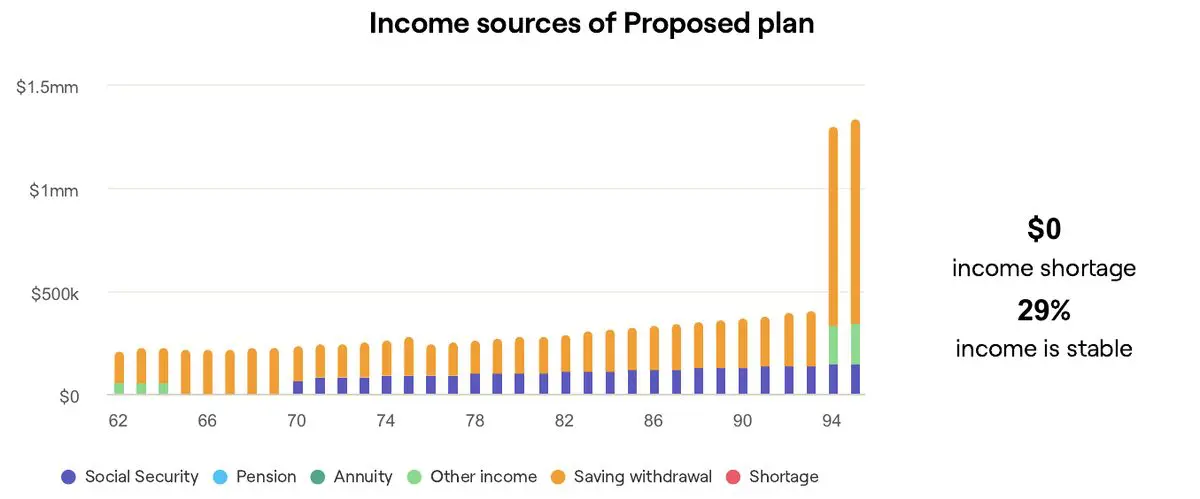
We tested the plan in RightCapital across 1,000 market paths, in today’s dollars: living costs of $84,000 a year plus about $20,400 of property tax and home insurance once the mortgage is paid off; $20,000 of travel to 75; marketplace health coverage at $13,000 a year until Medicare, then Medicare with a Medigap policy; Social Security at 70; the deferred compensation paid in five installments from 67; three years of consulting; a hybrid long-term care policy; and two years of nursing-home care at the end of the plan at $129,575 a year, the 2025 national median for a private room, rising with medical inflation. The number to read is the share of paths in which the money outlasts Elena at 95.

PathWorks in aboutMedian assets at 95What it depends on
Retire at 60, default tax approach48 of 100about $0Five bridge years funded from savings before Medicare and the first installment at 65, and the two care years at the end with little left for them.
Retire at 60, with the tax strategy50 of 100$0.1MThe same date with the Roth conversions and withdrawal order below. Better, and still a coin flip.
Retire at 62, default tax approach62 of 100$2.2MTwo more years of salary and saving, and two fewer years of drawing down.
Retire at 62, with this plan64 of 100$2.4MThe same date with the tax strategy. The extra points are small; the larger effect is about $458,000 more after tax at 95.
What this means. The retirement date moves this outcome more than anything else in the plan: 14 points, against about 2 points for the whole tax strategy. Elena can still choose 60. The plan’s job is to show what it costs, which is margin in the care years, so the choice is made with the number in front of her. At this spending we would not recommend 60. In the paths that go badly, the levers are the same ones: travel trimmed in a poor market, the consulting years extended, and the house, which this plan never sells, still there as a last reserve.

Illustrative results from planning software using the stated assumptions. All four paths include the consulting income, the deferred compensation installments, the hybrid care policy, Social Security at 70, and the care years. The installments follow the retirement date: they start at 65 in the two paths that leave at 60, and at 67 in the two that leave at 62, five years after the originally scheduled lump-sum date in each case. The projections include Align’s advisory fee on the accounts we manage and the fund costs of the model portfolios, as set in the software. Median assets are in future dollars. Probabilities are not predictions and will change with markets, tax law, spending, and health.
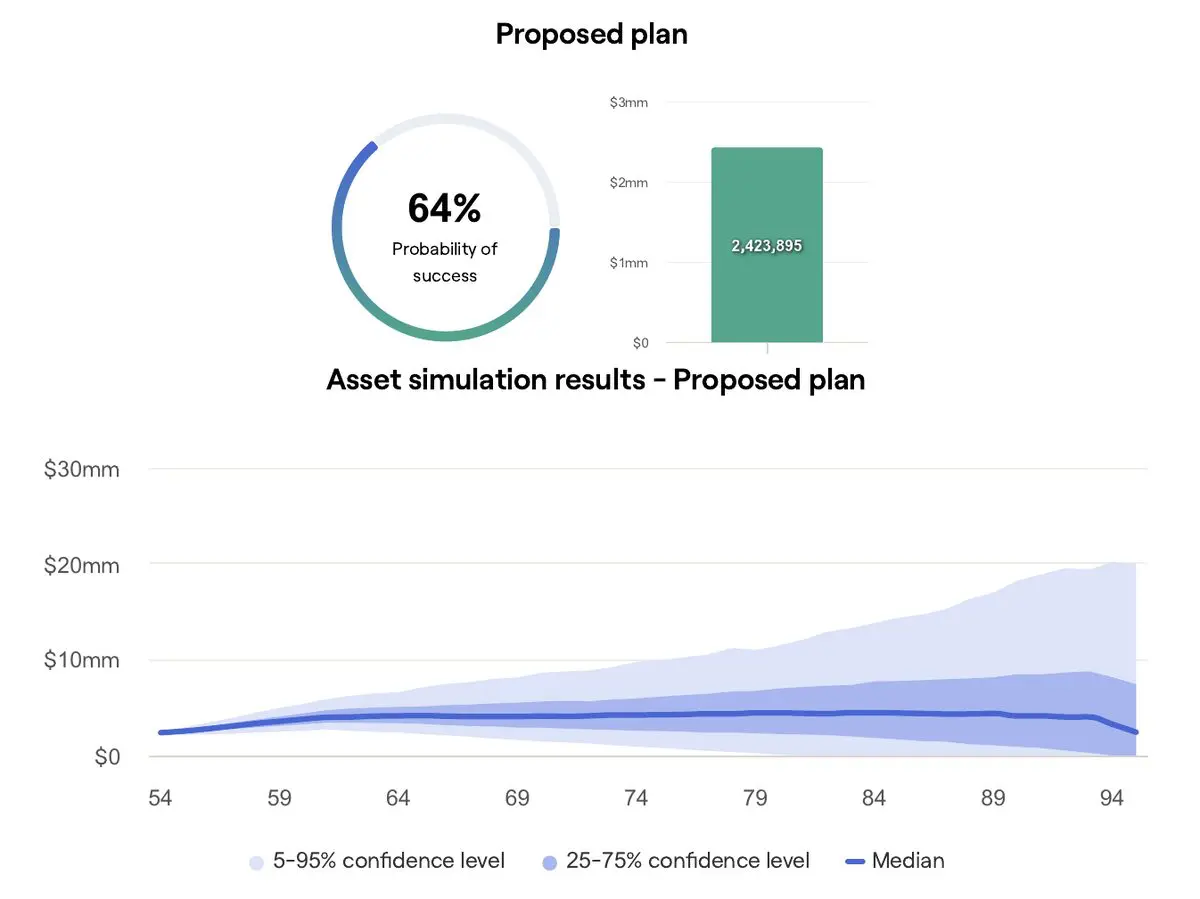
RightCapital screen: Probability of successRightCapital retirement analysis: 64% probability of success for the proposed plan, retiring at 62 with the tax strategyProposed plan: retire at 62 with the tax strategy. Median ending assets at 95 in future dollars, and the range of outcomes across 1,000 market paths.
DECISION 1

Retiring at 62: what the bridge years cost, and what 60 would have cost.

Elena’s last paycheck comes at the end of 2032, just before she turns 62. Between then and Medicare at 65 there are three years to fund from savings, with no Social Security, no deferred compensation (by design; see the deferred compensation section), and no second income beyond the part-time consulting she is willing to do. This is the most expensive stretch of the plan, and it is where a single woman’s plan needs more margin than a couple’s: there is nothing to fall back on if the market is poor in year one.

What the first bridge year costs

Age 62, from the softwareToday’s dollarsNote
Living costs$84,000Everything except housing, health, and travel
Property tax and home insurance$20,400The mortgage ends at 61, the year before she retires
Travel, go-go years$20,000Falls away in the plan after 75
Health coverage, before Medicare$14,900$13,000 at today’s marketplace prices, grown at medical inflation. At her income there is no premium credit
Long-term care policy premium$6,100$7,500 a year, fixed, last paid at 64
Federal and New Jersey income tax, and self-employment tax$18,400Includes the tax on that year’s Roth conversion and capital gains, and about $5,700 of self-employment tax on the consulting income
Less consulting income($40,000)Three years of part-time work, ages 62 to 64
Drawn from savings that year$123,800About 3.8% of the roughly $3.3 million (today’s dollars) the software projects at 62, taxes included. The software draws it from the brokerage account first, so the IRA keeps compounding. The software also pays health costs from the HSA, about $18,000 that year in its own dollars. In practice the HSA pays only qualified costs, and marketplace premiums generally do not qualify, so that part would come from the brokerage account. The expense is the same, but selling brokerage shares can realize gains and raise the income that sets Medicare premiums, so taxes and later balances would differ somewhat

Where each year comes from

YearAgeFunded byWhy that source
162Consulting income, the $60,000 moved to Treasuries now, and the first tranche of the employer stock sell-downIdle cash, and shares we want out of anyway
263Consulting income, the remaining proceeds of the employer stock sell-down, then the brokerage accountHighest-basis lots first, so the capital gains tax is small
364Consulting income and the brokerage accountBasis of $330,000 means much of it comes out untaxed, which leaves room for conversions at 12%
4 to 565 to 66Brokerage accountMedicare replaces the marketplace premium; the consulting income has ended, so these are the largest conversion years
6 to 867 to 69Deferred compensation installments, about $74,000 to $81,000 a year, with the brokerage account covering the restThe installments arrive as the bridge closes
9 to 1070 to 71The last two installments and the first Social Security checksThe two incomes overlap for two years
11 onward72 plusSocial Security, $4,464 a month in 2026 terms, the brokerage account until it is spent, then the IRA and the Roth in proportionThe larger check, adjusted for inflation each year, carries the late years; required withdrawals begin at 75
The 60 alternative. Leaving at 60 adds two bridge years and removes two years of salary and saving. In the software that is the difference between 64 of 100 and 50 of 100 with the same tax strategy, and 48 of 100 without it. The brokerage account can carry the early years either way; the gap shows up at the end, in the care years, where the extra margin is gone. That is the reason we recommend 62, and it is still Elena’s call.
RightCapital screen: Income sources by age, proposed planRightCapital income sources by age for the Elena sample plan: consulting at 62 to 64, Social Security from 70, withdrawals from savings, and two long-term care years at 94 and 95Consulting income at 62 to 64 (green), Social Security from 70 (purple), and withdrawals from savings (orange), which in the software include the deferred compensation installments at 67 to 71. The two tall bars at 94 and 95 are the care years the plan is built to survive.
DECISION 2

The deferred compensation election: one form, filed this year, turns one large tax year into five smaller ones.

Elena’s nonqualified deferred compensation account is $220,000 today. In the software it stays invested and grows about 4% a year, which puts it near $300,000 when she leaves at the end of 2032. Her election on file says lump sum at separation, and in this illustration the plan pays it in January of the year after separation. That makes the original payment date January 2033: the whole balance is paid and taxed as wages that year, on top of her consulting income.

The lump sum in 2033, single filer, simplified at 2026 thresholdsAmount
Consulting income that year$40,000
Deferred compensation paid that year$300,000
Taxable income, after the standard deduction$323,900
Federal tax that yearabout $82,000
Of which caused by the deferred compensationabout $80,000
Average federal rate on the deferred compensationabout 27%
Rate on the last dollars35%

With five installments instead, the account keeps growing to 67 and the software pays out the remaining balance over five years: about $74,000 in the first year rising to about $87,000 in the fifth, about $404,000 in all. From 67 to 69 the installments sit in the 10% and 12% brackets, and the Roth conversions are cut back to make room for them. At 70 and 71, once Social Security starts, part of each installment is taxed at 22%. In this projection, spreading the payments lowers the federal tax on the deferred compensation and keeps 2033 from becoming the highest-tax year of her life. The comparison depends on her other income in each payment year, so it is run again before the election is filed. New Jersey taxed the deferrals when they went in, so for the state only the growth is taxed when it is paid; the year-end projection sizes that.

The rule that makes the timing matter

Deferred compensation plans are governed by Section 409A of the tax code and by the plan’s own document, which we review before anything is filed. A change to a distribution election cannot take effect until 12 months after it is filed, and it must push the first payment at least 5 years past the original date. The delay is measured from the date the payment was scheduled, not from her last day of work. With the original payment scheduled for January 2033, a change filed now moves the first installment to January 2038 or later, the year she turns 67. Here the 5-year delay is the point.

Our recommendation. File the subsequent election in 2026: five annual installments, the first one at least five years after the originally scheduled payment. The rule only requires it to be on file 12 months before she leaves, but filing now protects the plan if she leaves sooner than expected. Confirm with HR that the plan permits installments and a subsequent election, and get the confirmation in writing.

The lump-sum table is simplified federal arithmetic at 2026 thresholds that leaves out the self-employment deductions, for illustration. The installment figures and brackets are the software’s projection. How a real plan credits growth and sizes each installment is set by the plan document. Deferred compensation is an unsecured promise from the employer. If the company became insolvent before 2042, the balance would be at risk, which is one more reason to keep the rest of the plan from depending on it. The recommendation is provisional until we have read the plan’s subsequent-election language.

DECISION 3

Roth conversions: aim for the top of the 12% bracket in every year it is open.

We tested this in RightCapital’s tax strategy solver, which compares combinations of asset location, withdrawal order, and conversion target across the whole plan, with the deferred compensation installments in place and Medicare premiums priced from her income. The top results all set the conversion target at the top of the 12% bracket each year. That starts at 62, not 65. Consulting and investment income use the 10% bracket and, in the first year, a little of the 12%. Each year the software sizes the conversion toward the top of the 12% bracket after deductions and her other income; in some years it lands a few thousand dollars short of the top.

AgesConverted each yearWhat sets the amount
62 to 64about $35,000 to $37,000Consulting and investment income use the lower brackets; the conversion uses most of the rest of the 12%
65 to 66about $80,000 to $83,000The consulting has ended and her other ordinary income is smaller than the standard deduction, so the 10% and 12% brackets are open
67 to 69about $15,000The deferred compensation installments use most of the bracket
70 to 71$0Social Security and the last two installments push her income into the 22% bracket
72 to 74about $36,000 to $40,000Room opens again before required withdrawals
75 onward$0Required withdrawals take the room
11 yearsabout $428,000Total moved to Roth, future dollars

Why it is worth doing

The conversions are one part of the strategy. The others are where the assets sit and which account pays for each year. The strategy holds the growth assets in the taxable account and the Roth, draws the taxable account down first, and then pulls from the IRA and the Roth in proportion instead of emptying the IRA last. Against a default of spending taxable, then IRA, then Roth, with no conversions, the software’s result over the plan is:

RightCapital tax strategy, proposed against referenceResult
After-tax ending assets at 95, valuing the IRA at a 24% terminal rate$458,051 more
Federal taxes paid over the plan$288,316 less
Withdrawals taken from the IRA over the plan$1,189,296 less

Why 12% and not less: in the projection, money converted at 12% now would otherwise come out later at 22% or 24%, once Social Security and required withdrawals stack up. The cost is Medicare. Conversions plus the capital gains from the brokerage account put Elena’s income over the first Medicare surcharge line in most years from 63 to 71, which raises her Part B and Part D premiums two years later. The software prices those surcharges, and in its ranking the 12% target still comes out about $219,000 ahead at 95 of the same approach with a 10% target. The solver’s very top result spends the Roth before the IRA and comes out about $18,000 further ahead over 40 years; we kept proportional withdrawals so the Roth is still there for the care years.

The three rules

  • Pay the tax from the brokerage account, not the IRA. Every dollar of tax paid from outside the IRA is a dollar that stays in the Roth.
  • Convert in December, after the year’s other income is known. We size it once, at year end, with the tax projection in front of us.
  • Cross the Medicare line on purpose, not by accident. A conversion that crosses a surcharge tier by a dollar costs a full year of higher Part B and Part D premiums two years later, so each year we check where the tiers fall before choosing the amount.

Federal brackets shown. New Jersey taxes conversions as income and does not tax Social Security. Its retirement income exclusion is reduced when New Jersey total income is above $100,000 and is not available above $150,000; we check eligibility each year, using New Jersey income rather than the federal figures. The state cost is sized in the year-end projection. Thresholds are 2026 figures and index each year; the conversion amounts above are the software’s future-dollar figures, rounded.
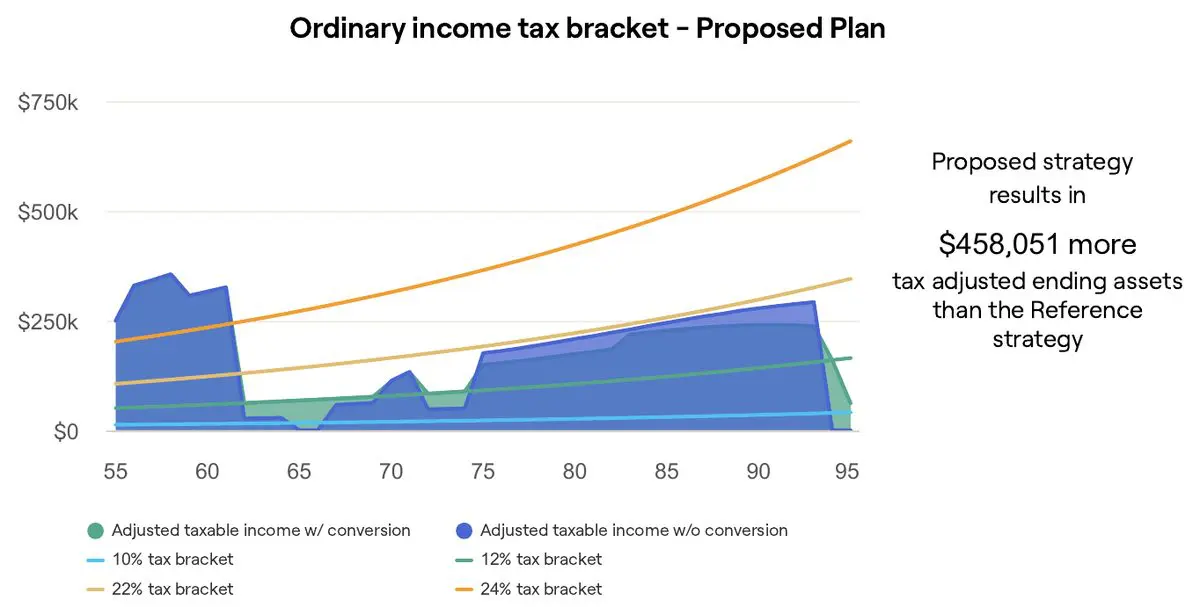
RightCapital screen: Roth conversions and taxable income by age, proposed planRightCapital tax strategy chart for the Elena sample plan, showing taxable income with and without Roth conversions against the federal tax bracketsTaxable income with conversions, against the federal brackets. The conversions bring income close to the top of the 12% bracket from 62 to 66, shrink while the installments are paid, stop at 70, and return briefly at 72 to 74.
DECISIONS 4 AND 5

Employer stock, and the one Social Security check.

Employer stock: 16% of everything, from the company that also pays the salary

Elena holds $210,000 of vested shares and has $210,000 more vesting over three years, about 16% of her investable assets counting the unvested shares (about 9% counting vested shares alone), on top of a salary, a bonus, and a deferred compensation account that all depend on the same employer. If the stock falls 40% in the year she retires, the bridge gets funded from a smaller pool at the worst time. No view on the company is needed to see it.

LotValueBasisGainAction
2024 and 2025 vests$90,000$84,000$6,000Sell first: almost no tax
2021 to 2023 vests$80,000$44,000$36,000Sell across two tax years
2018 to 2020 vests$40,000$12,000$28,000Do not sell. Give to a donor-advised fund in 2032, her last year of salary
Vests in 2027, 2028, 2029$70,000 eachat vestnilSell at vest. Set aside the withholding gap: the employer withholds 22%, Elena’s marginal rate is 32% to 35%, so each vest leaves $7,000 to $9,000 of federal tax under-withheld, which we cover with extra withholding or an estimated payment that year

The gift does two things at once. It gives a deduction of about $38,000 in a 35% year: the full $40,000 less the floor of 0.5% of income that applies to charitable deductions from 2026, assuming about $400,000 of income that year. And nobody ever pays tax on the $28,000 gain. The fund then makes Elena’s annual gifts for the next several years, which is money she was giving anyway, now given with appreciated shares instead of cash. After the sell-down, employer stock is held to 10% or less of investable assets, counting unvested shares, and reviewed each spring.

Social Security: wait until 70, and the reason why

Elena’s benefit at full retirement age is about $3,600 a month. For a married couple we spend a page on which check should wait, because one of them becomes the survivor’s income. Elena has one check and no survivor, so the question is simpler: the risk her plan cannot diversify away is a long life, and the larger check is lifetime income, adjusted for inflation, that she cannot outlive.

Claim atMonthly check, today’s dollarsAnnualWhat it means for the plan
62$2,520$30,240Locks in 70% for life. Every later year of the plan is funded more from the portfolio and less from the check
67$3,600$43,200The baseline
70$4,464$53,568124% for life, adjusted for inflation each year, and New Jersey does not tax it

Waiting is affordable because of the sequencing in Decision 1: the bridge is funded from consulting and taxable money to 64, the brokerage account and the deferred compensation installments carry 65 to 71, and the check starts at 70 at its maximum. If Elena’s health picture changed materially, the break-even math would be rerun with her, not assumed. Until then, the plan waits.

Benefit estimates from Elena’s Social Security statement, in 2026 terms, assuming full retirement age 67. The software raises the check 2.5% a year against 3% general inflation, so in its projection the check loses a little purchasing power over time.

PROTECTION AND THE SOLO-AGING PLAN

Four things we found in the documents, and one decision no one had made.

1. The 401(k) beneficiary is Elena’s mother, and the contingent line is blank

The designation is from 2009. Her mother is 84 and in assisted living. If nothing changes, $1.2 million could pass to her mother outright, or, if her mother dies first, under the plan’s default rules, which for a single participant often means Elena’s own estate and probate. Fix: her sister as primary and the two nieces as contingents, on the 401(k), both Roth accounts, and the brokerage account by transfer-on-death. The HSA is the one account not to leave to them: a non-spouse beneficiary owes tax on the whole balance in a single year, so it is spent in Elena’s lifetime on qualified health costs, and any remainder goes to a charity. Thirty minutes online. We send the screens.

2. Nobody holds Elena’s power of attorney

Elena holds her mother’s. No one holds hers. For a single woman this is one of the most important documents in the plan, because there is no spouse who would naturally step in, and without a signed document a court may have to appoint someone. Fix: a durable financial power of attorney and a proxy directive for health care, with her sister named first and a professional fiduciary named as successor, so the plan does not depend on a sister who is 61 and may one day need her own. We have prepared the questions for the attorney meeting.

3. The umbrella policy is $1 million against a $3.1 million balance sheet

Retirement accounts have strong creditor protection in New Jersey; the brokerage account, the cash, and the house do not. Counting the brokerage account, the employer stock, the cash, and the equity in the house, about $1.5 million is exposed. The deferred compensation is exposed differently: to the employer’s creditors, not hers. Fix: raise the umbrella to $2 million and confirm the auto and homeowners liability limits meet the umbrella’s minimums. The premium difference is usually modest.

4. Disability coverage ends the day she leaves, and there is no long-term care plan

Group disability is fine until 62 and irrelevant after. Long-term care is the decision no one had made, and for a single woman it matters more: there is no spouse to coordinate care or provide some of it at home. Fix, decided on paper now: build a care reserve inside the Roth equal to two years of care, about $260,000 in today’s dollars. The Roth holds $155,000 today, so this is a target, not money already set aside: Roth 401(k) contributions until she retires and the first conversions are projected to bring the Roth to that level around retirement, depending on markets. Once the taxable account is spent, withdrawals come from the IRA and the Roth in proportion, which does not protect the reserve on its own, so each spring we compare the Roth with the target and change the withdrawal mix if it falls short. Second, get one quote on a hybrid life and long-term care policy in early 2027, so the choice between self-funding and insuring is made with a real premium and real terms in front of us. A policy can be a good fit for a single woman because many include care coordination, which is what a spouse would otherwise do, but the answer depends on the actual benefit, inflation protection, and underwriting. In the plan we modeled a representative policy as if bought in 2026, with ten premiums of $7,500 through 2035, when she is 64, and a care benefit of $164 a day, about $60,000 a year, rising 3% a year. The software counts it as covering about 22% of two years of nursing-home care at 94 and 95; the rest comes from savings. The quote replaces these illustrative terms. Two more modeling choices matter: the model keeps paying her normal living costs during those two years and does not sell the house, which adds cost; and it uses the national median care cost, while New Jersey costs run higher, which would add cost too. The reserve is reviewed every spring for both reasons.
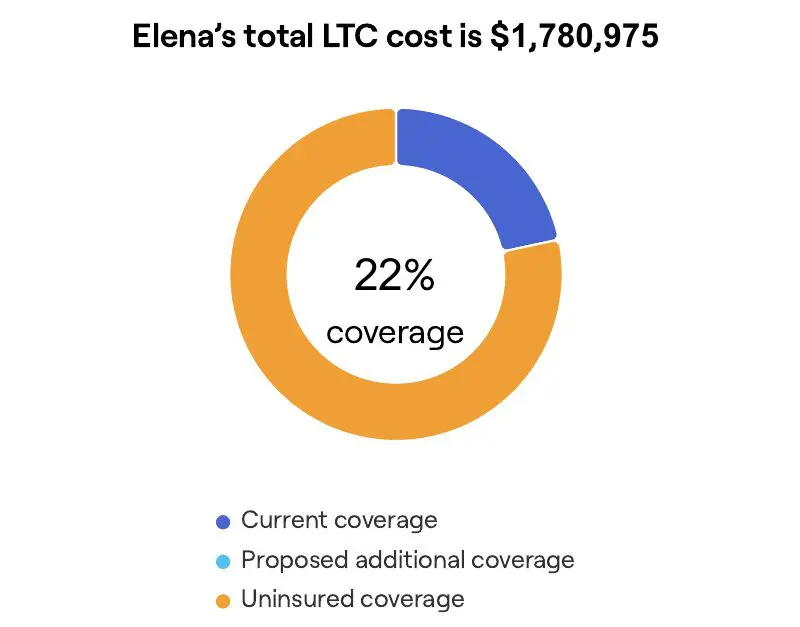
RightCapital screen: What two years of care does to the planRightCapital long-term care analysis for the Elena sample plan: total care cost and the share covered by the modeled hybrid policyTwo years of nursing-home care at 94 and 95 cost about $1.78 million in future dollars; the modeled policy covers 22%. The gap is why the care decision gets made now, on paper, and why the extra two years of salary matter.

Insurance that can go, and insurance that stays

PolicyFindingAction
Group life, 2x salaryEnds at separation. No dependents; the plan does not need it.Let it lapse. Do not convert.
Group disabilityEnds at separation by design.No action.
HomeownersDwelling coverage $520,000 against a rebuild estimate near $640,000.Raise dwelling coverage. Ask about extended replacement cost.
Her mother’s careFunded from her mother’s own assets for about 6 more years at current cost.Keep the two balance sheets separate. Review her mother’s plan with the facility annually; Elena’s plan does not assume she pays for it, and should not.

New Jersey inheritance tax. Transfers to a sister are taxed above $25,000 at 11% to 16%, and to nieces at 15% to 16%, and retirement accounts payable to them are not exempt. A Roth left to the nieces is tax-free federally but not free of this tax. It belongs on the agenda for the attorney meeting, alongside the question of charitable beneficiaries.

THE ACTION LIST

Who does what, and when.

Items are in order of deadline, not importance. Where Align is named, we do it; where Elena is named, we have prepared the screens, the wording, or the questions so it takes minutes rather than an afternoon.

Before December 31, 2026

  1. ELENA File the deferred compensation subsequent election: five annual installments, the first at least five years after the originally scheduled payment date, after we have reviewed the plan document. Get HR’s written confirmation that the plan permits it. It has to be on file at least 12 months before she leaves to count.
  2. ELENA Update beneficiaries on the 401(k), Roth 401(k), and Roth IRA; add transfer-on-death to the brokerage account; name a charity on the HSA. Sister primary, nieces contingent. We send the screens.
  3. ALIGN Move $60,000 of savings to a Treasury money market fund. Year-end tax projection in Holistiplan, including the 2026 RSU withholding gap; estimated payment due January 15.

First quarter 2027

  1. ELENA Estate attorney meeting: durable power of attorney and health care proxy with a professional successor, updated will, and whether a revocable trust is worth it for the house. Questions attached.
  2. ALIGN Sell the 2024 and 2025 RSU lots ($90,000, about $6,000 of gain). Sell the March 2027 vest at vest.
  3. ELENA Insurance agent: umbrella to $2 million, dwelling coverage to $640,000, confirm underlying limits. Request one hybrid long-term care quote; the plan is rerun with the real premium and terms in place of the illustrative policy. Questions attached.

2027 to 2032

  1. ALIGN Sell the 2021 to 2023 lots across two tax years. Open the donor-advised fund in 2032, her last year of salary, and gift the 2018 to 2020 lot.
  2. ELENA Decide whether the three years of consulting after 62 are real. The plan assumes $40,000 a year; if it is not going to happen, we rerun the retirement date with that removed.
  3. ALIGN Spring and fall reviews: employer stock against the 10% ceiling, spending against plan, the long-term care decision once the quote is in, and the retirement date with fresh numbers each spring.

At retirement, end of 2032

  1. ELENA, WITH ALIGN Last paycheck at the end of 2032, just before she turns 62. Roll the 401(k) to an IRA; consolidate the Roth accounts. Enroll in marketplace coverage. Dividends to cash. Roth conversions start in 2033; each December we size them in the software with that year’s income in front of us.

What we need from Elena

  • The deferred compensation plan document and her current election form. The deferred compensation recommendation is provisional until we have read the subsequent-election language.
  • Her most recent Social Security statement from ssa.gov, so the Social Security figures are current.
  • The RSU grant agreements, for the treatment of unvested shares at retirement.
  • Her sister’s agreement to serve as agent under the power of attorney, and the name of a professional fiduciary she would be comfortable with as successor.
ASSUMPTIONS AND DISCLOSURES

What the numbers rest on.

AssumptionValue used
Investment growthRightCapital’s standard return assumptions by asset class; 1,000 randomized market paths for the “works in about” figures
CostsAlign’s advisory fee on the accounts we manage and the fund costs of the model portfolios, as set in the software
Portfolio mixAbout 60% stocks and 40% bonds overall, with the growth assets held first in the taxable account, then the Roth, then the IRA
Deferred compensationInvested in the software at about 4% a year; five annual installments from 67 (from 65 in the paths that retire at 60), each the remaining balance divided by the years left, about $74,000 to $87,000 a year. The lump-sum comparison uses the software’s balance at separation, about $300,000, and simplified 2026 federal arithmetic
Inflation3% general; 5% for health and long-term care costs; Social Security adjusted at 2.5%
Spending$84,000 a year of living costs plus property tax and home insurance (about $20,400 once the mortgage ends at 61), and $20,000 of travel from retirement to 75, in today’s dollars
Health coverage$13,000 a year of marketplace coverage, today’s prices, from retirement to 65, with no premium credit; then Medicare Part B and Part D with a Medigap policy, premiums estimated from her income, surcharges included. In practice the HSA is used only for qualified costs, which include Medicare Part B and Part D premiums but not marketplace or Medigap premiums
Part-time income$40,000 a year of consulting, today’s dollars, for three years after the last paycheck at the end of 2032
Long-term careTwo years of nursing-home care at 94 and 95 at $129,575 a year in today’s dollars, the 2025 national median for a private room (CareScout), rising with health inflation; normal living costs continue and the house is not sold; an illustrative hybrid policy, modeled as bought in 2026 with ten $7,500 premiums and a $164 daily benefit rising 3% a year, covers about 22% of the cost
Tax strategyGrowth assets in taxable and Roth accounts first; taxable account drawn first, then the IRA and the Roth in proportion; Roth conversions to the top of the 12% bracket from the 401(k) and IRA only; IRA valued at a 24% terminal rate
Tax thresholds2026 federal brackets, single, standard deduction $16,100, indexed annually; New Jersey rates applied in the year-end projection
Medicare premium threshold2026 first surcharge tier at $109,000 of modified adjusted gross income, single, based on income from two years earlier, indexed in the software
Required minimum distributionsAge 75 (born after 1959)
Social SecurityStatement estimate of $3,600 a month at full retirement age 67, in 2026 terms; claimed at 70; increased 2.5% a year in the software
Deferred compensation electionSection 409A subsequent-election rules: the change takes effect 12 months after filing and must delay the first payment at least 5 years from its originally scheduled date, assumed here to be January of the year after separation; the plan document governs
Planning horizonTo age 95

How this document is used

A Wealth Blueprint™ is not a one-time report. It is reviewed each spring and fall, and every item on the action list is re-checked against the calendar and the latest statements. Numbers on this page change as markets, tax law, and life move; the reasoning is meant to hold.

Important. All content is for information purposes only. It is not intended to provide any tax or legal advice or provide the basis for any financial decisions. Nor is it intended to be a projection of current or future performance or indication or future results. The information provided is not based on actual current or past clients. All situations are unique, and results will differ depending on individual situation.

Elena is a hypothetical composite created to illustrate the structure and content of a Wealth Blueprint™. She is not a client of Align Financial Solutions LLC, and no part of this document describes an actual client, actual results, or actual recommendations. All figures, including account values, tax calculations, benefit estimates, insurance findings, and probability-of-success results, are illustrative and depend on the assumptions shown. Software screens are from a hypothetical household built in RightCapital for this illustration. Deferred compensation rules depend on the terms of each plan. Align Financial Solutions LLC is a registered investment adviser in the State of New Jersey. Registration does not imply a certain level of skill or training. Advisory services are provided only under a written agreement, and any recommendation for an actual client is based on that client’s complete information. Consult a qualified professional about your own situation. CFP Board owns the marks CFP® and CERTIFIED FINANCIAL PLANNER® in the U.S., which it authorizes use of by individuals who successfully complete CFP Board’s initial and ongoing certification requirements.

Questions about the sample plan

No. Elena is a hypothetical composite built to illustrate a common situation, a single woman in her mid-50s with employer stock, deferred compensation, and a retirement date in mind. No part of the plan describes an actual client, and the figures are illustrative.

The projections and the 1,000-path testing are built in RightCapital, including the tax strategy solver that sized the Roth conversions. The year-end tax projections that set each conversion are run in Holistiplan. The plan you read is the translation: what the numbers mean, what we recommend, and why, in plain language.

The structure is the same for every client: where things stand, the map, the decisions in front of you, protection, and the action list. What fills it is scoped to your situation. A married couple’s plan, for example, adds survivor and joint-filing analysis that Elena’s does not need.

Start with a 15-minute Align Call. You tell us what you are trying to decide, we tell you plainly whether Align is the right advice team for you, and you leave with your best next step either way.

See what your own plan would look like

Tell us what you are trying to decide. On a 15-minute call we will tell you whether Align is the right advice team for you and what a plan built around your decisions would cover.