

Written by Hazel Secco, CFP®, CDFA®
Estimated reading time: 18 minutes
🎧 Prefer to watch or listen? This Align Your Retirement episode walks through all three versions of the plan on screen.
Table of contents
- Clare and Dan’s numbers
- What delaying Social Security to 70 did on its own
- Social Security at 62 vs 67 vs 70: what the delay buys a couple
- The one change: Roth conversions in the empty years
- What changes after the conversion window closes
- What this means if most of your money is pre-tax
- What to do this week
- Frequently asked questions
- Get the Executive Women’s Retirement Tax Playbook
- Listen to the episode
- Sources
Delay Social Security to 70. It is the most repeated piece of retirement advice on the internet, and the advice is not wrong. The check you get at 70 really is much bigger than the one you get at 62. What the advice leaves out is what happens to the rest of your money while you wait.
So I modeled it for this couple, Clare and Dan, exactly as given. They came in planning to claim at 62, the way many people plan to. Delaying Social Security to 70 and changing nothing else left them with about $137,000 less at the end of the plan. Claiming earlier would not have fixed it. One more change did, and it turned the very same delay into roughly $1.5 million of improvement.
This post walks through all 3 versions of their plan with the actual software screens, so you can see why the famous advice moved their numbers in opposite directions, what the delay really buys, and what the empty years it creates are for.
Clare and Dan’s numbers
Clare is 56 and Dan is 58. Between them they earn $365,000 a year, they are saving steadily, and they want to stop on the same day, 4 years from now, when she is 60 and he is 62. They have a little over $3 million invested, spread across two 401(k)s, an IRA, a joint brokerage account, and one small tax-free account.
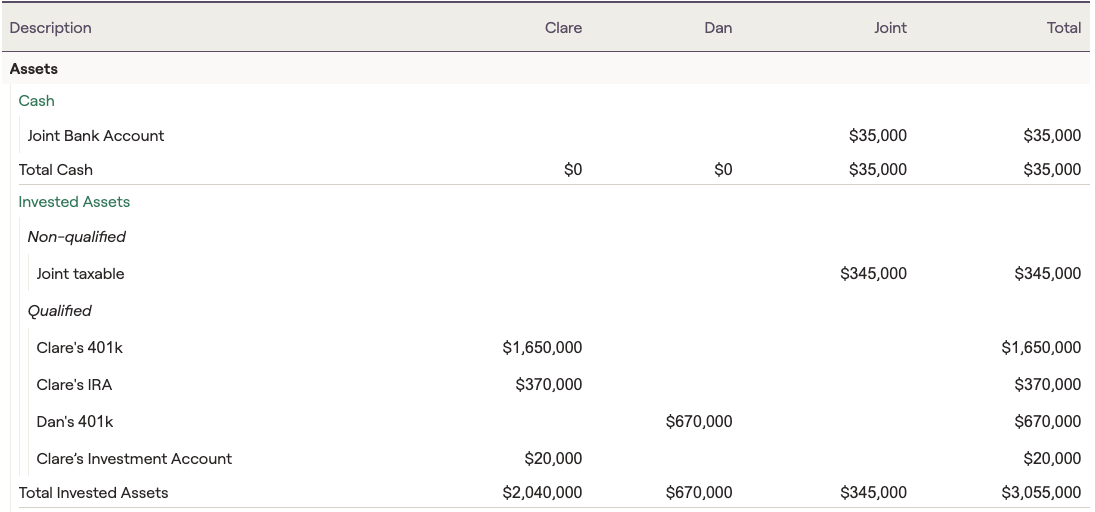
One thing to notice before anything is run, because it becomes the whole story later. Almost all of it is pre-tax. About 88% of everything they have saved sits in accounts the IRS has not touched yet. Every dollar of it will be taxed as ordinary income on the way out, either when they withdraw it, when required distributions force it out in their 70s, or when the survivor draws it alone.
Their plan as they described it: retire at 60 and 62, spend about $125,000 a year plus the mortgage, and claim Social Security at 62. I ran it forward exactly like that, with no improvements, because the baseline is what every improvement gets measured against.
2 numbers come back, and they answer different questions. The first is the probability of success, which comes from running the plan through 1,000 different market histories and counting how many never ran out of money. Their plan as described comes back at 58%. The second is what is typically left at the end, the median ending portfolio across those 1,000 paths, and for them that is about $1.1 million at 95. One number tells you how often the plan survives. The other tells you what surviving usually looks like. Keep both in mind, because they are about to disagree.
What delaying Social Security to 70 did on its own
Delaying Social Security to 70 by itself raised Clare and Dan’s probability of success from 58% to 60% and lowered their median ending portfolio from about $1.1 million to about $965,000. That is $137,000 less, from following the most repeated advice in retirement. Both numbers moved, in opposite directions, and both moves are real.
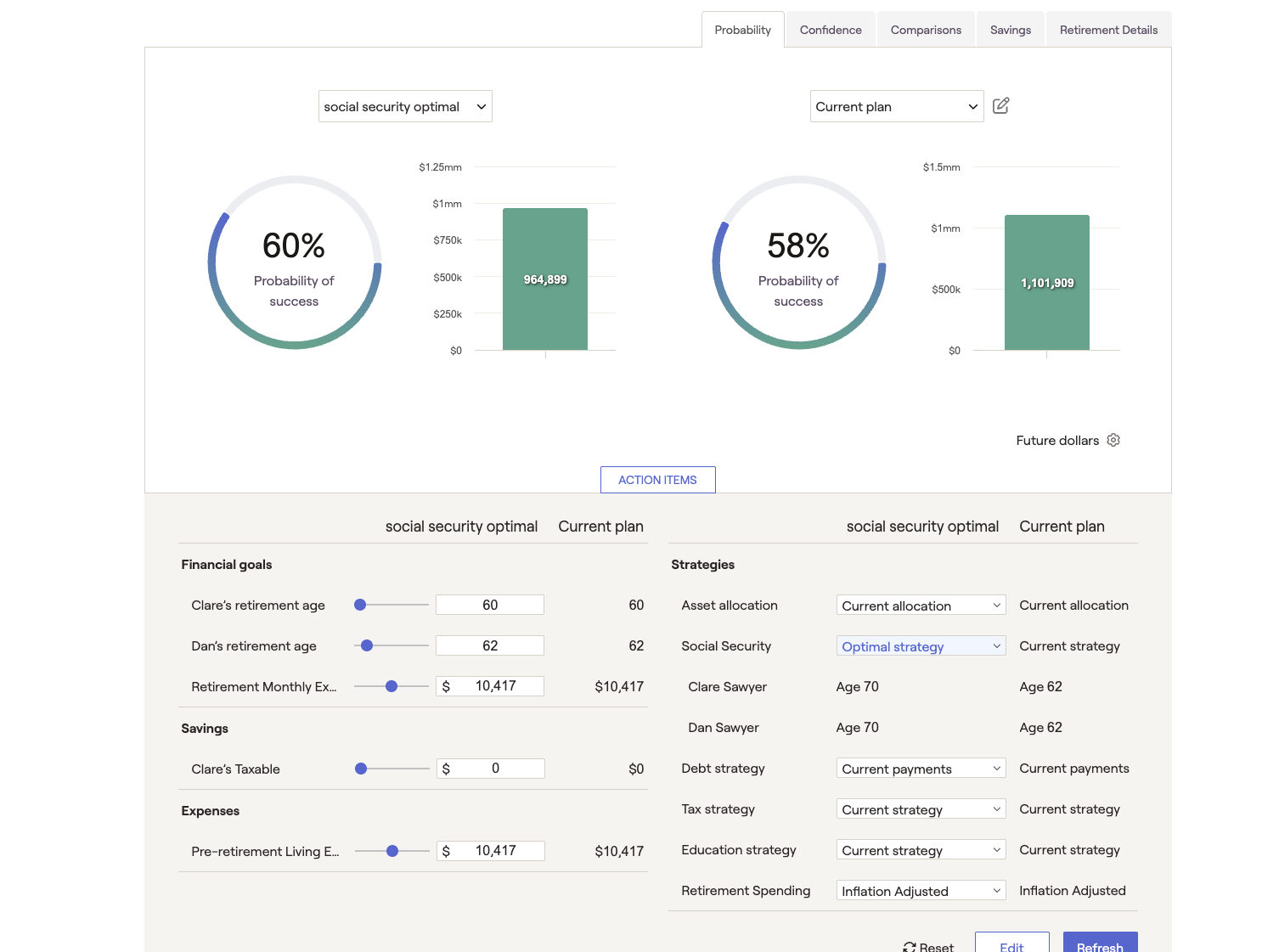
2 points of probability is a small move, closer to a nudge than a verdict, and I want to be honest about that. The dollar move is the one to understand.
When they delay to 70, there are 8 years for Dan and 10 for Clare where no Social Security arrives at all, so every dollar of their life comes out of the portfolio. They spend it down deeper and earlier, which is why the typical path ends smaller. That is the cost. But the checks that eventually arrive at 70 are much larger, they are adjusted for inflation every year, and they show up in every single one of those 1,000 futures, including the ones where the market delivers a decade of bad returns. The bigger check matters most in exactly the futures where the portfolio fails. That is why survival went up while the typical estate went down.
So the delay is not a mistake. It is a purchase. They bought insurance, and the premium came out of their estate. The software will even price that insurance: its claiming optimizer says waiting to 70 is worth about $1.27 million more in lifetime benefits than claiming at 62, over the lifetimes assumed in the plan.
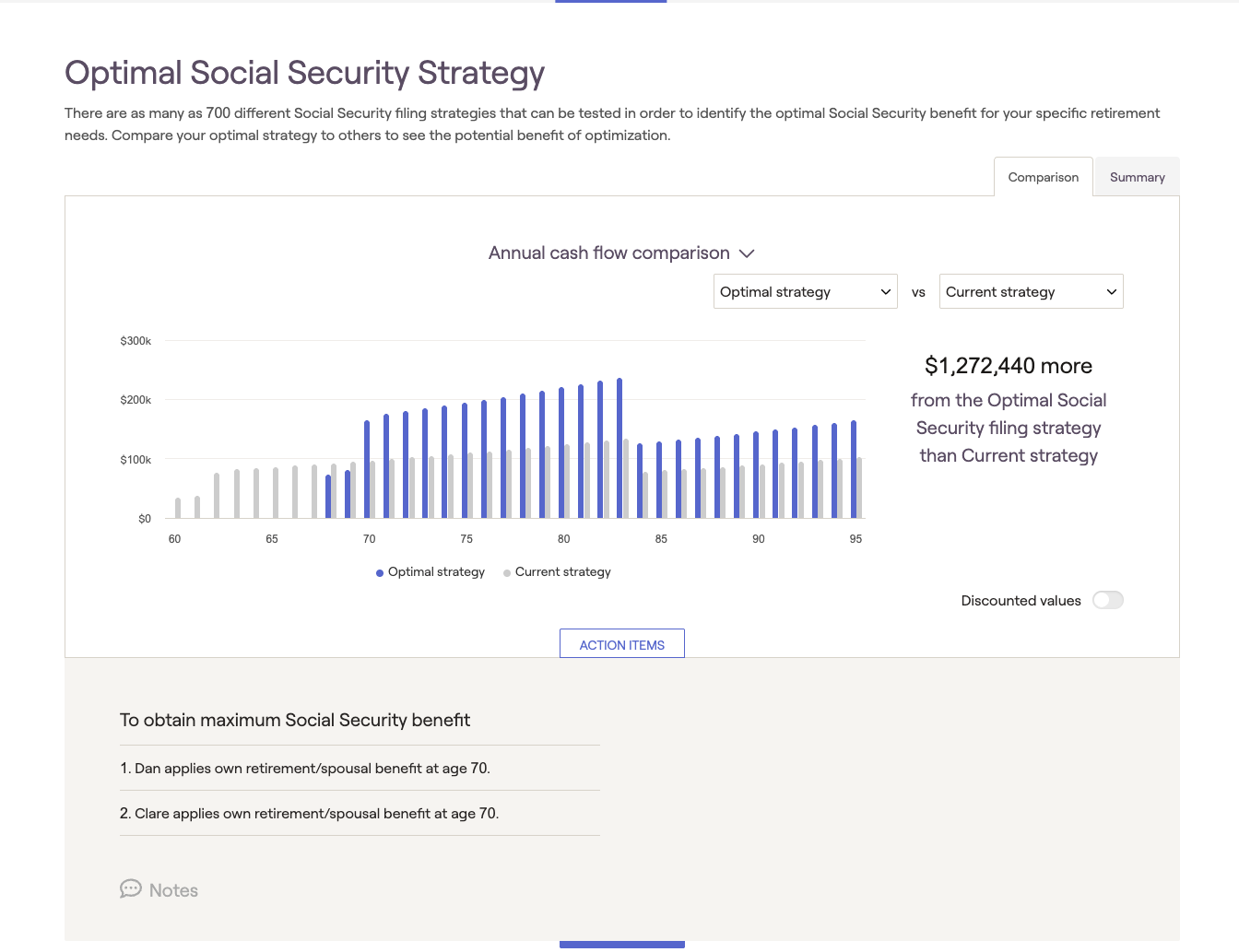
They collect more if they live long enough, and they leave a smaller estate in the typical case. Both are true at the same time, and nobody who repeats the advice mentions the second half.
Social Security at 62 vs 67 vs 70: what the delay buys a couple
For anyone born in 1960 or later, full retirement age is 67. Claiming at 62 locks in a check that is 30% smaller than the full benefit for life. Waiting past 67 adds delayed retirement credits of 8% a year until 70, where the increases stop. The table shows what that means for the same full benefit.
| Claiming age (full retirement age 67) | Share of full benefit | On a $3,000 monthly full benefit |
|---|---|---|
| 62 | 70% | $2,100 |
| 67 | 100% | $3,000 |
| 70 | 124% | $3,720 |
For a married couple there is one more layer, and it is the one that applies most directly to women. (If only one of you should wait, that is a separate question, and I covered it in Married? Only One Social Security Check Should Wait Until 70.) When one spouse dies, the survivor does not keep both checks. She keeps the larger one. Dan is older, and women on average live longer than men, so the years this insurance protects most are likely to be years Clare is managing alone.
In this plan, Dan’s years run to 85 and Clare’s run to 95, which is 12 years by herself. If they both claimed at 62, the check Clare lives on through those 12 years is about $78,000 a year. If they both waited to 70, it is about $125,000. That is $47,000 a year more, every year she is alone. That is the insurance actually paying out, and it pays out to her.
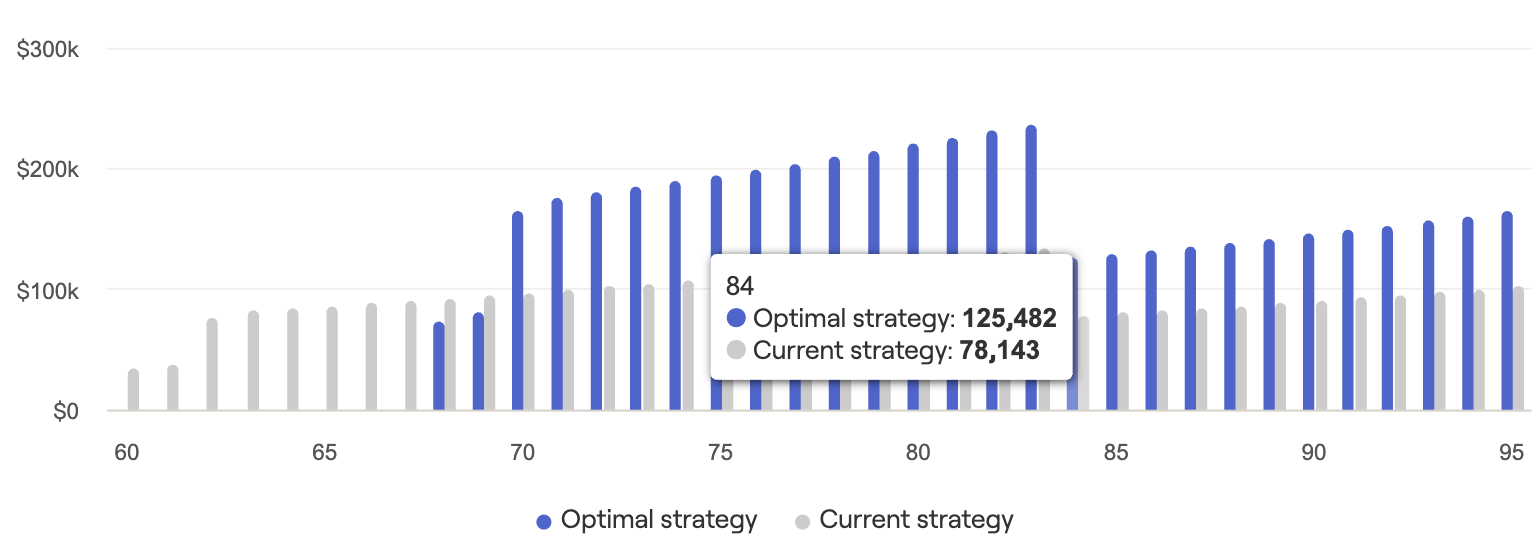
Whether that purchase is worth it depends on a question worth asking before anyone opens the software, which is what this money is actually for. If the answer is that Clare never wants to worry about a bad decade, the trade can absolutely be worth making. If part of what this money is for is also their kids, or a legacy, then $137,000 is not a rounding error either, and pretending the trade does not exist is how people end up in a plan they never chose.
Either way, the advice everyone repeats turned out to be a trade with a price on it. And the delay did one more thing that nobody was looking at.
The one change: Roth conversions in the empty years
Pairing the delay to 70 with a Roth conversion strategy raised Clare and Dan’s probability of success to 65% and their median ending portfolio to about $2.6 million, roughly $1.5 million more than the plan they walked in with, in the same life, with the same spending and the same claiming age. The delay created the empty tax years, and the conversions are what made those years pay.
Go back to the 88% problem. That pre-tax pile is sitting in the plan like a mortgage nobody wrote down. Now look at what the delay accidentally built. From retirement until 70, Clare and Dan have no paychecks and no Social Security. Their taxable income in those years is close to nothing. Those are the emptiest tax years they will ever have, and in the delay-only plan they are wasted.
So we changed one thing. Same retirement dates and spending, same delay to 70, and we added a Roth conversion strategy: move money out of the pre-tax accounts every year, fill up the 24% bracket, and stop right there. Because the delay keeps Social Security out of their income through their 60s, there is room under that line to do it.
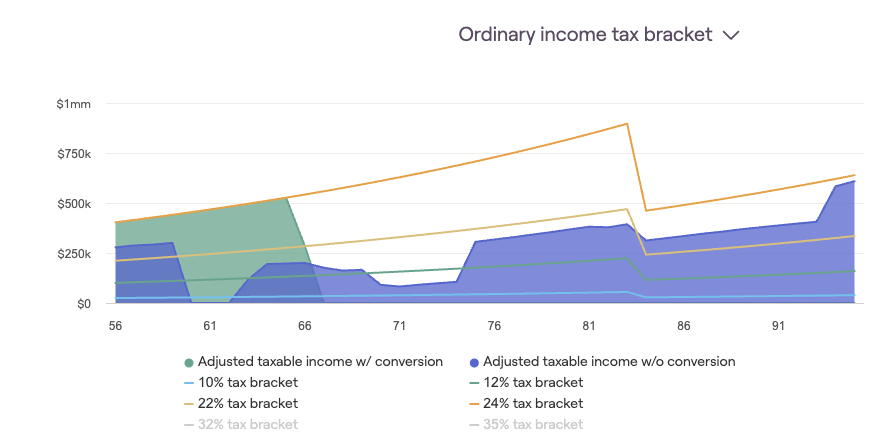
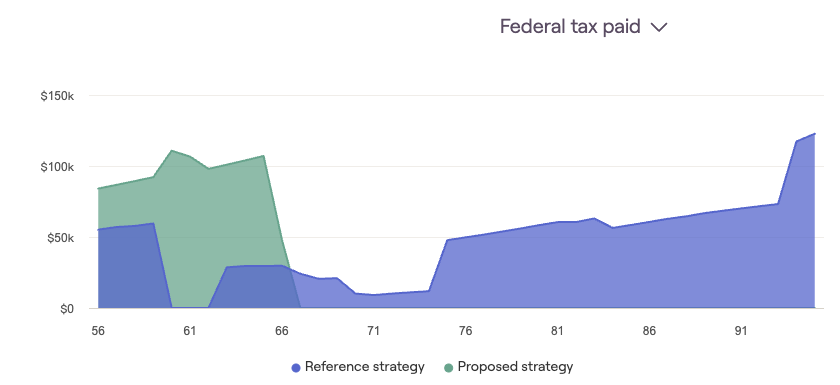
You can see the whole idea in one picture. In their model the conversions finish by the time Clare is 66, and by then the entire pre-tax balance has crossed over. This costs real money while they are doing it. Their total tax bill from now through 2036, the 4 remaining working years plus the conversion years, is about $1.4 million, close to $1 million more than the old plan pays over the same 11 years. Income that high can also raise their Medicare premiums for a few years, since the Medicare surcharge is set from your tax return 2 years earlier. Conversions are a decision to pay a smaller total bill on purpose instead of a bigger one by default.
You might wonder whether the conversions were doing all the work on their own. I ran that too: the same conversions, but claiming at 62 the way they planned. Their odds went down a little, to 56%, and the money left at the end went up only about $87,000.
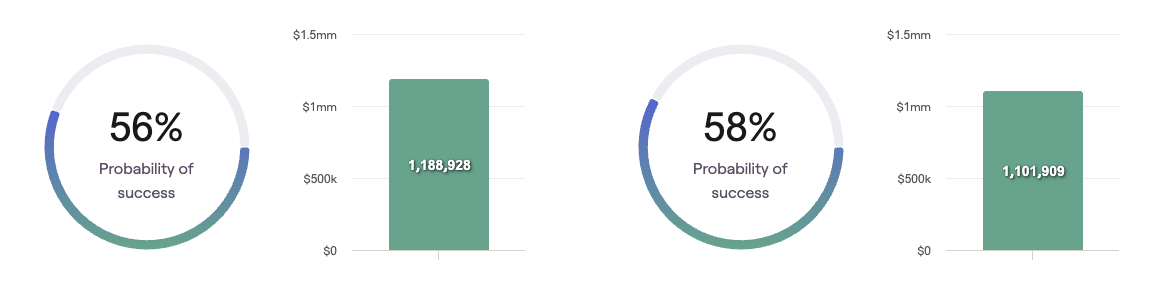
Then we put the two together.
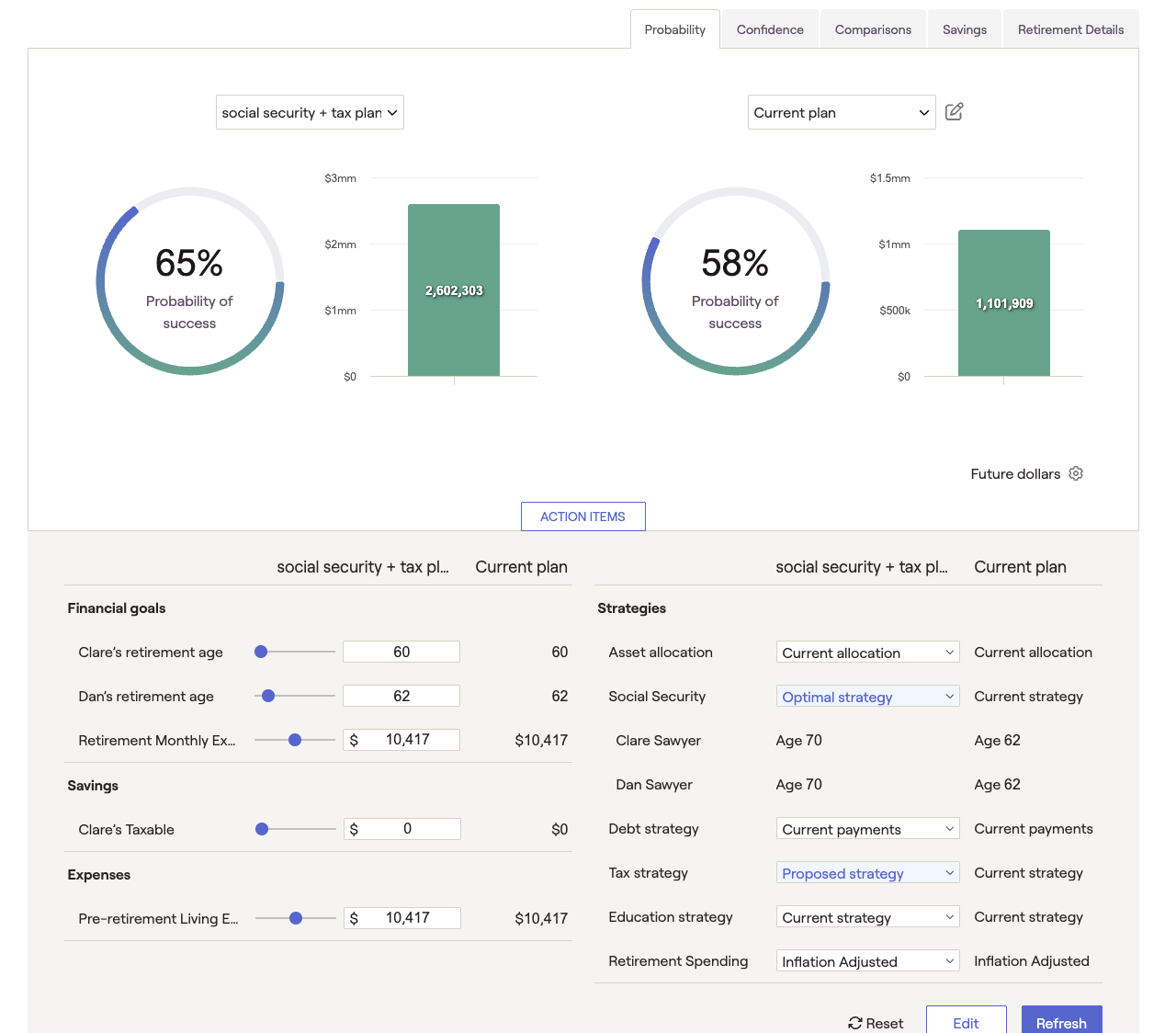
| Scenario | Probability of success | Median ending portfolio |
|---|---|---|
| Plan as described (claim at 62) | 58% | $1,101,909 |
| Delay to 70 only | 60% | $964,899 |
| Roth conversions only (claim at 62) | 56% | $1,188,928 |
| Delay to 70 plus Roth conversions | 65% | $2,602,303 |
Both numbers moved the same direction this time. On its own, the delay was a trade, security up and estate down, and reasonable people can take either side of it. Paired with the conversions, the trade went away. The same delay that had been shrinking their estate became the thing growing it.
What changes after the conversion window closes
After the window closes, the paired plan has no pre-tax balance left to tax. Required minimum distributions fall to zero, the model shows almost no income tax from 67 on (in practice some tax on Social Security benefits would remain), and over the whole plan they pay about $1 million less tax than the plan they walked in with, paid earlier, at lower rates, on purpose.
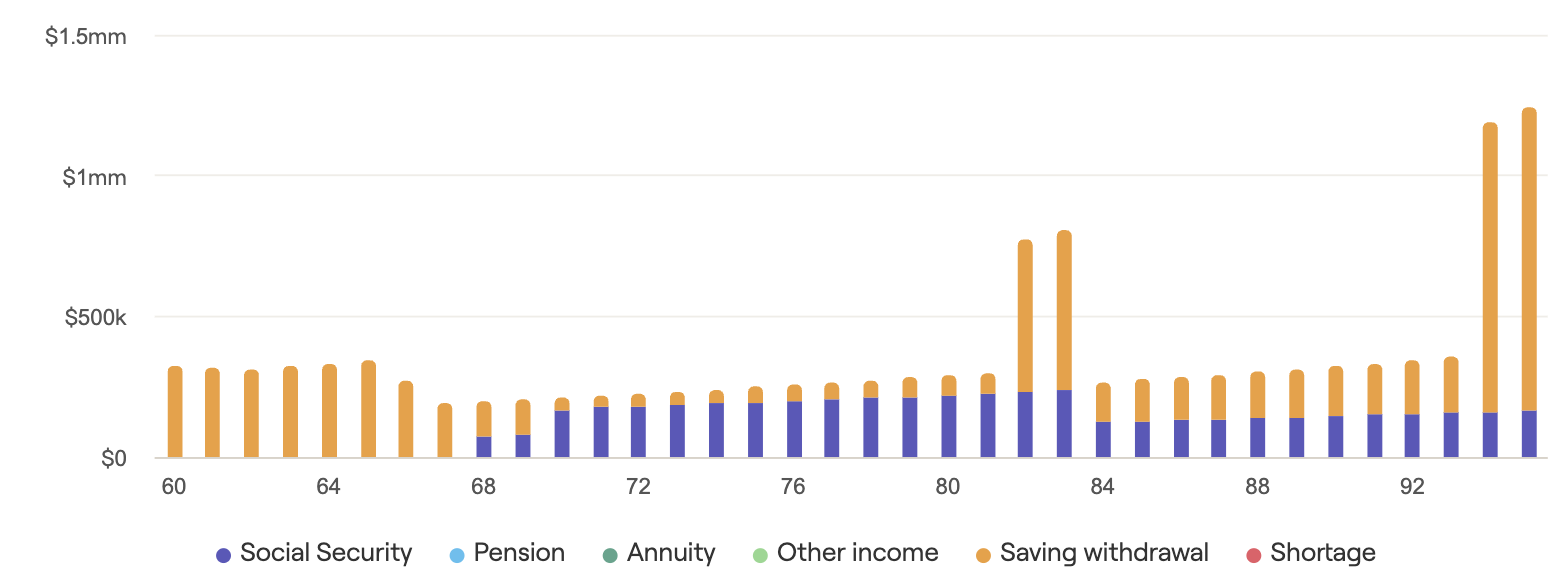
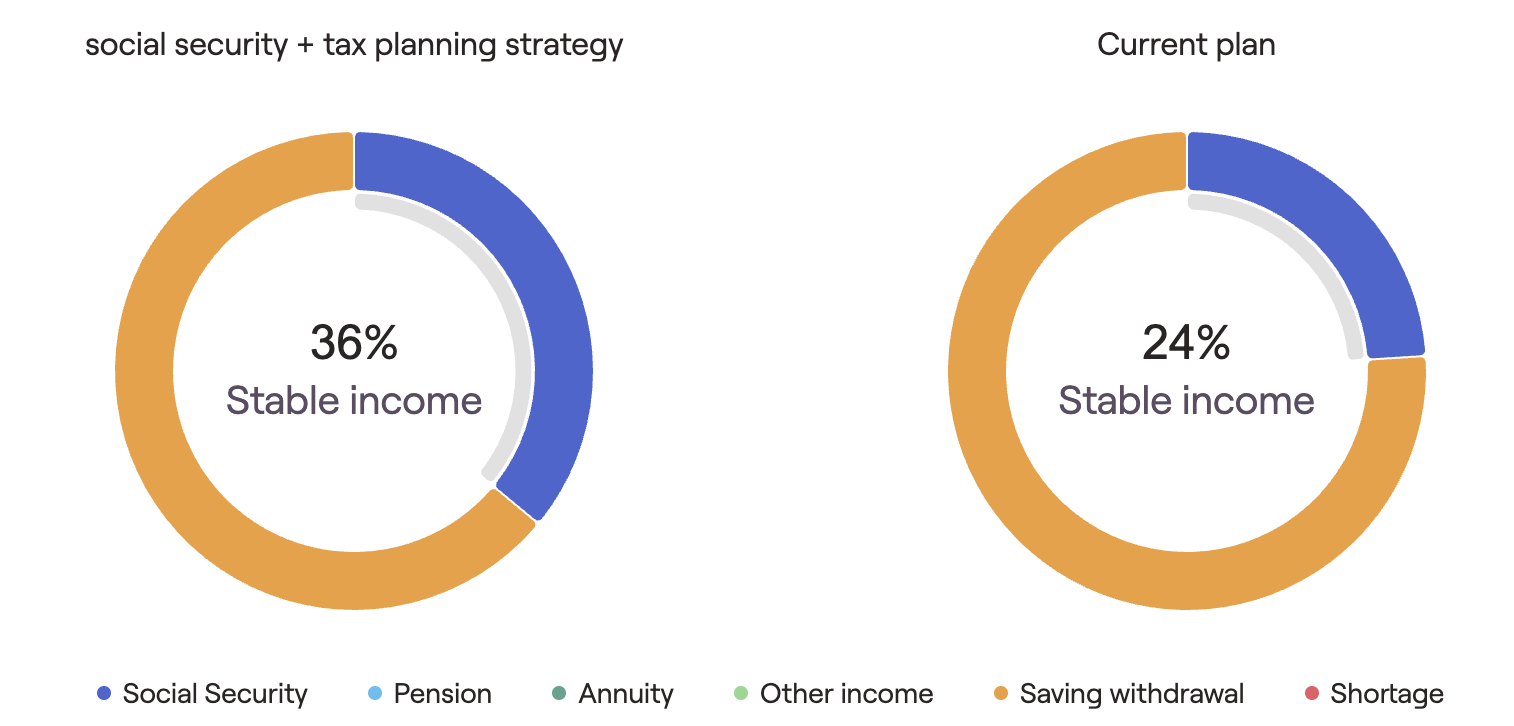
In the old plan, required withdrawals start forcing money out of the pre-tax accounts at 75 whether they need it or not, the tax bills run for life, and in the first year Clare files alone her bill is about $65,000, on her own, in the narrowest brackets. That is the widow’s penalty arriving right on schedule. In the paired plan the pre-tax balance is simply gone before any of that can happen.
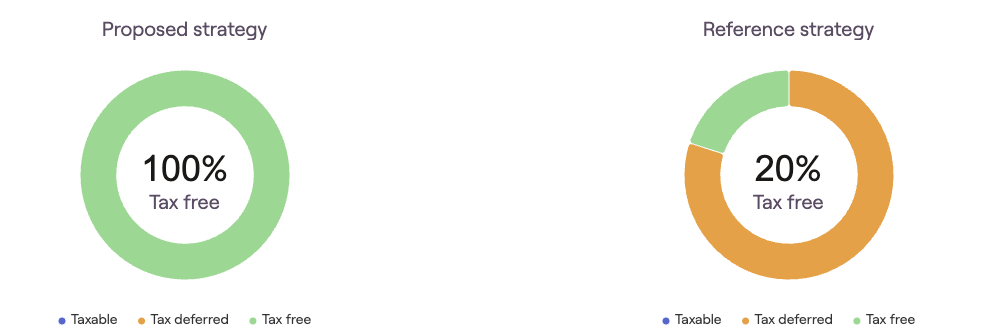
At the end of this plan, the model shows 100% of their ending wealth as tax-free. The survivor inherits tax-free accounts and the larger check instead of a tax problem and a reduced one, in the years she is filing alone.
This is a projection resting on stated assumptions about returns, inflation, and tax law, and the ending values are in future dollars. The projection will change with its assumptions. The mechanism will not. The delay creates the window. The conversions use it. Neither one finds the other on its own, and no rule of thumb or calculator can see the pair, because the pair only shows up when someone models your whole life in one place.
What this means if most of your money is pre-tax
If most of your savings sits in a 401(k) or IRA and you plan to retire before 70, the claiming decision and the Roth conversion decision belong in the same conversation. Separately, delaying Social Security costs you estate and converting costs you tax. Together, the delay produces the lowest-income years of your life, which is exactly when converting is cheapest.
Do not ask whether to claim at 62 or 70, because that question has no answer by itself. Ask why the famous advice moved the 2 numbers in opposite directions, because that is how you will know it is a trade, and whether what it buys is what your money is for. Then ask what the empty years are for, because that is the question that was worth $1.5 million here, and nobody on the internet can answer it for you. They cannot see your years.
What to do this week
Add up your pre-tax share. Total every 401(k), 403(b), and traditional IRA, and divide by everything you have invested. The higher that share, the more the empty years between retirement and 70 are worth modeling before you decide when to claim.
Count your empty years. Write down your planned retirement date and the age you expect to claim. The gap between them is your conversion window. For Clare and Dan it was 10 years for her and 8 for him.
Ask to see both numbers. If anyone has run a projection for you, ask for the probability of success and the median ending value side by side, before and after each change. A decision that moves them in opposite directions is a trade, and you should know what you are trading.
Price the survivor check. Pull both spouses’ estimates from your my Social Security accounts and compare the larger benefit at 62 with the larger benefit at 70. That difference is roughly the difference in the check the survivor keeps for the rest of her life.
Look at the next 3 tax years, not just this one. Conversions in one year can raise Medicare premiums 2 years later. Before you convert, check where your income would land against the Medicare surcharge thresholds for each of the years involved.
Frequently asked questions
Is it better to take Social Security at 62 or 70?
Neither answer is right on its own. For a full retirement age of 67, claiming at 62 pays 70% of your full benefit for life and waiting to 70 pays 124%. Delaying buys inflation-adjusted income that does not depend on markets, which matters most in bad markets and in the survivor’s years, and it costs portfolio dollars in the meantime. Which side of that trade is right depends on what the money is for and what else you do with the years before 70.
Does delaying Social Security help with Roth conversions?
Yes, and the pairing is easy to miss. Delaying keeps Social Security out of your taxable income through your 60s, which leaves room under a chosen tax bracket to convert pre-tax money to Roth at a known rate. In Clare and Dan’s model, the delay alone cost $137,000 of ending value and the conversions alone added $87,000. Together they added about $1.5 million.
How does a surviving spouse’s Social Security work?
When one spouse dies, the survivor does not keep both checks. If she already receives her own benefit, she receives the higher of the two amounts. That is why delayed credits on the larger earner’s record protect the surviving spouse: the bigger check is the one she keeps. In this case, that was the difference between about $78,000 and about $125,000 a year for Clare’s 12 years alone.
Do Roth conversions raise Medicare premiums?
They can. Medicare sets the income-related surcharge on Part B and Part D using your tax return from 2 years earlier, and a conversion counts as income in the year you do it. A large conversion at 64 can raise your premiums at 66. For a plan like Clare and Dan’s, that cost is real and is part of the price of converting, so it belongs in the comparison.
What is a Monte Carlo probability of success?
It is the share of simulated market histories in which a plan never runs out of money. Software runs the plan through 1,000 or more sequences of returns and counts the ones that survive. It is a projection resting on assumptions, not a guarantee, and small moves of a point or two are closer to noise than to a verdict. The median ending value is a separate output: the amount left at the end in the middle of all those paths.
Get the Executive Women’s Retirement Tax Playbook
If most of your savings sits pre-tax and nobody has ever shown you your own empty years, the place to start is the Executive Women’s Retirement Tax Playbook. It is free, and the conversion window you just saw is the center of it. Download it at https://alignfinancialsolutions.com/retirement-tax-playbook.
Hazel Secco, CFP®, CDFA®, is the founder of Align Financial Solutions, a fee-only fiduciary firm in Hoboken, New Jersey, that helps high-net-worth women bring retirement, equity compensation, tax, and estate planning into one plan.
We are fee-only advisors. We receive no commissions, we do not sell products, and we are paid only by our clients.
Align is based in Hoboken, NJ, but we work with clients across the country virtually.
When you are ready to see your own 3 scenarios, with your accounts and your dates instead of Clare’s, book a 15-minute Align Call at https://alignfinancialsolutions.com/book-a-call/.
Listen to the episode
This post is based on the Align Your Retirement episode “Delaying Social Security to 70 Cost This Couple $137,000. One Change Made It Worth $1.5 Million.” Watch it on YouTube at https://www.youtube.com/@AlignYourRetirement or listen on Apple Podcasts at https://podcasts.apple.com/us/podcast/id1706740766 and Spotify at https://open.spotify.com/show/43q5MvqiNYkBTIFMgysxnB.
Clare and Dan are a hypothetical composite, not clients, and their figures are illustrative. The projections come from a financial planning model run in August and October 2026 and rest on stated assumptions about returns, inflation, and tax law. Ending values are in future dollars. Probability of success is a projection, not a promise. Align Financial Solutions does not provide tax or legal advice. This article is for educational purposes only and is not personalized financial, tax, or legal advice. When to claim Social Security and whether to convert to a Roth depend on your specific situation.
Sources
- Social Security Administration, Delayed Retirement Credits: https://www.ssa.gov/benefits/retirement/planner/delayret.html
- Social Security Administration, Early or Late Retirement (benefit percentages by claiming age): https://www.ssa.gov/OACT/quickcalc/early_late.html
- Social Security Administration, What You Should Know About Social Security if Your Spouse Passes Away (survivor receives the higher amount): https://blog.ssa.gov/what-you-should-know-about-social-security-if-your-spouse-passes-away/
- Social Security Administration, Cost-of-Living Adjustment (benefits adjusted for inflation each year): https://www.ssa.gov/cola/
- Social Security Administration, Medicare Premiums: Rules for Higher-Income Beneficiaries (2-year lookback): https://www.ssa.gov/benefits/medicare/medicare-premiums.html
- 26 CFR 1.401(a)(9)-2, applicable age for required minimum distributions (age 75 for those born in 1960 or later): https://www.law.cornell.edu/cfr/text/26/1.401(a)(9)-2
- Align Financial Solutions, the Roth conversion window: https://alignfinancialsolutions.com/roth-conversion-window/
- Align Financial Solutions, the widow’s penalty: https://alignfinancialsolutions.com/widows-penalty-retirement/
- Align Financial Solutions, which spouse should delay Social Security: https://alignfinancialsolutions.com/which-spouse-should-delay-social-security/
- IRS Publication 590-B, Distributions from Individual Retirement Arrangements (pre-tax withdrawals taxed as ordinary income): https://www.irs.gov/publications/p590b
- IRS Publication 590-A, Contributions to Individual Retirement Arrangements (Roth conversions included in income): https://www.irs.gov/publications/p590a
- Social Security Administration, Actuarial Life Table (life expectancy by sex): https://www.ssa.gov/oact/STATS/table4c6.html
- 26 U.S.C. 401(a)(9)(C), required beginning date: https://www.law.cornell.edu/uscode/text/26/401