

Author: Hazel Secco, CFP®, CDFA®
Estimated reading time: 10 minutes
Table of contents
- How Long Does a Surviving Spouse Keep the $500,000 Capital Gains Exclusion?
- What Is the Step-Up in Basis on the House When a Spouse Dies?
- The Math on Selling the House After Your Husband Dies
- When Keeping the House Is the Right Call Anyway
- The Middle Paths: Rent, Downsize, or Bridge
- What to Do This Week
- Are you on track?
- Frequently Asked Questions
- Sources
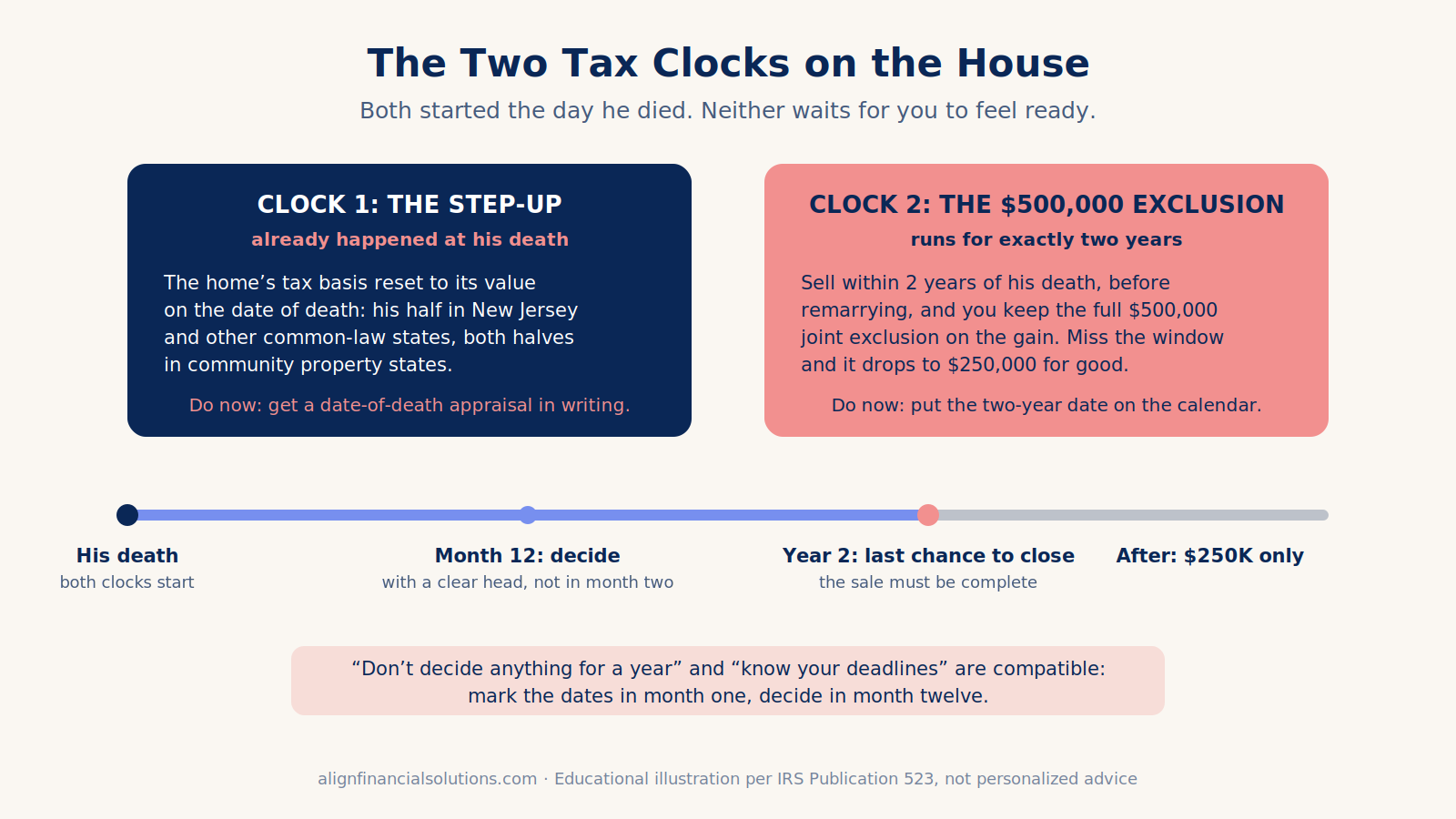
Should a widow sell the house? Every article answers the same way: do not make any big decisions for a year. That advice is half right. Grief is a terrible negotiator, and I have never once told a client to list her home in month three. But the generic version leaves out something the tax code does not pause for anyone. Two clocks started running on the day your husband died. They run whether you decide anything or not.
The first clock is the $500,000 home-sale exclusion, which a surviving spouse keeps for exactly two years. The second is the step-up in basis, which quietly reset part of the tax math on your house the day he died. Neither one forces you to sell. Both change what selling costs, and at a $1.6 million house in a $2 million estate, the difference can run six figures.
So this post holds both truths at once. Do not decide in grief. Do know your deadlines. I will walk through the two-year exclusion and the step-up math with real numbers. I will cover when keeping the house is the right call regardless of taxes. And the middle paths in between. The version of “wait a year” that actually protects you: mark the two-year date on the calendar in month one, decide around month twelve.
How Long Does a Surviving Spouse Keep the $500,000 Capital Gains Exclusion?
Two years from the date of death. A surviving spouse can generally exclude up to $500,000 of gain, the full married amount, under IRS Publication 523. It applies when she sells the primary home within two years of her husband’s death. Miss that window and the capital gains exclusion for a surviving spouse drops to the single filer’s $250,000. Same house, same gain, half the shield.
The conditions come straight from Publication 523. The sale happens within 2 years of your spouse’s death. You have not remarried at the time of the sale. You meet the 2-year ownership and residence tests, and your late husband’s time in the house counts toward both. And neither of you took the exclusion on another home sold in the 2 years before this sale. For a couple who owned and lived in their home for decades, the tests are usually a formality. The deadline is not. The clock runs from the date of death. So a sale that closes at two years and one month gets the $250,000 exclusion, not the $500,000.
| Sale timing (2026 rules) | Exclusion available |
|---|---|
| Within 2 years of the date of death, not remarried, tests met | Up to $500,000 |
| More than 2 years after the date of death | Up to $250,000 |
Note what the calendar does here. Everyone tells a widow not to decide for a year. Fine. A year of waiting still leaves a year of runway inside the window. The advice only fails when nobody tells you the window exists. That is why the two-year date belongs in your first-year financial checklist even if you never use it.
What Is the Step-Up in Basis on the House When a Spouse Dies?
The step-up in basis means part or all of your home’s cost basis reset to its fair market value on the date your husband died. Basis is what the tax code treats as your purchase price; gain is what you sell for above it. Under IRS Publication 551, inherited property generally takes a basis equal to its value at the owner’s death. For a jointly owned home, his half steps up while your half keeps its original basis.
Where you live decides how big the reset is. IRS Publication 555 lists nine community property states: Arizona, California, Idaho, Louisiana, Nevada, New Mexico, Texas, Washington, and Wisconsin. In those states, the entire property generally steps up to date-of-death value, both halves. In a common-law state like New Jersey, only his half steps up. Your half keeps its share of the original purchase price plus improvements. That is why the folder of renovation receipts you have been meaning to organize is now a tax document.
Here is the part that changes the sell-or-keep question. From the day of death forward, every dollar of appreciation is new gain on top of the stepped-up basis. Sell soon after the step-up and there may be very little taxable gain at all. Wait a decade in an appreciating market and you rebuild the gain year by year, and by then you face it with only $250,000 of exclusion. The two clocks compound each other.
The Math on Selling the House After Your Husband Dies
A hypothetical composite, labeled as such. Claire is 61, in New Jersey. She and her husband bought their house in 1998 for $400,000 and it was worth $1.6 million when he died. New Jersey is a common-law state, so his half steps up: his $200,000 of basis becomes $800,000, her half stays at $200,000, and her new basis is $1,000,000.
If she sells within the window. Eighteen months after his death, the house sells for $1.65 million net of selling costs. Gain: $650,000. Subtract the $500,000 exclusion and $150,000 is taxable. Federal long-term capital gains rates run 0, 15, or 20 percent depending on taxable income, per IRS Topic 409. At 15 percent, her federal bill is about $22,500. The 3.8 percent net investment income tax can add more once her MAGI as a single filer passes $200,000. Painful, not catastrophic. Had this same house been in a community property state, her basis would have been the full $1.6 million. The entire $50,000 gain would have disappeared inside the exclusion: zero federal tax.
If she keeps it eight years. The basis stays $1,000,000. If the house grows to $2.2 million, her gain is $1.2 million, and as a single filer past the two-year mark she can exclude only $250,000. That leaves $950,000 taxable. At 15 to 20 percent plus the 3.8 percent surtax, the federal bill lands somewhere between roughly $180,000 and $225,000. That is before New Jersey takes its share. The same house, the same widow, a tax bill roughly ten times larger, purely because of when she sold.
None of this means Claire must sell. It means the sale has a price tag in year one and a very different price tag in year nine, and she deserves to see both numbers before she decides. Seeing them ahead of time is exactly the kind of move I map out in my retirement tax playbook. It lands on top of the bracket squeeze every widow inherits. After the final joint return, you generally file at single rates. I cover that pattern in the widow’s penalty and in your first-year tax return as a widow.
When Keeping the House Is the Right Call Anyway
Sometimes the answer to “should I keep or sell the house” is keep, and the tax math loses. The decision is bigger than taxes. The house holds your footing, your neighbors, and your Tuesday routines. Trading that away during the worst year of your life to avoid a $22,500 tax bill is a bad trade.
The real test is carrying cost. The house now runs on one income and one standard deduction. Add up property taxes (a serious line item in New Jersey), insurance, utilities, and realistic maintenance. Then ask where that money comes from, because a life insurance payout can carry a house for years and still not be the best job for that money. If the answer is your paycheck or portfolio income with room to spare, the house fits. If the answer is pulling extra from retirement accounts every year, the house is quietly competing with your plan. Those withdrawals push your taxable income into higher single-filer brackets.
Keep the house when the carrying cost fits your one-income cash flow. Keep it when the location still matches the life you expect at 70. And keep it when you are not spending down tax-deferred accounts to feed it. Keep it, too, when it is the emotional anchor that lets you function this year. That is a legitimate line in the plan, as long as it is a chosen one. All I ask of clients is that they decide with the two-year date in view, so keeping the house is a decision made and not a deadline discovered later.
The Middle Paths: Rent, Downsize, or Bridge
The choice is not binary. Three middle paths come up constantly with widows I work with.
Rent it out, carefully. Renting keeps the asset and adds income, but it erodes the exclusion. The residence test still applies: generally two of the five years before the sale. So a widow who rents the house out for several years can lose the exclusion entirely. And gain attributable to depreciation claimed while renting is not excludable. A short stretch inside the window can work; renting indefinitely usually converts a tax-free sale into a taxable one.
Downsize inside the window. Selling within two years with the full $500,000 exclusion and buying a smaller place resets everything. You get a fresh basis and lower carrying costs. The freed-up equity goes to work inside your plan instead of sitting in unused square footage.
Bridge with borrowing, briefly. A HELOC or bridge loan can cover cash flow while you decide, or let you buy the next place before selling this one. Used for a season, fine. Used to defer the decision past year two, it adds interest cost on top of the exclusion you gave up.
If you sell, the proceeds become the next planning question. I take that up in retirement planning for women over 50. A widow’s plan is not a couple’s plan with one name removed.
What to Do This Week
- Get a date-of-death appraisal in writing. A retrospective appraisal as of the date of death is the evidence for your step-up in basis. Order it now, while comparable sales from that period are easy to document, even if you will not sell for years.
- Put the two-year date on your calendar. Two years from the date of death is the last day a sale can close with the $500,000 exclusion. Set a reminder at eighteen months so the decision has a runway.
- Pull the purchase records and improvements file. In a common-law state, your half of the basis is original cost plus improvements. Closing statements, renovation invoices, and addition permits all raise your basis and lower a future taxable gain.
- Run the keep-versus-sell carrying-cost math. Property taxes, insurance, utilities, and maintenance against your one-income cash flow. Write the annual number down.
- Talk to a CPA before you list if you are near the deadline. Inside six months of the two-year mark, closing dates, contract timing, and the remarriage rule all matter. A one-hour conversation before listing beats a surprise at filing.
Are you on track?
If you want to see where you actually stand, I built a free 3-minute Retirement Readiness Assessment that gives you a personalized score and a specific dollar gap estimate based on your numbers. Take the assessment here.
Hazel Secco, CFP®, CDFA®, is the founder of Align Financial Solutions, a fee-only fiduciary firm in Hoboken, New Jersey, that helps high-net-worth women bring retirement, equity compensation, tax, and estate planning into one plan. Align is a fee-only financial advisor for women in Hoboken, New Jersey, and its financial planning for women treats retirement timing, taxes, equity compensation, and estate decisions as one plan.
Already past the research phase? Book a free 15-minute Align Call: https://alignfinancialsolutions.com/book-a-call/
🌐 https://alignfinancialsolutions.com
📺 https://www.youtube.com/@AlignYourRetirement
💼 https://linkedin.com/in/hazel-secco
Disclaimer: Advisory services are offered through Align Financial Solutions LLC (“AFS”), an Investment Advisor in the State of New Jersey. This article is for educational purposes only and does not constitute personalized tax, legal, investment, or financial planning advice. Rules and figures are current for 2026 and subject to change. All client scenarios are hypothetical composites for illustration and do not represent any specific client outcome. Consult a qualified professional about your specific situation.
Each decision in this article touches the others, which is why we manage investments, taxes, and retirement income as one coordinated plan through Align360™ Wealth Management. And if your assets have crossed the seven-figure mark, here is how we work with high-net-worth women. If you are local to us, our team meets with widows in person as a fee-only financial advisor in Hoboken, NJ.
Frequently Asked Questions
Does a widow pay capital gains when selling the house?
Often little or none, if she sells within two years of her husband’s death. The step-up in basis raises the home’s cost basis at his death. It applies fully in community property states, and to his half in states like New Jersey. And a sale within two years keeps the full $500,000 exclusion. Gain above basis plus exclusion is taxed at long-term capital gains rates.
How long does a widow have to sell to get the $500,000 exclusion?
Two years from the date of her spouse’s death, per IRS Publication 523. She must not have remarried by the sale date. She must meet the two-year ownership and residence tests, and her late husband’s time counts. And neither spouse can have used the exclusion on another sale in the prior two years. After two years, the limit is $250,000.
What is the step-up in basis on a house when a spouse dies?
The home’s cost basis resets to fair market value as of the date of death. That means the entire property in the nine community property states, and the deceased spouse’s half in common-law states. Take a house bought for $400,000 and worth $1.6 million at death. Its new basis is $1.6 million or $1 million respectively. That shrinks or erases the taxable gain on a sale soon after.
Should I sell my house right after my husband dies?
No, not right after. Selling in the first months of grief is how irreversible mistakes happen, and the two-year window means you do not have to. Spend month one documenting: a date-of-death appraisal, the basis records, the calendar entry. Spend the year stabilizing, then decide around month twelve with a full year of runway left.
Sources
- Publication 523, Selling Your Home, Internal Revenue Service. https://www.irs.gov/publications/p523
- Publication 551, Basis of Assets, Internal Revenue Service. https://www.irs.gov/publications/p551
- Publication 555, Community Property, Internal Revenue Service. https://www.irs.gov/pub/irs-pdf/p555.pdf
- Topic No. 409, Capital Gains and Losses, Internal Revenue Service. https://www.irs.gov/taxtopics/tc409