

Author: Hazel Secco, CFP®, CDFA®
Estimated reading time: 1 minute
🎧 Prefer to watch or listen? I cover this in the Align Your Retirement episode “The Tax Mistake Married Women Make Before They’re Widowed.”
Table of contents
- What is a qualifying surviving spouse?
- A Widow Filing Taxes the First Year Still Files a Final Joint Return
- Who Gets Qualifying Surviving Spouse Status (Fewer Widows Than You Think)
- Widow’s Penalty Taxes: What Changes When You File Single
- The Roth Conversion Schedule: Use the Wide Brackets While They Exist
- Your First Single Year: Withholding, Estimated Taxes, and the MAGI Dial
- What to Do This Week
- Are you on track?
- Listen to This Episode
- Frequently Asked Questions
- Sources
A widow filing taxes the first year after her husband’s death is usually braced for the wrong thing. The first return is the easy one. The IRS still considers you married for that entire year. You file one final joint return at the brackets you have used for decades. The tax hit arrives later, on a schedule. Each year on that schedule has a different filing status, a different set of thresholds, and a different move. Your surviving spouse filing status is the first of those changes, and it is the one most widows have never heard of.
I call the destination the widow’s penalty. It is the same income taxed harder once you file single, often for decades, because women usually outlive their husbands. I break down the full math in why taxes rise after losing a spouse. This post is the map that goes with it. It covers the year of death, the two years after, and the single-filer years that follow. Each window comes with the 2026 numbers and the action that belongs in it. Every move here has a known deadline. The goal is to see each one coming instead of meeting it by accident.
What is a qualifying surviving spouse?
A qualifying surviving spouse is a widow or widower who, for the 2 tax years after the year a spouse died, can still use the married filing jointly brackets and the joint standard deduction ($32,200 in 2026) instead of filing single. The IRS called this status “qualifying widow(er)” through the 2021 tax year. The name changed; the rules did not.
You can file as a qualifying surviving spouse for a tax year only if all 5 of these are true:
- Your spouse died in one of the 2 tax years before this one. For a 2026 return, that means a death in 2024 or 2025.
- You were entitled to file a joint return for the year of death, whether or not you did.
- You have not remarried before the end of the tax year.
- You have a child or stepchild (not a foster child) you can claim as a dependent, or could claim except that the child earned too much or filed a joint return.
- That child lived in your home all year, apart from temporary absences such as school, and you paid more than half the cost of keeping up the home.
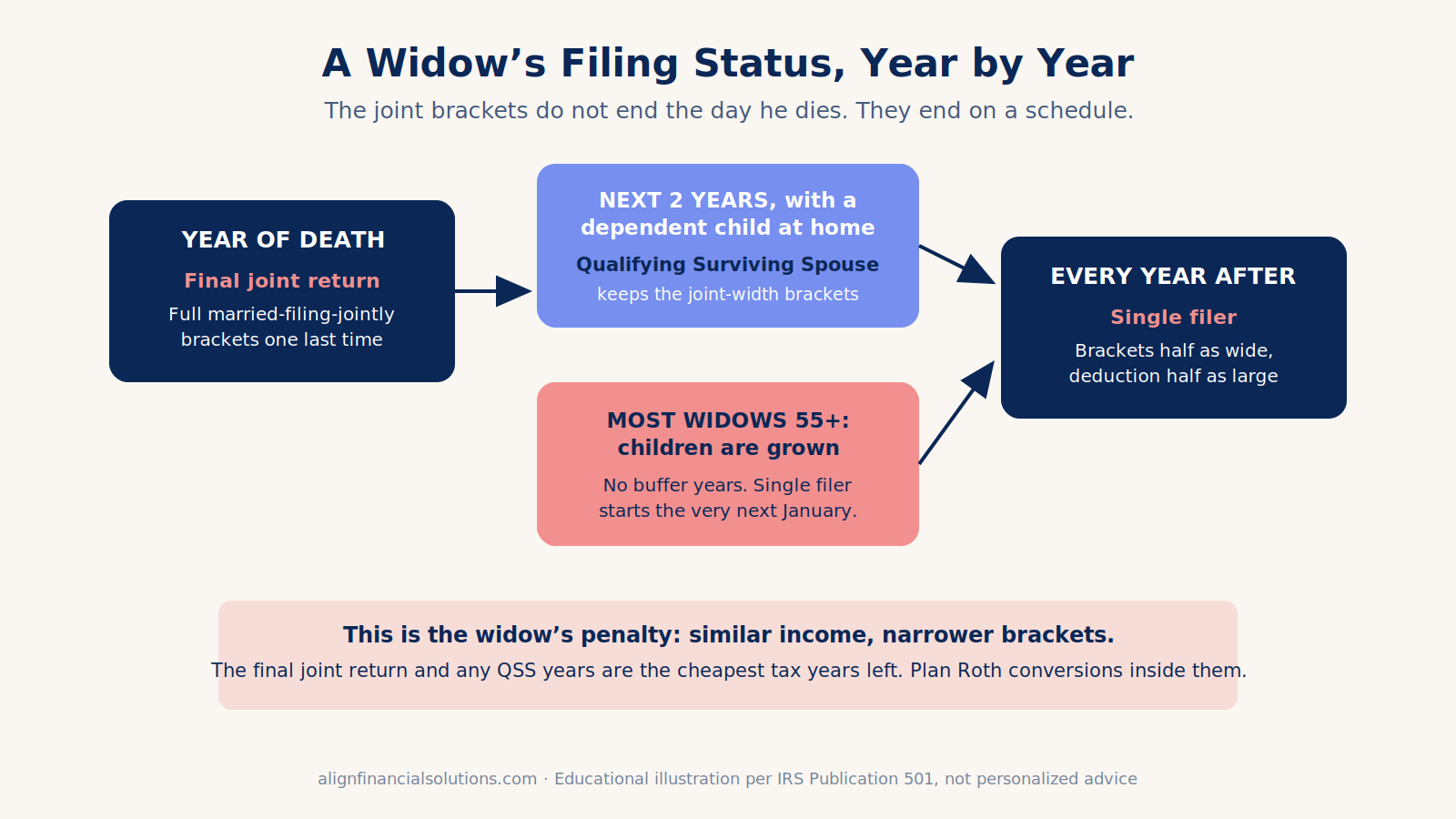
The status is worth the most to a widow with a child still at home, and it does nothing for the widow everyone pictures, in her 60s or 70s with grown children. She goes from the final joint return straight to single. Here is what each year looks like:
| Tax year | Filing status | 2026 standard deduction |
|---|---|---|
| Year of death | Married filing jointly (the final joint return) | $32,200 |
| Years 2 and 3, dependent child at home | Qualifying surviving spouse | $32,200 |
| Years 2 and 3, no dependent child | Single, or head of household if another dependent lives with you | $16,100 single, $24,150 head of household |
| Year 4 and after | Single, or head of household while a dependent qualifies | $16,100 single, $24,150 head of household |
A Widow Filing Taxes the First Year Still Files a Final Joint Return
For the year your husband dies, your widow tax filing status is still married filing jointly. That holds whether he died in January or December. IRS Publication 501 is explicit. The IRS considers you married for the entire year of death, so you can file jointly. The one condition: you do not remarry before December 31. Joint brackets, the full $32,200 joint standard deduction for 2026, one last time.
The mechanics trip people up more than the rule does. If the court has appointed an executor or administrator for his estate, that person signs the return for him. You sign as the surviving spouse. If no one has been appointed, you sign for both of you. Write “Filing as surviving spouse” in his signature area. Mark the return deceased, with his date of death at the top. Your CPA has done this before; your job is to confirm who the executor is before filing season.
While you are talking to the estate attorney, put one more date on the calendar: the portability election. Filing an estate tax return (Form 706) lets his unused estate tax exemption carry over to you. The 2026 exemption at $15 million per person is the relevant number. That election can preserve up to $15 million of shelter for your estate if the law tightens later. Form 706 is due nine months after death, extendable by six months. Rev. Proc. 2022-32 allows a simplified late election up to five years after death. It applies to estates that were not otherwise required to file. This is a flag-for-your-CPA item: raise it once, calendar it, done. The broader estate and cash-flow sequence lives in my first-year financial checklist for widows.
Who Gets Qualifying Surviving Spouse Status (Fewer Widows Than You Think)
Qualifying surviving spouse status lets a widow keep the married-filing-jointly brackets and the $32,200 standard deduction. The status runs for the two tax years after the year of death. It is the buffer everyone assumes exists. For most widows, it does not. The reason is one requirement in the middle of the list.
Per Publication 501, you generally qualify only if all of these hold. First, you were entitled to file jointly for the year he died. Second, you have not remarried. And third, you paid more than half the cost of keeping up your home. And a dependent child or stepchild (not a foster child) lived in that home with you all year. That last test is the gate. A daughter who is 27 and lives in Chicago does not count. A son away at college can, while he is still your dependent, since temporary absences for school are allowed. Adult children with their own households never do.
Run the test against the actual rule, because the two answers produce two different maps. If you qualify, you get two more years of joint-width brackets. Those years have a specific job I will get to below. If you do not qualify, the buffer years simply are not there. Most widows do not qualify, because their children are grown. The year after the final joint return, you file single, and the plan should assume it. For a young widow with children at home, those 2 joint-bracket years are also the cheapest years to realize gains or convert to Roth; widowed before 60 explains why.
Widow’s Penalty Taxes: What Changes When You File Single
Here is why taxes after your husband dies go up. Your income barely drops, and every threshold that governs it roughly halves. The larger Social Security check survives, the pensions and required minimum distributions keep coming, and the portfolio keeps paying dividends. That income now runs through single brackets about half as wide. It runs against a 2026 standard deduction of $16,100 instead of $32,200. Widow’s penalty taxes are not a surcharge on some IRS form. They are ordinary single-filer math applied to a married-sized income.
The 2026 numbers, side by side:
| 2026 threshold | Married filing jointly / QSS | Single |
|---|---|---|
| Standard deduction | $32,200 | $16,100 |
| Top of the 12% bracket (taxable income) | $100,800 | $50,400 |
| Top of the 24% bracket (taxable income) | $403,550 | $201,775 |
| 0% capital gains rate ends (taxable income) | $98,900 | $49,450 |
| IRMAA surcharges begin (MAGI, two-year lookback) | $218,000 | $109,000 |
Read down the single column: it is the same story five times. Bracket lines sit at exactly half the married level through the 32 percent bracket. The 0 percent capital gains window compresses from $98,900 of taxable income to $49,450. And Medicare runs the same squeeze on a two-year delay. A single filer crosses into IRMAA surcharges above $109,000 of MAGI in 2026. That is half the $218,000 married line. I map those tiers in my IRMAA 2026 guide. For a widow with $1.5 million or more in traditional retirement accounts, that matters. IRMAA is often the first penalty that shows up in an actual bill.
The Roth Conversion Schedule: Use the Wide Brackets While They Exist
The response to a penalty that arrives on a schedule is a plan that runs on the same schedule. The final joint year is the single best Roth conversion window many widows will ever have. It offers full married brackets, one last time. And it often runs against income that already dipped when his salary stopped mid-year. A conversion completed by December 31 of the year of death lands on that final joint return. Miss the year-end, and you pay tax on the identical conversion at a single filer’s compressed brackets. This is the logic of the conversion window between retirement and RMDs, with a harder deadline attached.
A hypothetical case study shows the stakes. Claire is 61. Her husband died in March 2026, and the final joint return will show about $180,000 of taxable income. Converting $150,000 of her traditional IRA before December 31 fills the rest of the 22 percent bracket ($31,400). It taxes the remaining $118,600 at 24 percent: roughly $35,400 of federal tax. Now convert the same $150,000 a year later as a single filer on the same $180,000 base. Only $21,775 fits in the 24 percent bracket. The next $54,450 lands at 32 percent and the final $73,775 at 35 percent. The bill: roughly $48,500. Same conversion, about $13,100 more. And consider a widow already on Medicare, or within two years of 65. For her, the lookback would carry a $330,000 MAGI into a high IRMAA tier on top of it. Claire, at 61, at least escapes that piece.
If the dependent-child test gives you qualifying surviving spouse status, those two years are conversion years two and three. They offer joint-width brackets without a year-end-of-death deadline attached. They are the calmest years on this map to move money deliberately. The choice you make with his 401(k) feeds this math too. Rolling it into your own IRA versus keeping it as an inherited account changes what is available to convert. It also changes when withdrawals start counting as income.
Your First Single Year: Withholding, Estimated Taxes, and the MAGI Dial
The first year you file single is the year your entire withholding setup is quietly wrong. Your W-4, the withholding percentage on IRA distributions, the pension survivor election. All of it assumed married rates. Left alone, it produces either an underpayment penalty in April or a large refund. That refund was really an interest-free loan. This is the year that earns a full tax projection. This is the kind of decision we work through in tax planning.
The projection has three dials. Withholding and estimated taxes, so the right amount arrives each quarter. The brackets, so you know how much room remains under $201,775 before the 32 percent rate starts. And the MAGI dial. Every discretionary dollar pulled from a traditional account now moves your capital gains rate. It also moves your IRMAA tier two years out. The starting line just dropped to $109,000. This is the coordinated, multi-year math I walk through in my retirement tax playbook. The first single year is when it stops being optional.
One steadying note to end the map. The widow’s penalty is real, and it is also one of the most solvable problems in retirement planning. Every threshold above is published. You know every deadline in advance. And each move here sits on a calendar you can read today. The work is to reach each one a few months ahead of its deadline.
What to Do This Week
- Confirm who signs the final joint return and how. If an executor is appointed, they sign for him. If not, you sign for both and write “Filing as surviving spouse” in his signature area. Settle this with your CPA before April.
- Run the qualifying surviving spouse test against the actual rule. You need a dependent child or stepchild living in your home essentially all year. Adult children do not count; do not plan around buffer years you will not get.
- Get a Roth conversion projection before the final joint year closes. The married brackets on that last return expire December 31. Model the conversion that fills your target bracket, then execute or decline it on purpose.
- Calendar the portability election with the estate attorney. Form 706 is due nine months after death (six-month extension available); the simplified late election under Rev. Proc. 2022-32 runs five years.
- Run a first-single-year withholding projection. Reset your W-4, IRA withholding, and estimated payments for single rates before that year’s first quarterly deadline. Then check what planned withdrawals do to MAGI.
Are you on track?
If you want to see where you actually stand, I built a free 3-minute Retirement Readiness Assessment that gives you a personalized score and a specific dollar gap estimate based on your numbers. Take the assessment here.
Hazel Secco, CFP®, CDFA®, is the founder of Align Financial Solutions, a fee-only fiduciary firm in Hoboken, New Jersey, that helps high-net-worth women bring retirement, equity compensation, tax, and estate planning into one plan. Align is a fee-only financial advisor for women in Hoboken, New Jersey, and its financial planning for women treats retirement timing, taxes, equity compensation, and estate decisions as one plan.
Already past the research phase? Book a free 15-minute Align Call: https://alignfinancialsolutions.com/book-a-call/
🌐 https://alignfinancialsolutions.com
📺 https://www.youtube.com/@AlignYourRetirement
💼 https://linkedin.com/in/hazel-secco
Listen to This Episode
🎧 Apple Podcasts
🎧 Spotify
📺 YouTube
Disclaimer: Advisory services are offered through Align Financial Solutions LLC (“AFS”), an Investment Advisor in the State of New Jersey. This article is for educational purposes only and does not constitute personalized tax, legal, investment, or financial planning advice. Rules and figures are current for 2026 and subject to change. All client scenarios are hypothetical composites for illustration and do not represent any specific client outcome. Consult a qualified professional about your specific situation.
Each decision in this article touches the others, which is why we manage investments, taxes, and retirement income as one coordinated plan through Align360™ Wealth Management. And if your assets have crossed the seven-figure mark, here is how we work with high-net-worth women.
Frequently Asked Questions
What filing status does a widow use the year her husband dies?
Married filing jointly, for the full year, as long as she does not remarry before December 31. The IRS treats her as married for the entire year of death. So the final return uses joint brackets and the $32,200 joint standard deduction for 2026. If no executor has been appointed, she signs for both spouses. She writes “Filing as surviving spouse” in the signature area.
Who qualifies for qualifying surviving spouse status?
A widow who meets four tests. She was entitled to file jointly in the year of death and has not remarried. She pays more than half the cost of keeping up her home. And she has a dependent child or stepchild living in that home all year. The status preserves joint brackets and the joint standard deduction for the two tax years after the year of death. Widows whose children are grown and living on their own do not qualify and file single instead.
Why do taxes go up after a spouse dies?
Because the survivor’s income barely falls while her thresholds are cut roughly in half. As a single filer in 2026, the standard deduction drops from $32,200 to $16,100. Bracket lines sit at half the married level through the 32 percent bracket. And Medicare IRMAA surcharges start at $109,000 of MAGI instead of $218,000. Planners call this the widow’s penalty.
Can a widow do a Roth conversion in the year of death?
Yes. She converts her own traditional IRA by December 31 of that year. The conversion lands on the final joint return at married brackets. That is often the best conversion window she will ever have. Dollars he left in an IRA generally must first become her own IRA before she can convert them. So the rollover decision and the conversion projection belong in the same conversation, before year-end.
Is qualifying surviving spouse the same as qualifying widow(er)?
Yes. The IRS renamed the filing status starting with 2022 returns. Older articles, tax software menus, and some state forms still say qualifying widow(er). The requirements, the brackets, and the 2-year limit are the same under either name.
How long can a widow file as a qualifying surviving spouse?
For the 2 tax years after the year of death, and only in years when a dependent child or stepchild lives in her home. A husband who died in 2025 leaves a final joint return for 2025 and qualifying surviving spouse status for 2026 and 2027, assuming the child test is met each year. Starting with the 2028 return she files single, or head of household if a dependent still lives with her.
Sources
- Publication 501, Dependents, Standard Deduction, and Filing Information, Internal Revenue Service. https://www.irs.gov/publications/p501
- IRS releases tax inflation adjustments for tax year 2026, including amendments from the One, Big, Beautiful Bill, Internal Revenue Service. https://www.irs.gov/newsroom/irs-releases-tax-inflation-adjustments-for-tax-year-2026-including-amendments-from-the-one-big-beautiful-bill
- Rev. Proc. 2025-32 (2026 inflation adjustments, including capital gains rate thresholds), Internal Revenue Service. https://www.irs.gov/pub/irs-drop/rp-25-32.pdf
- Frequently Asked Questions on Estate Taxes (Form 706 deadline, portability, Rev. Proc. 2022-32), Internal Revenue Service. https://www.irs.gov/businesses/small-businesses-self-employed/frequently-asked-questions-on-estate-taxes