

About this guide. Align Financial Solutions is not affiliated with, endorsed by, or sponsored by The Walt Disney Company. Plan provisions described here are drawn from public filings and Disney’s own published materials where a source exists, and were last reviewed on September 23, 2026. Employers change plan terms, and terms frequently differ by hire date, job level, location, and collective bargaining status, so what applies to you may differ from what is described here. Your own plan documents and your employer’s benefits team are the authority. Nothing here is individualized investment, tax, or legal advice.
Written by Hazel Secco, CFP®, CDFA®
Reviewed September 19, 2026. Educational information; confirm current terms in your own plan documents.
Key Points
- Disney’s benefits go far beyond a paycheck, and can include retirement plans, pensions, equity compensation, health accounts, and severance protections.
- Understanding how your 401(k), deferred compensation, and pension benefits fit together can meaningfully improve flexibility and retirement timing.
- Equity compensation often makes up a large share of total pay for senior leaders and can require proactive planning around vesting, taxes, and diversification.
- HSAs and FSAs can reduce taxes today and, when used strategically, support long-term financial flexibility.
- Severance and insurance benefits can provide critical protection during career transitions and should factor into decisions around role changes and long-term planning.
Table of contents
- Before you choose a retirement date: gather these five answers
- Disney Retirement Benefits Summary
- #1: Disney’s Core Retirement Benefits: 401(k) and Deferred Compensation Plans
- Disney pension and DRSP: know which benefit you have
- #3: Disney Stock Awards
- #4: Health Savings Accounts (HSA) and Flexible Spending Accounts (FSA)
- #5: Severance and Insurance Benefits
- Disney retirement FAQs I hear from Women Leaders
- Turning Your Disney Benefits into Real-Life Flexibility
- Related Posts
As a Disney senior leader or executive, your compensation goes well beyond a regular paycheck. Between equity, retirement plans, and other financial benefits, you have access to tools that can meaningfully support long-term wealth building. The opportunity can be significant, but only if you understand how these pieces fit together and how to use them intentionally. How those pieces fit together is covered in equity compensation planning.
I know how hard it is to find the time or mental energy to dig into the fine print of a benefits package, especially when your days are already full. That’s why I put together a practical guide that helps break down the benefits you’re likely receiving and shows you how they can support the life you’re working toward.
Before you choose a retirement date: gather these five answers
If you are weighing a departure date, bring your benefit statements, equity awards, and investment accounts into the same conversation. These five questions can help you prepare.
- Which benefits are vested? Ask for your vested balance and remaining service requirements in each plan.
- What changes at each possible departure date? Compare pension estimates, contribution timing, and your own equity award documents.
- Which payments are available, and when? Request distribution choices separately for each plan.
- How will you cover the first year? List spending needs, health coverage, cash reserves, and expected payments.
- Who is coordinating the tax picture? Bring benefit estimates into the same discussion as your other investments and household income.
This is part of your retirement runway, the years surrounding your transition out of full-time work. Explore how to calculate your retirement readiness and which accounts to draw from in retirement.
If you would like help coordinating your benefits, investments, and retirement-income decisions, learn about Align’s wealth-management approach or schedule a 15-minute Align Call to discuss whether working together fits your needs. This introductory conversation covers fit and next steps.
Disney Retirement Benefits Summary
Your Disney retirement benefits may include a 401(k), a separate company-funded savings account, and, for eligible participants, a traditional pension. Start by identifying the exact plans listed in your benefits portal. Similar names can hide important differences in how your retirement money works.
The Disney Retirement Savings Plan, or DRSP, is a company-funded defined-contribution plan: Disney contributes to a retirement account for eligible participants. It is separate from the traditional pension. Disney’s 2026 proxy statement and retirement service guide identify that distinction. Your current plan documents determine eligibility, vesting, and distribution options.
#1: Disney’s Core Retirement Benefits: 401(k) and Deferred Compensation Plans
For many senior leaders at Disney, two core retirement benefits form the foundation of your long-term financial plan.
Disney’s Savings and Investment Plan
Disney’s Savings and Investment Plan (Disney SIP) is your main 401(k). It allows you to set aside a percentage of each paycheck on a pre‑tax or Roth basis, and Disney adds a company match based on your eligible compensation. For many salaried Disney cast members, Disney matches up to 2% of your compensation, but the exact formula can vary by role and business unit, so it is important to confirm your match details in your Fidelity 401(k) portal.
Disney’s Voluntary Non-Qualified Deferred Compensation Plan
If you’re an executive or highly compensated employee, you may be eligible to defer a portion of your salary and bonuses on a pre-tax basis. These contributions grow tax-deferred and are taxed when you take distributions later, potentially during lower-income years.
Together, these plans help you save consistently, grow your money over time, and take advantage of potentially meaningful tax benefits.
How to estimate your Disney 401(k) match
- Log in to your Disney 401k on Fidelity NetBenefits and find your “Company Match” percentage.
- Note:
- The maximum percentage of your pay that is eligible for a match (for example, 4 percent).
- The match rate (for example, 50 percent of what you contribute).
- Do this quick calculation:
| Estimating your annual Disney match (example) | Amount |
|---|---|
| Salary | $150,000 |
| You contribute | 4% of pay ($6,000) |
| Disney matches | 50% of what you contribute |
| Annual company match | $3,000 |
Disney’s salaried plan uses a lesser-of match: the company contributes the smaller of 2% of eligible compensation or 50% of what you put in, generally beginning after a year of service. The shape matters more than the number. Because it is a lesser-of formula, the match reaches a ceiling at a fairly low contribution level, and saving above that point grows your own balance but not Disney’s contribution. Company contributions vest immediately, so none of it is forfeitable if you leave. Three things vary and your own documents settle all of them. Disney runs separate plans for salaried and hourly populations with different match terms, and collective bargaining coverage affects which applies, so confirm which plan you are in before you use any figure. The two halves of the formula are measured against different compensation definitions, so your exact crossover point is a plan question rather than a clean percentage. And the plan can change or stop the match. Your Summary Plan Description has your formula and your definitions. One last thing worth knowing: the plan auto-enrolls and escalates your contribution automatically, so the match ceiling is not a reason to cap your own saving.
If you are contributing above the point where the match stops growing, the question is where those extra dollars belong, not whether to stop saving them. For most people within ten years of a retirement date, that question sits alongside the Retirement Savings Plan, deferred compensation elections, and stock awards, and the order you take them in matters. If you would rather not work that sequence out alone, a 15-minute Align Call is a good place to start.
Before enrolling in deferred compensation, review the election deadlines, distribution rules, and how the payments fit your retirement timeline.
Disney pension and DRSP: know which benefit you have
And here’s how to get more out of them:
- Contribute at least enough to your Disney 401(k) to receive the full company match every year. That match is one of the most reliable returns available to you.
- For 2026, the standard employee 401(k) contribution limit is $24,500. If your plan permits catch-up contributions, the usual age-50-and-over catch-up is $8,000; a higher $11,250 catch-up applies instead for participants who turn 60, 61, 62, or 63 during the year. Confirm your plan’s provisions and applicable Roth catch-up requirements before setting payroll elections. If your prior-year wages from Disney topped $150,000, the catch-up portion must go in as Roth under a rule that took effect in 2026; the mandatory Roth catch-up rule explains what that costs and when it helps.
- Keep your investment choices simple and diversified. Low-cost index funds or an age-appropriate target-date fund can work well, especially if a meaningful portion of your compensation is already tied to Disney stock.
Once you’ve maxed out your Disney 401(k), the Deferred Compensation Plan can help you build additional tax-deferred savings. However, make sure you can comfortably cover living expenses and stay on track with emergency savings and other near-term goals before deferring income.
Review your personal benefit documents before making an election. Employment history and plan coverage can change which rules apply to you.
If you have several Disney retirement accounts, establish what each one contributes to your future income. SIP is your 401(k); DRSP is a separate company-funded defined-contribution account. A traditional pension, if you are eligible, is another distinct benefit. Review the exact plan names on your statements before comparing retirement dates.
An account balance and a pension estimate belong in the same retirement plan, but they need different assumptions. Before choosing a departure date, request the documents for each benefit you actually hold.
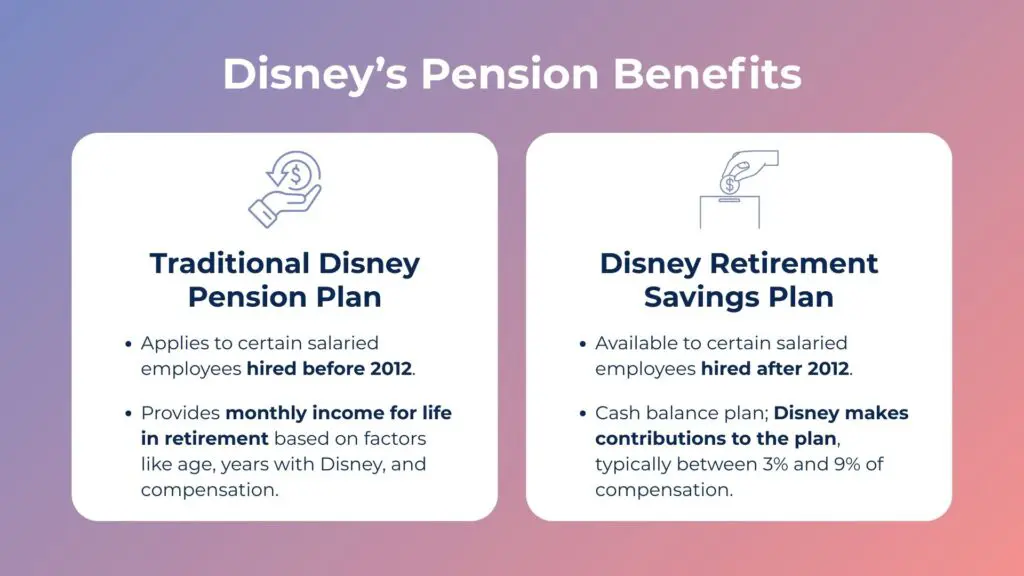
Traditional Disney Pension Plan Vs. Disney Retirement Savings Plan (DRSP)
Disney offers different retirement benefits depending on your plan coverage and employment history. Confirm the plans you hold before comparing their provisions.
Traditional Disney Pension Plan. This plan applies to certain salaried employees hired before 2012 and provides a monthly income for life in retirement. The benefit is based on factors like age, years with Disney, and compensation.
Disney Retirement Savings Plan (DRSP). This is a company-funded defined-contribution plan for eligible participants. Your account balance, vested amount, investments, and permitted distributions are the relevant starting points. Hiring history, transfers, and rehires can affect coverage, so confirm your own plan provisions.
Key Points About Traditional Pension Plan
If you’re covered by the Traditional Pension Plan, here are a few key points to keep in mind:
Pension plans typically define a normal retirement age, with earlier claiming available at a reduced benefit and, in some plans, continued accrual if you work past it. Disney does not publish its formula or its normal retirement age publicly, so request a personalized benefit estimate rather than working from a general rule.
You have multiple payout options, including choices that provide income for a spouse or other beneficiaries. These decisions can affect both lifetime income and taxes, so it’s worth reviewing them carefully with a financial planner.
Key Points About Disney Retirement Savings Plan (DRSP)
If you’re enrolled in the DRSP, the planning considerations are slightly different:
- Request the distribution choices permitted under your specific DRSP account. Do not assume that a traditional pension election applies to this savings plan.
- You may also have the option to roll the balance into an IRA or a new employer’s 401(k). This usually allows you to continue deferring taxes.
Review your DRSP account, SIP account, and any pension estimate together. Compare their timing, tax treatment, and available choices before submitting distribution instructions. Your retirement withdrawal strategy should reflect each benefit and your other investments.
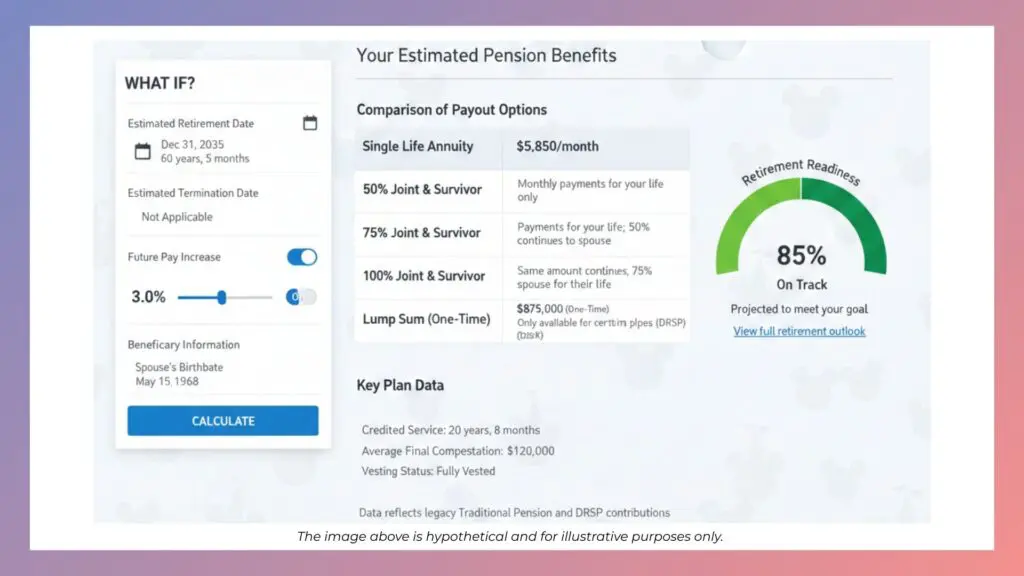
If you have a traditional pension, request a personalized estimate for the dates you are considering. For SIP and DRSP, review account balances, vesting, and permitted distributions. Use the tools and documents specific to each plan.
#3: Disney Stock Awards
As you climb the Disney ladder, equity awards are often a substantial part of your compensation. If you ignore this benefit or let it run on autopilot, you might be leaving money on the table.
Disney tends to award equity in the form of restricted stock units (RSUs) and performance-based awards. If you’re managing either (or both), here are a few tips.
Tips for Your Disney RSUs
Know your vesting calendar.
- When you receive your Disney shares affects both cash flow and taxes. RSUs commonly vest over three years in equal annual tranches, though performance-based awards cliff-vest at three years and can pay anywhere from nothing to 200% of target. Disney’s filed award terms say partial service within a vesting year earns no pro-rated portion of that tranche, but that rule is expressly subject to exceptions: awards can keep vesting after a qualifying retirement at age 60 with 10 or more service years, for three months following a qualifying layoff, and on death or disability. Read your own grant documents before assuming a departure date forfeits anything.
- Performance-based awards, which are common at more senior levels, typically vest after a three-year performance period and depend on company results.
Treat each vest like a cash bonus that happens to show up in stock. Decide ahead of time how much you’ll sell at vest, so your portfolio doesn’t become too concentrated in Disney stock.
Think about taxes. Withholding on equity income is often lower than your actual tax rate, which can create an unpleasant surprise later. You may need to adjust withholding, make estimated payments, or set cash aside from each vest to stay ahead of the tax bill.
Be intentional with what you do after you sell. Consider reinvesting the proceeds into a diversified portfolio or using them to fund other financial priorities.
Stock options generally provide a right to buy shares at an exercise price. Any stock-purchase discount depends on the specific program terms. Confirm your award or purchase-plan documents, and assess employer stock alongside your other investments before deciding how much to hold.
#4: Health Savings Accounts (HSA) and Flexible Spending Accounts (FSA)
Disney offers tax-advantaged health accounts that can help cover everyday medical expenses. It can also support your long-term financial plan, when used thoughtfully.
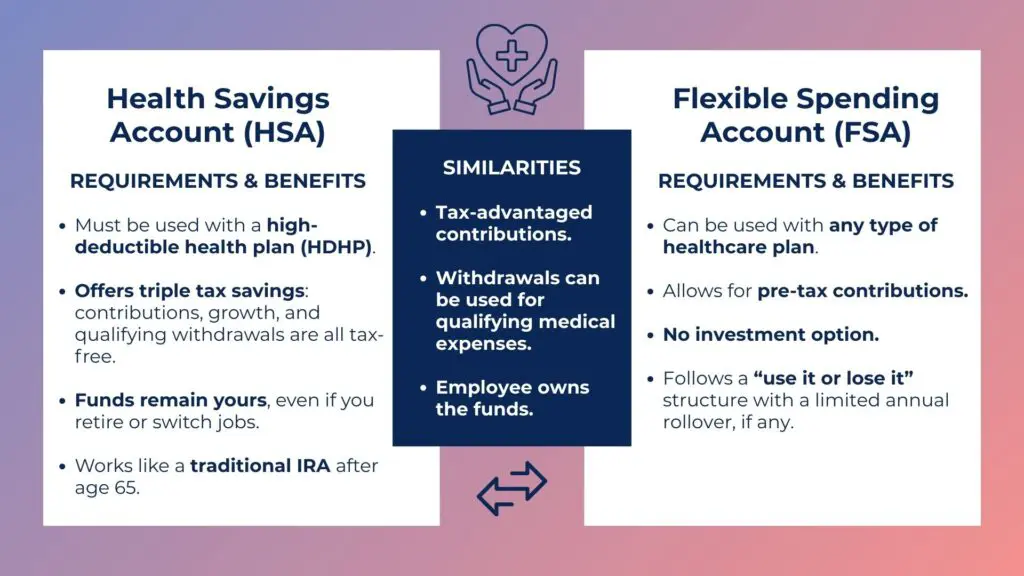
An HSA-qualified high-deductible health plan is one requirement for contributing to a Health Savings Account (HSA). Your other coverage and Medicare enrollment can also affect eligibility.
Values of Health Savings Accounts
They offer triple tax savings.
- You contribute pre-tax dollars.
- You can invest the balance once it reaches the required threshold.
- You can use the money tax-free for qualified medical expenses.
The funds are portable.
- The money is yours, even if you leave Disney.
After age 65, an HSA works much like a traditional IRA.
- Non-medical withdrawals are taxed as ordinary income, while qualified medical expenses remain tax-free.
Disney also offers a Flexible Spending Account (FSA), which allows you to pay for healthcare expenses with pre-tax dollars. But unlike an HSA, an FSA is designed for short-term use.
Most FSAs follow a use-it-or-lose-it structure. Before combining an FSA with HSA contributions, check that the FSA is an HSA-compatible arrangement.
How to Maximize Your HSA Benefits
- If you’re eligible for an HSA, work toward the annual IRS contribution limits: $4,400 for self-only coverage and $8,750 for family coverage in 2026.
- A general-purpose health FSA generally prevents HSA contributions; qualifying limited-purpose or post-deductible arrangements may be compatible. Review your other coverage and enrollment status as well.
- Pro tips: Keep receipts so you have the option to reimburse yourself later if necessary.
#5: Severance and Insurance Benefits
Many Disney benefits focus on building wealth, often in tax-advantaged ways. Others play a quieter but equally important role by protecting what you’ve already built. These benefits don’t always get much attention, but they can matter when circumstances change unexpectedly.
Two parts of your benefits package are especially important to understand:
Executive Severance Pay Plan.
- Effective February 2, 2026, Disney adopted an Executive Severance Pay Plan for eligible executives at the E6 or E7 level. This plan provides severance pay and continued benefits if you’re involuntarily terminated without cause or resign for certain defined reasons and aren’t covered by an individual severance agreement.
Insurance benefits.
- Disney provides employer-paid basic life insurance and accidental death and dismemberment coverage. Additionally, employees can purchase optional long-term disability insurance. Coverage is typically based on a multiple of your base salary, with the option to purchase additional coverage up to plan limits.
Here’s how to think about these benefits in the context of your broader plan:
Know your severance terms.
- Understand your eligibility under the Executive Severance Pay Plan and how many months of income and benefits it could provide if your role ends unexpectedly.
Review your insurance coverage.
- Confirm how many times your salary is covered by life and disability insurance, and increase coverage if needed. The goal is to protect your family and cash flow without forcing you to sell equity or tap deferred compensation at the wrong time.
Look beyond base pay when making career moves.
- When evaluating a new role or internal transition, weigh changes to severance protection, long-term incentive targets, and deferred compensation eligibility alongside any salary adjustment.
When you account for these protections upfront, you can create more resilience in your financial plan and reduce some of the pressure that often comes with career transitions.
Disney retirement FAQs I hear from Women Leaders
- “Is Disney’s 401(k) match good?”
For many cast members, Disney’s match is competitive and can add a significant portion to your retirement savings, especially if you contribute at least enough to receive the full match. The key is to avoid under‑contributing in years when cash flow feels tight. Not every plan lets you make up a missed match later, so find out whether yours has a true-up provision.
- “What is the difference between the SIP and the Disney Retirement Savings Plan?”
SIP is the Savings and Investment Plan, the Disney 401(k). DRSP is a separate company-funded defined-contribution plan for eligible participants. Review the exact plan names on your personal statements and confirm current provisions with the administrator before choosing a distribution.
- “Where do I see all of this?”
You will typically log in to your Disney retirement benefits through Fidelity NetBenefits to see your Disney SIP (401(k)), your Disney Retirement Savings Plan, and, if applicable, your traditional pension. Because the portal shows each plan separately, it is easy to underestimate how strong your overall retirement position is until you look at them together in one plan.
“What is Disney’s 401(k) match in 2026?”
It varies by role and business unit, which is why the only reliable answer is your own Fidelity NetBenefits portal. The salaried plan uses a lesser-of formula, capping the company contribution both as a share of your pay and as a share of what you contribute, generally beginning after a year of service. Because of that structure the match reaches a ceiling at a modest contribution level, and your portal will show where yours sits. Contribute at least enough to reach it every year. If you fall short in a given year, some plans make it up at year end with a true-up contribution and some do not, so check your plan documents.
“Does Disney have a pension plan?”
A traditional pension remains relevant for eligible participants, but coverage depends on the applicable plan and employment history. DRSP is a separate company-funded defined-contribution savings plan. If you have a pension benefit, request a personalized estimate and the payment choices under that specific plan before comparing retirement dates.
“What is the Disney SIP?”
SIP stands for the Savings and Investment Plan, Disney’s 401(k). It is separate from DRSP, the company-funded defined-contribution savings plan. Your benefits portal lists the plans you hold and their applicable terms.
Where do I see my Disney retirement accounts? (Disney Net Benefits)
Disney’s 401(k), the Savings and Investment Plan, is administered through Fidelity’s Net Benefits portal (netbenefits.com). That’s where you can check your balance, confirm your contribution rate and 401(k) match, review your investment elections, and find your pension or DRSP details. I recommend logging into Disney Net Benefits at least once a year, and always before open enrollment, to make sure each benefit is still pulling its weight in your bigger plan.
Turning Your Disney Benefits into Real-Life Flexibility
Two decisions sit outside the benefits package and change what the package is worth: when to claim Social Security, and what a large pre-tax 401(k) balance costs once required withdrawals begin. Both are worth settling before the retirement date is.
Your Disney benefits become more useful when you can see how they fit your retirement timeline. Consider your savings accounts, any pension, equity awards, and health coverage together as you evaluate the next stage of your life.
At Align Financial Solutions, we help women leaders make sense of complex compensation and benefits, including Disney’s SIP 401(k), Retirement Savings Plan, pension options, equity awards, and severance protections. We help walk you through your options, talk through the tradeoffs, and build a strategy that better supports the life you want now and in the years ahead.
Are you on track?
If you want to see where you actually stand, I built a free 3-minute Retirement Readiness Assessment that gives you a personalized score and a specific dollar gap estimate based on your numbers. Take the assessment here.
Hazel Secco, CFP®, CDFA®, is the founder of Align Financial Solutions, a fee-only fiduciary firm in Hoboken, New Jersey, that helps high-net-worth women bring retirement, equity compensation, tax, and estate planning into one plan. If your Disney retirement date is inside the next ten years, see how Align works with Disney employees and Cast Members and what retirement planning for women covers, from pension timing to the tax on the years in between.
Book a free 15-minute Align Call: https://alignfinancialsolutions.com/book-a-call/. Whether we work together or not, you’ll walk away with clarity on your best next step.
🌐 https://alignfinancialsolutions.com
📺 https://www.youtube.com/@AlignYourRetirement
💼 https://linkedin.com/in/hazel-secco
Related Posts
Disclosures:
Align Financial Solutions (“AFS”) is a registered investment advisor offering advisory services in the State of NJ and in other jurisdictions where exempted. Registration does not imply a certain level of skill or training.
All written content on this site is for information purposes only and is not intended to provide specific advice or recommendations for any individual. Opinions expressed herein are solely those of AFS, unless otherwise specifically cited. Hazel Secco and AFS are neither an attorney nor an accountant, and no portion of this website content should be interpreted as legal, accounting, or tax advice. Material presented is believed to be from reliable sources and no representations are made by our firm as to other parties’ informational accuracy or completeness. There is no assurance that the views or strategies discussed are suitable for all investors or will yield positive outcomes. Investment involves risks, including possible loss of principal, and unless otherwise stated, are not guaranteed. Any economic forecasts set forth may not develop as predicted and are subject to change. All information or ideas provided should be discussed in detail with an advisor, accountant, or legal counsel prior to implementation.
Align Financial Solutions, LLC and its employees are not affiliated with or endorsed by The Walt Disney Company or its affiliates.
Additional references: IRS retirement-plan contribution limits; IRS Publication 969: HSA and FSA eligibility; understanding RSU withholding.
This content is for educational purposes and is not personalized investment, tax, or legal advice. Align Financial Solutions is a registered investment adviser. Examples are hypothetical and provided for illustration only. Past performance is not indicative of future results. Please consult a qualified professional regarding your specific situation.