
Author: Hazel Secco, CFP®, CDFA®
Estimated reading time: 12 minutes
Table of contents
- What is a backdoor Roth IRA?
- Who should consider a backdoor Roth?
- How to do a backdoor Roth, step by step
- What is the pro-rata rule?
- A hypothetical example
- Is the backdoor Roth legal?
- Backdoor Roth vs. mega backdoor Roth
- What to do this week
- Frequently Asked Questions
- Get the bigger tax picture
- Disclosures
- Sources
Your income passed the Roth IRA limit a few raises ago, and now the bank or your tax software won’t let you add to a Roth. You’ve heard of a backdoor Roth IRA, a two-step move that lets high earners get money into a Roth anyway. It’s legal, it’s widely used, and the steps themselves don’t take long.
The steps are simple. The trap is the pro-rata rule. If you have money sitting in a traditional, rollover, SEP, or SIMPLE IRA, most of your backdoor Roth can end up taxed, and it often shows up only when the tax return is prepared. This guide covers who the backdoor Roth is for, how to do it in 2026, and how to check for that trap before you start.
What is a backdoor Roth IRA?
A backdoor Roth IRA is a way to fund a Roth IRA when your income is too high to contribute directly. You put after-tax money into a traditional IRA, which has no income limit, and then convert it to a Roth IRA, which also has no income limit. The money ends up in the Roth, where it can grow tax-free.
There’s no special account called a backdoor Roth. It’s a regular Roth IRA, funded through a conversion instead of a direct contribution. Once the money is there, it follows the usual Roth rules, including tax-free withdrawals in retirement once you meet the age and five-year requirements, and no required minimum distributions during your lifetime.
Who should consider a backdoor Roth?
A backdoor Roth is for people whose income is above the Roth IRA limit. For 2026, you can’t contribute directly to a Roth IRA if your modified adjusted gross income (MAGI) is $168,000 or more as a single filer, or $252,000 or more if you’re married filing jointly. Below those numbers there’s a phase-out range where you can make a partial contribution.
| 2026 filing status | Partial Roth contribution | No direct Roth contribution |
|---|---|---|
| Single or head of household | MAGI $153,000 to $168,000 | MAGI $168,000 or more |
| Married filing jointly | MAGI $242,000 to $252,000 | MAGI $252,000 or more |
| Married filing separately | MAGI $0 to $10,000 | MAGI $10,000 or more |
The 2026 IRA contribution limit is $7,500, or $8,600 if you’re 50 or older. That’s the most you can move through the backdoor each year, per person. A married couple can each do one, so a couple over 50 can move $17,200 a year into Roth accounts this way.
It’s worth doing if you expect to keep the money invested for years and you like the idea of a pool of savings you can take out tax-free. It’s less useful if you’ll need the money in the next few years, or if you have a large pre-tax IRA balance you can’t move, which I cover below.
How to do a backdoor Roth, step by step
A backdoor Roth takes two transactions and one tax form. You contribute to a traditional IRA without taking a deduction, convert that money to a Roth IRA, and report both on Form 8606 with your tax return. Most large custodians let you do both steps online.
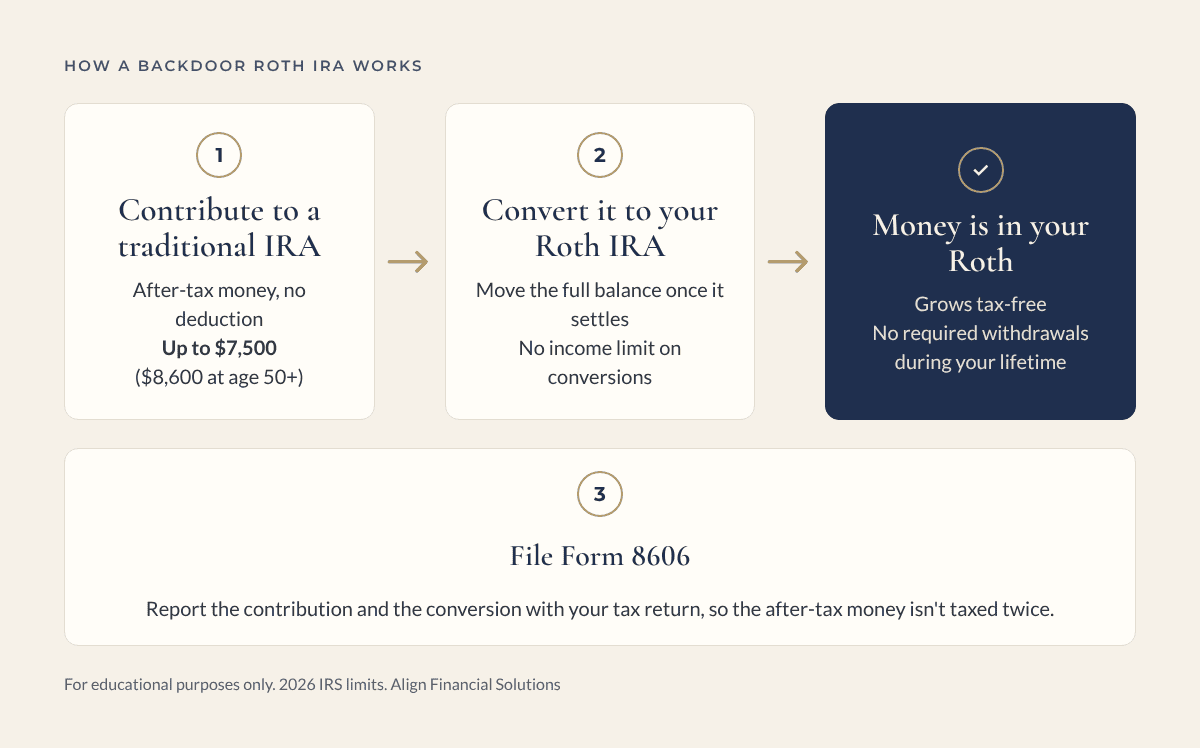
- Check your other IRAs first. Add up everything in traditional, rollover, SEP, and SIMPLE IRAs. If the total is zero, or you can move it out by December 31, you’re clear to go. If not, read the next section before you do anything.
- Contribute to a traditional IRA. Put in up to $7,500, or $8,600 if you’re 50 or older. Most high earners with a workplace retirement plan can’t deduct this contribution, which is what makes the conversion tax-free later. You can make a 2026 contribution until the April 15, 2027 tax deadline.
- Leave it in cash until it settles. If you invest it first and it grows, the growth is taxable when you convert. Holding cash for the few days it takes to clear keeps that amount small.
- Convert it to your Roth IRA. Move the full balance from the traditional IRA into your Roth IRA. A small amount of interest may come along, and that interest is taxable. You can’t undo a conversion, so double-check the accounts before you submit.
- File Form 8606. Part I reports the nondeductible contribution, and Part II reports the conversion. Your custodian will send a Form 1099-R for the conversion. Give your CPA both, and tell them it was a backdoor Roth, so they don’t tax the conversion twice.
When it shows up on your tax return
The conversion counts in the tax year you do it. The contribution can count for the prior year if you make it before the April deadline. That mismatch is normal, but it means one backdoor Roth can show up on two different tax returns, which is another reason to keep your CPA in the loop.
What is the pro-rata rule?
The pro-rata rule says the IRS treats all your traditional, rollover, SEP, and SIMPLE IRAs as one account when you convert. You can’t choose to convert only the after-tax dollars. The IRS taxes each conversion in proportion to how much of your total IRA money is pre-tax, based on your balances on December 31 of the year you convert.
This catches people in a few predictable ways. One person rolled an old 401(k) into an IRA years ago and forgot it counts. A self-employed person has a SEP IRA. Another does a clean backdoor Roth in February and then rolls an old 401(k) into an IRA in November. Because the IRS looks at the December 31 balance, that late rollover pulls the earlier conversion into the pro-rata math.
What’s counted and what isn’t
Counted are traditional IRAs, rollover IRAs, SEP IRAs, and SIMPLE IRAs in your name. Not counted are 401(k), 403(b), and 457(b) plans, Roth IRAs, inherited IRAs, and your spouse’s IRAs. Each spouse runs the pro-rata rule separately, so one spouse may have a clean backdoor Roth while the other doesn’t.
How to clear the way
The usual fix is to move your pre-tax IRA money into your current employer’s 401(k) before December 31, if the plan accepts incoming rollovers. Once it’s in the 401(k), it no longer counts. Ask your plan administrator whether they accept roll-ins from IRAs and what paperwork they need, and give it a few weeks.
Another option is to convert the whole pre-tax IRA to Roth and pay the tax. That can make sense in a lower-income year, and I explain how to think about that timing in my post on the Roth conversion window. For a large balance in a high-income year, though, the tax bill can outweigh the benefit, so it’s worth running the numbers first.
A hypothetical example
Here’s a hypothetical example to show the difference. Maya is 52, single, and earns $240,000 as a director at a large company. That’s well above the Roth limit. She also has $92,500 in a rollover IRA from a job she left 10 years ago.
In 2026 she contributes $8,600 to a traditional IRA without a deduction and converts it to her Roth a week later. Because her rollover IRA is still there on December 31, the IRS treats only about 8.5% of the conversion as her after-tax money. That leaves about $7,868 of the $8,600 conversion taxable. At her 32% federal bracket, that’s roughly $2,518 of federal income tax she didn’t expect.
Now say Maya rolls the $92,500 into her current 401(k) in October, before she converts. On December 31 her traditional IRA balance is zero, so the whole $8,600 conversion is tax-free, apart from any small interest it earned while it sat in the account. Same contribution, same Roth, about $2,500 less in tax.
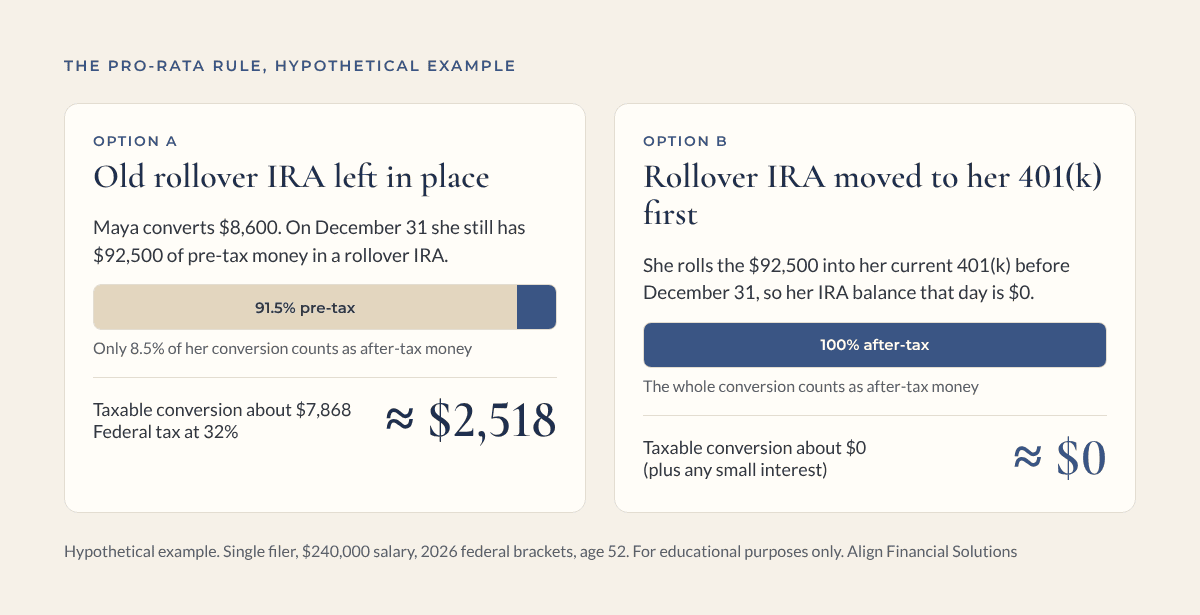
In the first version she doesn’t lose that after-tax money for good. The roughly $7,868 of after-tax money that wasn’t used stays on record as basis in her IRA, and Form 8606 tracks it for future years. It’s still a cash cost now, and it makes her records harder to keep straight for years.
Is the backdoor Roth legal?
Yes. Congress acknowledged it directly when it passed the Tax Cuts and Jobs Act in 2017. The conference report said that an individual who isn’t allowed to contribute directly to a Roth IRA can contribute to a traditional IRA and then convert it to a Roth IRA. The IRS processes these conversions every year through Form 8606.
Proposals to end the backdoor Roth have come up before. A 2021 House version of the Build Back Better Act would have blocked conversions of after-tax IRA money, but that provision didn’t become law. It’s still allowed in 2026.
People used to wait weeks or months between the contribution and the conversion, worried the IRS would treat the two steps as one direct Roth contribution. Since the 2017 conference report, many tax professionals are comfortable converting once the money settles. Your CPA may have a preference, so ask.
Backdoor Roth vs. mega backdoor Roth
A backdoor Roth runs through an IRA and is limited to $7,500, or $8,600 at 50 or older, in 2026. A mega backdoor Roth runs through your 401(k), using after-tax contributions above the regular 401(k) limit, and can move far more each year. The mega version only works if your employer’s plan allows after-tax contributions and in-plan conversions or in-service withdrawals.
They aren’t either-or. Many high earners can do both in the same year. The IRA pro-rata rule described above applies only to the IRA version. If your plan offers it, my mega backdoor Roth guide walks through how it works and what to ask HR.
What to do this week
Add up your pre-tax IRAs. Pull your latest statements for every traditional, rollover, SEP, and SIMPLE IRA in your name, and your spouse’s if you’re married. That total decides whether the backdoor Roth is clean for you.
Call your 401(k) plan. If you have a pre-tax IRA balance, ask whether your current plan accepts rollovers from IRAs, and how long it takes. Get it done before December 31 of the year you convert.
Check your income against the 2026 limits. Use your expected 2026 MAGI. If you’re in or near the phase-out range, a bonus or RSU vest late in the year can push you over, so plan for the backdoor route instead of contributing directly and fixing it later.
Open the accounts. You’ll need a traditional IRA and a Roth IRA at the same custodian to make the conversion simple. Opening them now means you can contribute and convert in January without waiting.
Tell your CPA. Let them know you’re doing a backdoor Roth so they file Form 8606 and don’t treat the conversion as fully taxable. If you’ve done backdoor Roths before without filing Form 8606, ask about fixing the missing forms.
Frequently Asked Questions
What is the deadline for a 2026 backdoor Roth?
You can make a 2026 traditional IRA contribution until the April 15, 2027 tax deadline. The conversion counts in the year you actually do it, so a contribution made in March 2027 for 2026 and converted that month shows up as a 2027 conversion. Your CPA reports the contribution on your 2026 return and the conversion on your 2027 return.
Does my 401(k) count for the pro-rata rule?
No. The pro-rata rule only counts traditional, rollover, SEP, and SIMPLE IRAs in your own name. Money in a 401(k), 403(b), or 457(b) doesn’t count, and neither do Roth IRAs or inherited IRAs. That’s why rolling a pre-tax IRA into your workplace plan before December 31 is the most common way to make a backdoor Roth tax-free.
Can I do a backdoor Roth if I’m married and my spouse doesn’t work?
Usually yes. A spouse without earned income can contribute to an IRA based on the working spouse’s income if you file jointly, as long as your combined earned income covers both contributions. Each spouse then converts their own traditional IRA. Each spouse figures the pro-rata rule separately, based on the IRAs in their own name.
Do I pay tax on a backdoor Roth?
If you have no other pre-tax IRA money on December 31, you generally pay tax only on any small earnings between the contribution and the conversion. If you do have pre-tax IRA money, part of the conversion is taxable under the pro-rata rule. Either way, you report it on Form 8606 so the after-tax part isn’t taxed again.
Should I do a backdoor Roth every year?
Many high earners do, because each year’s limit is gone once the tax deadline passes. It’s most useful when you can keep the money invested for a long time and have no pre-tax IRA balance getting in the way. It’s less useful if you’ll need the money soon, or if a large IRA balance would make most of the conversion taxable.
Get the bigger tax picture
A backdoor Roth is one piece of a retirement tax plan. My free Retirement Tax Playbook shows how Roth money, pre-tax accounts, and lower-income years fit together so you’re not paying more tax than you need to over your lifetime.
Hazel Secco is a CFP® and fiduciary financial advisor. If you’d like to check whether a backdoor Roth fits your accounts, book a free 15-minute Align Call. Whether we work together or not, you’ll walk away with clarity on your best next step. Align is based in Hoboken, NJ, but we work with clients across the country virtually.
Disclosures
Advisory services are offered through Align Financial Solutions LLC (“AFS”), an Investment Advisor in the State of New Jersey.
This article is for educational purposes only and should not be considered legal, tax, or financial advice. AFS does not provide tax or legal advice. Maya is a hypothetical example, and her figures are simplified and based on 2026 federal tax brackets and IRA limits. Tax rules change and individual situations vary. Always consult a qualified tax professional and your financial advisor regarding your specific situation before acting on any strategy described here.
Sources
- IRS, 401(k) limit increases to $24,500 for 2026, IRA limit increases to $7,500. https://www.irs.gov/newsroom/401k-limit-increases-to-24500-for-2026-ira-limit-increases-to-7500
- IRS, Instructions for Form 8606, Nondeductible IRAs. https://www.irs.gov/instructions/i8606
- IRS, Publication 590-A, Contributions to Individual Retirement Arrangements. https://www.irs.gov/publications/p590a
- IRS, Publication 590-B, Distributions from Individual Retirement Arrangements. https://www.irs.gov/publications/p590b
- 26 U.S.C. § 408(d)(2), aggregation of IRAs. https://www.law.cornell.edu/uscode/text/26/408
- 26 U.S.C. § 408A, Roth IRAs. https://www.law.cornell.edu/uscode/text/26/408A
- H. Rept. 115-466, Conference Report to accompany H.R. 1, Tax Cuts and Jobs Act (2017). https://www.congress.gov/congressional-report/115th-congress/house-report/466/1
- Congressional Research Service, Retirement Provisions in H.R. 5376 (IF11963). https://www.congress.gov/crs_external_products/IF/PDF/IF11963/IF11963.2.pdf
- IRS, Revenue Procedure 2025-32 (2026 tax brackets and standard deduction). https://www.irs.gov/pub/irs-drop/rp-25-32.pdf
Hazel Secco, CFP®, CDFA®, is a fiduciary financial advisor and founder of Align Financial Solutions in Hoboken, New Jersey. She helps individuals and couples make informed decisions about retirement, investments, and taxes so their money supports the life they want.